Part of the series: Women Founders in Indonesia
- Women Founders in Indonesia: Nurhayati Subakat, Who Rebuilt After the Fire
- Women Founders in Indonesia: Formalising a Small Business in Indonesia
- Women Founders in Indonesia: Building a Foreign-Owned Business
- Women Founders in Indonesia: Own It in Your Own Name
- Women Founders in Indonesia: Structuring for Impact
- Women Founders in Indonesia: Making a Woman-Led Business Bankable
- Women Founders in Indonesia: The Merits of Bootstrapping a Business
- Women Founders in Indonesia: The Art of Reinvention
- Women Founders in Indonesia: When a Business Has to Close
Current as at 3 August 2026.
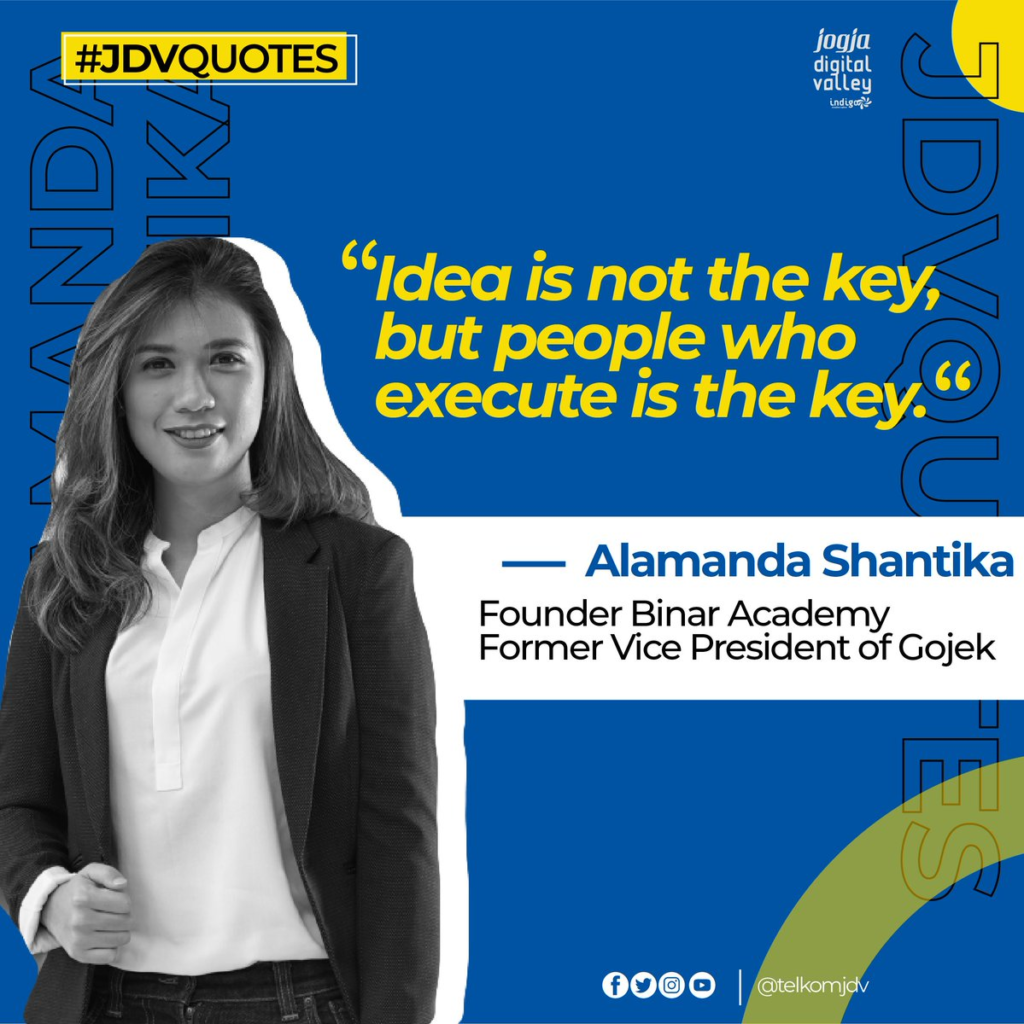
In 2016 Alamanda Shantika left Gojek. She had led the product team that built the app millions of Indonesians now open without thinking, and she resigned as its vice-president of product to start again from nothing.
“It was as if my baby was already born and had started to learn to walk,” she said at the time. “Now it is time for me to raise new babies.”
In 2017 she founded the Binar Academy, a school that teaches Indonesians to build technology, and set out to raise the next generation of the people who make the things she once made herself.
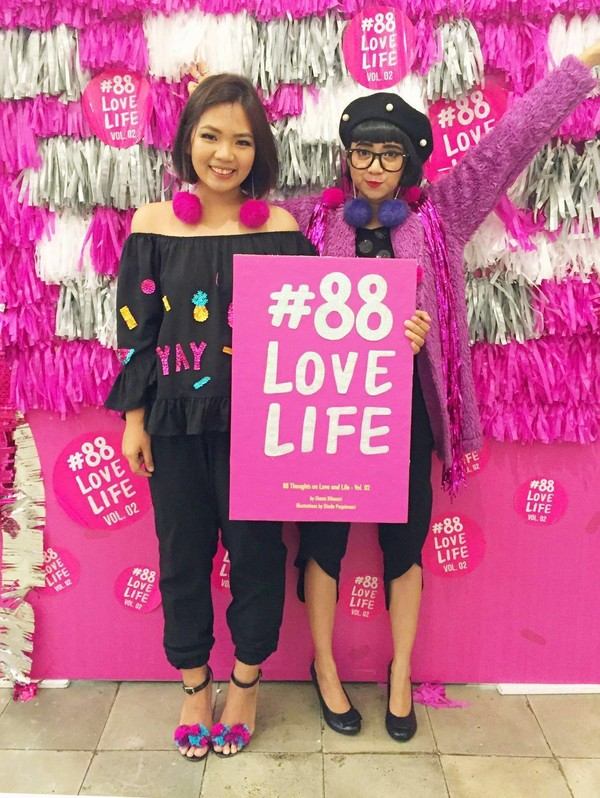
Diana Rikasari has reinvented herself four times over. She was a market researcher who blogged after work, then a fashion blogger with a following, then, in 2011, the founder of a footwear label she built with no training in fashion at all. She wrote a bestselling book, #88 Love Life. She now lives in Lausanne, in Switzerland, where in 2019 she sat at a sewing machine for the first time and began making upcycled clothing.
“When I learned to sew and use a sewing machine for the first time, I just fell in love,” she has said.
Neither woman had failed at what she left. Each walked away from something that was working to build something else. That is a pivot, and it is the subject of this instalment, the first of two on founders who change direction. The next covers the harder case, a business that fails or is taken away. This one follows the founder who chooses to move on.
What a pivot is
The word pivot comes from the language of startups. Eric Ries, who popularised it in The Lean Startup, defined a pivot as “a structured course correction designed to test a fundamental hypothesis about the product, strategy and engine of growth”. In wider use it has come to mean a decisive change of direction in a business or a career, which is the sense this series uses. What sets the change off is not always the founder’s to choose.
Tracy Wilkinson, who founded TraceWorthy, took over an Australian company called Acirema Associates from an owner who no longer enjoyed it. It had been set up to supply merchandise for the America’s Cup that Australia hosted in Fremantle after winning the trophy in 1983. Many of its relationships came with it. Tracy built on them and widened the business well beyond merchandise, exporting coal in tripartite deals and importing and exporting paper to capture the tax and tariff advantages. It ran on personal relationships, on catalogues hundreds of pages thick, and on hours in the customs offices searching physical files for the right tariff classification.
In the mid-1990s the internet changed the market conditions: buyers could search and source for themselves, and the knowledge the business traded on was everywhere. Its market had gone. Tracy did not choose that. What she chose was how to respond: she closed Acirema rather than cling to it. Import and export was never Tracy’s calling; it was an opportunity she had spotted and taken, and she let the company go without regret.
What a founder moves towards
Tracy had seen Acirema’s demise coming, and she founded her next company, Inkata Market Concepts, before she closed the old one. Acirema’s customer base gave Inkata its first clients, and she built it as a marketing consultancy, on the view that a computerised business world needed new marketing thinking. It began in market research, in the design of surveys and instruments for measuring performance, but the data collection did not inspire her. She was more interested in the psychology underneath it, and she took it into the workings of a business itself.
Tracy examined the ecosystem of relationships inside a company and the patterns of communication up, down and across a hierarchy, and built solutions for what she found. She would even take apart a strategic plan built on an entrepreneur’s ego rather than the reality of the market, and put it back together. It was her first step away from a product-centred way of working and towards a human-centred one.
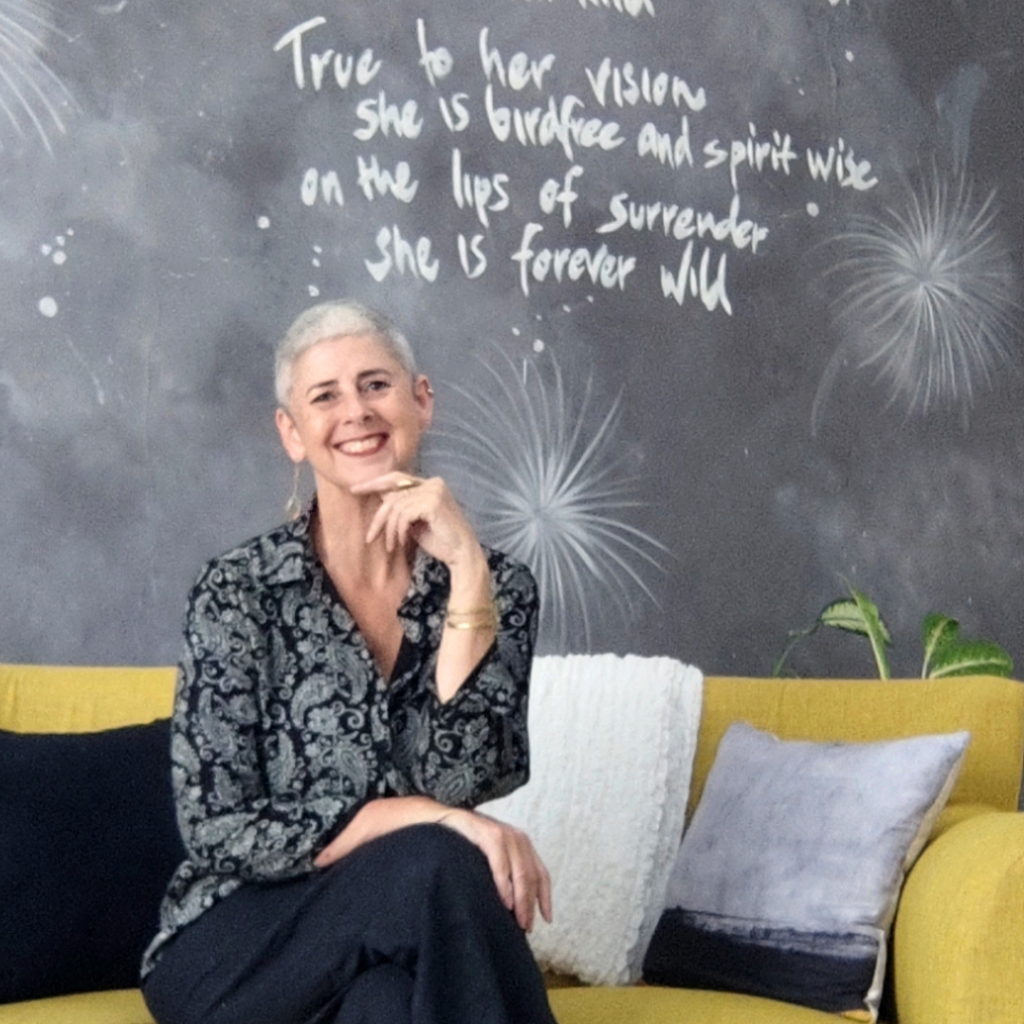
Diana Rikasari left the same field, market research, for a creative life she taught herself from nothing.
Kaye, a client of TraceWorthy whose name is changed here, made her first turn under more strain. She had built a career in finance and was burnt out by the relentless pace of it. She and her family had moved to Indonesia for a gentler life, and she left finance for health and wellbeing, wanting work with a person at the centre of it. For a time it gave her that. She built a brand, ran online programmes and coached clients one to one, and the work let her be fully self-expressed.
Each moved towards work that felt more her own: Shantika from a giant she could have stayed inside, Rikasari from measurement to making by hand, Kaye from the certainty of finance, and Tracy from an import-export business made obsolete by the internet.
Reinvention from an established career
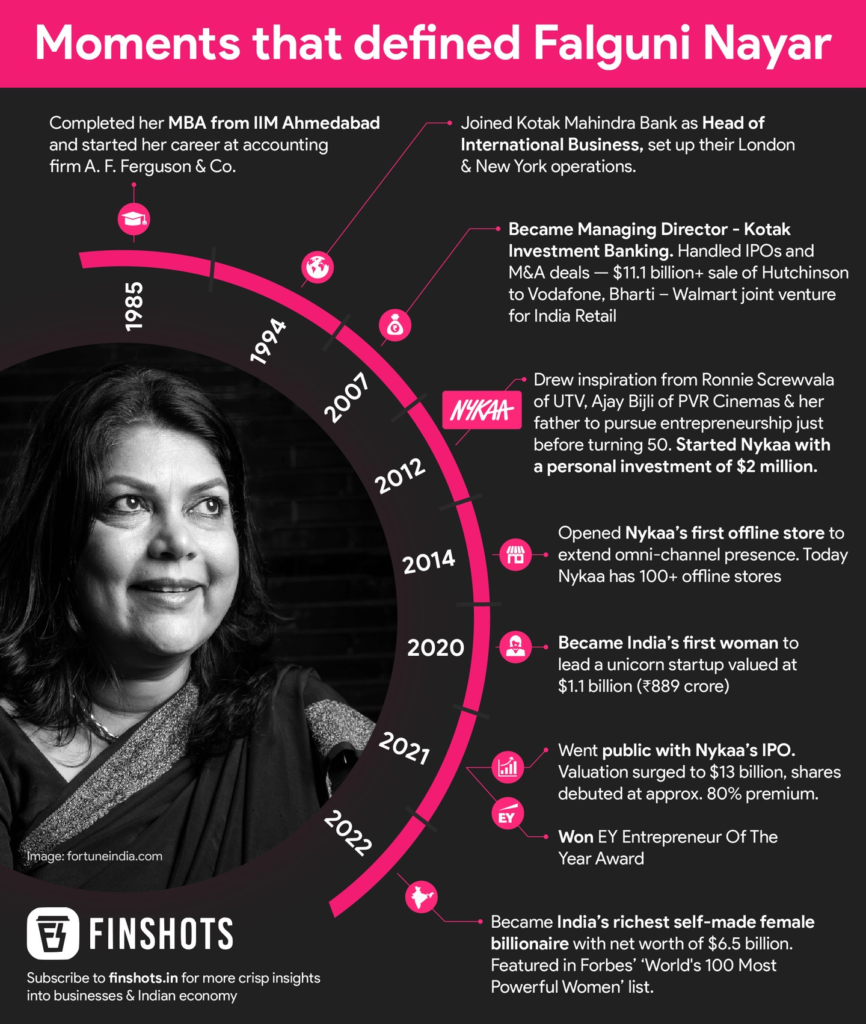
Falguni Nayar spent nearly two decades in banking in India, latterly as one of the country’s senior investment bankers, and left at the age of forty-nine to start something she had never done. In 2012 she founded Nykaa, an online beauty business, in a market where advisers told her to sell electronics or fashion instead. She kept to beauty. When Nykaa listed on India’s National and Bombay stock exchanges in November 2021, at a value of around thirteen billion US dollars, it made her one of India’s wealthiest self-made women. Leaving a senior, secure position at forty-nine, with a reputation already made, is a different kind of risk from a young founder’s, and she took it anyway. On women and ambition, she has said, “Women need to not feel guilty if they want to dream for themselves.”
Rebrand, or begin again
A founder can keep the company she has and change what it does, or she can start a new one. Tracy did each, at different times. When her marketing work turned fully towards people, she rebranded Inkata Market Concepts into a performance-coaching business, Free Spirit, that coached the ecosystem around a leader, from the executive herself to the team she led, the spouse at home and the wider family, on Tracy’s understanding that an executive’s performance runs through that whole ecosystem. Later she built a second company alongside it, Natural Order, a business incubator, and she carried what she had learned coaching high-earning executives to founders who were starting with far less, mostly women working from home. She ran the two together, the coaching practice and the incubator, so the new company stood beside the old rather than replacing it.
The choice between rebranding and starting again is not only a question of a name. A rebrand keeps the company’s history, its contracts, its tax registration and its record, which suits a business evolving into something close to what it already was. A new company is the cleaner choice where the ownership, the risk, the market or the funding is genuinely different, even though it begins the paperwork afresh. Either way, what a founder has already built, the intellectual property, the brand, the contracts and the client relationships, has to be carried across on purpose, by proper assignment, rather than assumed to follow her. Getting that wrong is how a founder loses the value of the thing she is leaving. A founder who assumes the new company owns her brand can find, when she comes to license it or raise against it, that the right still sits with the old entity, or with a former partner.
When the new venture has to cross a border
Kaye’s second pivot brought a problem that many foreign founders in Indonesia meet. Her wellbeing business had grown into a thriving coaching practice and a set of online programmes, and parts of it let her work exactly as she wanted. Other parts did not. The clients she was drawing were not the people she wanted to work with, and the work stopped inspiring her. Her business had succeeded and still stopped being the work she wanted, and she was honest enough to see it. She came back to TraceWorthy to design something new, a personal brand that would showcase other enterprises through branding, marketing, self-expression and a measure of influencer work.
Here Kaye had to build the pivot around Indonesian immigration law. A foreigner in Indonesia cannot lawfully earn influencer income, or carry out the commercial photography and videography that content creation needs, while based onshore, and immigration treats any activity with economic value as work, whether or not it is paid. Enforcement has been active: in 2026 a Bali task force detained and deported dozens of foreigners for working on the wrong visa, content creators among them, and a short content-creator visa that now exists is built for defined campaigns rather than an ongoing business. The route TraceWorthy is building for Kaye places the enterprise offshore, with its clients outside Indonesia, and positions her as its brand ambassador on a residency basis matched to what she does here. Structured that way, with the entity abroad, the income properly declared, and her Indonesian status aligned to her activity, the reinvention she wanted becomes lawful. Her family’s residency is being re-based to suit income earned abroad, with the aim of keeping their stay secure. Because a person who lives in Indonesia is taxed here on income from anywhere, the arrangement is built to meet that obligation in full.
The adviser’s part
Tracy has reinvented her own working life many times over, in Australia and then in Indonesia. Through the Australian companies she moved steadily towards a more human-centred way of working. Running Acirema taught her when to close a business whose market has gone. Marketing taught her to look past the product to the person. In coaching she came to see a business as a set of human relationships before anything else, and in incubation she built those lessons into other people’s ventures.
In Indonesia, Tracy built five more companies before TraceWorthy, working the same way she had with Acirema. She opened an advertising company because it was the quickest route to a list of thousands of businesses, and from that list she offered the clients she chose the consulting she wanted to deliver, in pivoting, scaling, self-expression and other human-centred work. She also consulted to a four-wheel-drive tour operator in difficulty and later took it over when the owner’s priorities shifted. The experience of the sector, and the supplier and destination-management relationships that came with it, made her consulting relevant to tourism operators. She took it to businesses such as Bali Bird Park and Handara Golf Resort, work that brought them into compliance, strengthened their governance, opened new markets, and reshaped how each was run around its people.
TraceWorthy is where all of it meets, and it is the work she wanted, an advisory business that is human-centred because the woman who built it arrived there the long way, one reinvention at a time. Tracy is careful to say that a pivot is not a verdict on what a founder leaves. Acirema was a good business, and the internet changed the market it depended on. The wellbeing work suited Kaye for a time, and then it no longer did.
A founder who comes to TraceWorthy wanting to change direction is working with a company whose own founder has done it again and again, and whose team treats the structural work as its own craft. The team sets up the new entity, decides with her whether to rebrand or begin again, carries the intellectual property and the brand across, closes the old venture in good order, and, where the new work crosses a border, builds it offshore while protecting her life in Indonesia. A founder is then free to do the thing only she can do, which is to imagine what comes next.
She does what she loves. We look after the rest.
If you are thinking of changing direction, or you have already outgrown the business you have, the way to start is to build the structure around where you are going. Speak with our team, and we will set out what your reinvention would take.
Our team is your team.
This article is general information current as at 3 August 2026. Immigration, tax, company and investment rules change, and the position for any person or business depends on its own facts, so obtain advice for your own situation before you act. It is not legal, tax, or immigration advice, and it does not create an advisory relationship or reach any conclusion on a particular reader’s position.
Quoted statements are reproduced from the published interviews cited, and company figures are drawn from the sources linked and change over time.
Frequently Asked Questions
What is the difference between a pivot and a failure?
The two can look similar from outside and are different in substance. A pivot is a change the founder chooses, leaving a business that works, or that no longer suits her, to build something new. A failure removes the choice, when the venture stops working and the founder is forced out. This article covers the pivot a founder chooses; the next covers the failure that removes the choice.
Should I rebrand my company or start a new one?
It depends on how close the new direction is to the old. Rebranding keeps the same company, with its history, its contracts, its tax registration and its record, which works well when the business is evolving into something adjacent. A new company gives a clean separation, better suited to a venture whose ownership, risk, market or funding is genuinely different. The decision carries trademark, contract, tax and employment consequences, so it is worth taking advice rather than defaulting to a new logo.
How do I move my brand and intellectual property into a new business?
The transfer must be a formal, written assignment; the value does not move on its own. The intellectual property, the brand, the contracts and the client relationships that carry value in the old business are transferred deliberately and in writing, so the new company owns what it is built on. Skip it, and the new company may not own the brand it trades under.
Do I have to close my old company when I start something new?
You do not always have to close it straight away, and in some cases you need not close it at all. Some founders run the old and the new together for a time, as income shifts from one to the other. Where the old venture is finished, closing it in good order, settling its obligations and deregistering it, keeps it from following you. The right sequence depends on tax, staff, creditors and any continuing contracts.
Can a foreigner run an influencer or content-creation business in Indonesia?
A foreigner cannot run one onshore without the correct legal basis. Indonesian immigration treats any activity with economic value as work, so earning influencer income, or doing the commercial photography and videography that content creation needs, is not permitted on a tourist visa, and enforcement has been active in 2026. A short content-creator visa exists for defined campaigns. For an ongoing personal-brand business, the practical route is usually to base the enterprise offshore, serve clients abroad, and match your Indonesian residency to what you do here, which is a structuring question to take advice on.
What happens to my Indonesian residency if my new income comes from offshore?
It depends on how your residency is based. If your stay depends on onshore work or a local company, moving your income offshore can undermine it, so the residency basis is changed to match, for example to one that suits income earned abroad, with any dependants’ permits aligned to it. A person resident in Indonesia is also taxed here on worldwide income, so the arrangement is planned to be compliant. Take advice before you move the income.
How does TraceWorthy help with a reinvention?
We treat the structure as our work rather than yours. We set up the new entity, help you decide whether to rebrand or begin again, carry your intellectual property and brand across, close the old venture cleanly, and, where the new work has to sit offshore, build it there while protecting your residency in Indonesia. The aim is to free you to build the next thing while we handle the transition.