Part of the series: Women Founders in Indonesia
- Women Founders in Indonesia: Nurhayati Subakat, Who Rebuilt After the Fire
- Women Founders in Indonesia: Formalising a Small Business in Indonesia
- Women Founders in Indonesia: Building a Foreign-Owned Business
- Women Founders in Indonesia: Own It in Your Own Name
- Women Founders in Indonesia: Structuring for Impact
- Women Founders in Indonesia: Making a Woman-Led Business Bankable
- Women Founders in Indonesia: The Merits of Bootstrapping a Business
- Women Founders in Indonesia: The Art of Reinvention
- Women Founders in Indonesia: When a Business Has to Close
Current as at 21 July 2026.
In 1990, fire took almost everything Nurhayati Subakat had built. The factory burned. So did the office, and the family home with it. The bank loans that had paid for the business were not yet repaid. She was a pharmacist who had started making shampoo at home five years earlier, and she faced a plain choice, to continue or to stop.
Her first thought was for the people who worked for her. “If I close my company, what will become of them?” she has recalled asking herself. She kept them on. She paid their wages out of her husband’s monthly salary, and she rebuilt the factory with his savings. The company she refused to close, PT Paragon Technology and Innovation, is now the largest cosmetics company in Indonesia, and around 14,000 people work in it.
She could keep those people through the fire for a reason that had nothing to do with cosmetics. A registered limited liability company is a legal person in its own right, separate from its founder, able to own a brand and employ the people who make it. That legal person is the quiet part of this story, and it is the part Subakat would have handed to someone else if she could.
Top of her class, and no job
Subakat was born in 1950 in Padang Panjang, in the highlands of West Sumatra, one of eight children in a Minangkabau family. Her father was a merchant and a Muhammadiyah figure, and her mother ran a business of her own. She went to a girls’ Islamic boarding school, finished secondary school at the top of her year, and studied pharmacy at the Bandung Institute of Technology, where she graduated first in her class.
The distinction did not open a door. “Although I graduated from ITB at the top of my class, I was not lucky in finding a job,” she has said. She worked as a hospital pharmacist, then in quality control at the German haircare company Wella, and left after a few years. In 1985, at home, she started making a product of her own.
She began with a shampoo. “Having a pharmaceutical background, I knew that making a shampoo wasn’t all that different from making medicine,” she told The CEO Magazine. She did not begin alone. “I recruited my two housemaids as employees and we started processing it.” She sold the shampoo into salons and door to door, and the family ran with the work. “Production took place on the second floor of our house and, as children, we had to help pack the bottles in the boxes and take telephone orders,” her daughter Sari Chairunnisa later told Monocle. In 1990 the company opened its first factory at Cibodas. The fire came the same year.
The bet on halal
After the rebuild, Subakat looked past the salons. In 1995 she launched Wardah, one of the first halal-certified cosmetics ranges in Indonesia.
“There were no halal beauty products at the time and I wanted women to have affordable access to products that were in keeping with their faith,” she said. “All women want to look beautiful and feel fresh, and Muslim women are no different.”
She named the ingredient she wanted to keep out. “Sometimes lard is used as an ingredient in cosmetics. I wanted Muslims to feel safe to use cosmetics,” she told the World Intellectual Property Organization.
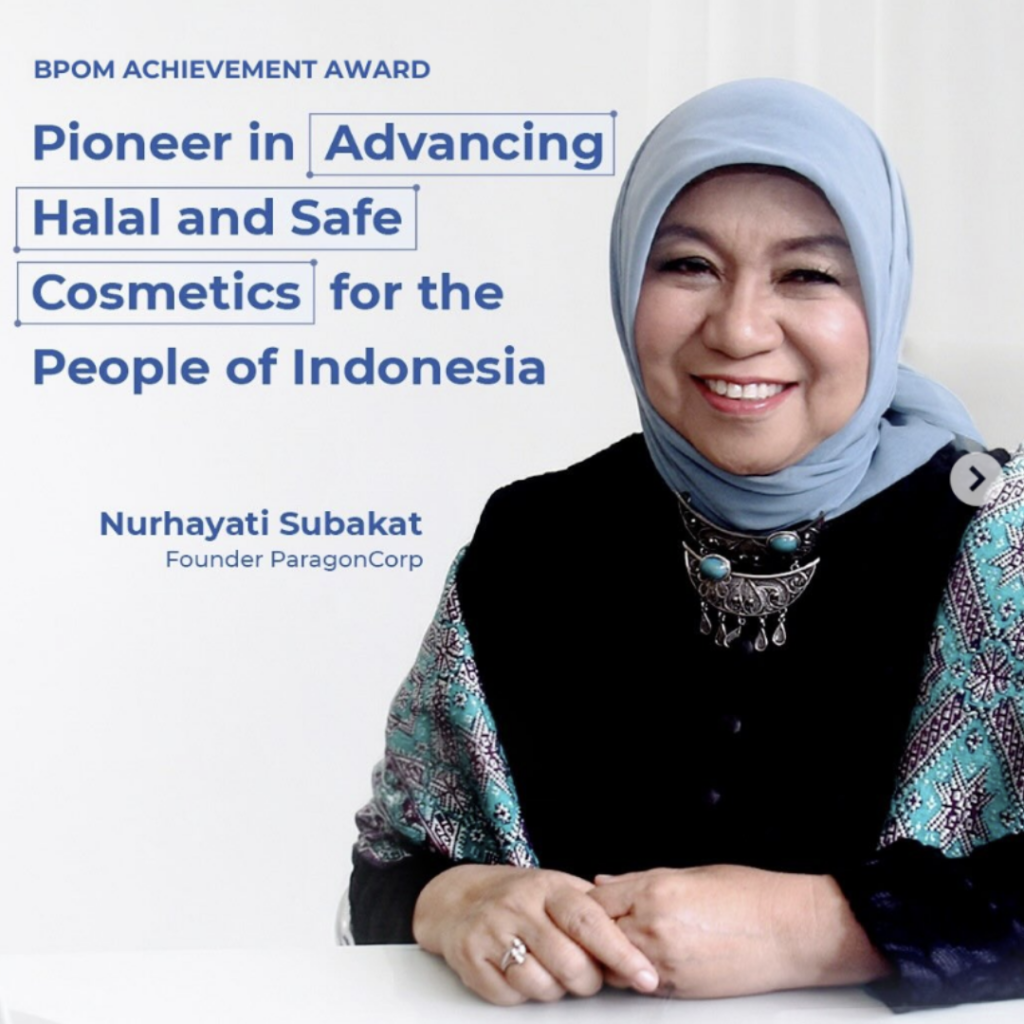
Nobody was asking for it yet. “Halal cosmetics were not familiar back then. We had to build awareness among consumers and also Muslim communities in Indonesia,” she said. She sold Wardah the way she had sold the shampoo, hand to hand, including through religious school networks. Between 2008 and 2010, a movement toward more observant Muslim life spread among Indonesian women, and a range with headscarf-wearing models met a demand no global brand had served. What she had built in a market of one became the country’s leading beauty brand.
The people she calls Paragonians
Subakat gives the credit for that to the people who work for her, and she describes it as a deliberate choice rather than modesty. The company calls its staff Paragonians. “Our young employees not only know how to target our consumers, they also help create our products,” she said. When the business needed a brand for a younger generation, she followed what the young employees knew, and launched Emina in 2014. “Our research revealed that millennials and teens don’t want the same cosmetics brand as older women,” she said. Make Over followed for professionals, and Kahf for men.
She has also stepped out of the way. “I still meet with our R&D team once a week to share my experience, but I don’t make the decisions,” she said. “It’s the team that creates the ideation and the product.” Her children run the company now. Her son Harman Subakat is group chief executive, and her daughter Sari Chairunnisa, a dermatologist, is deputy chief executive and leads research. Harman describes a company that does not perform its hierarchy. “If you walked into a meeting room, you wouldn’t be able to spot the CEO simply by looking unless you’d done your research,” he told The CEO Magazine, and, of the board, “We talk about growth and impact, not profit.”
What she built, and what she gave back
Paragon now makes fourteen brands and reaches roughly a quarter of Indonesia’s beauty market, and Wardah has grown into one of the best-known cosmetics names in Southeast Asia. In 2019 the Bandung Institute of Technology gave Subakat an honorary doctorate, and the same year she received the ASEAN Business Award in the women entrepreneur category.
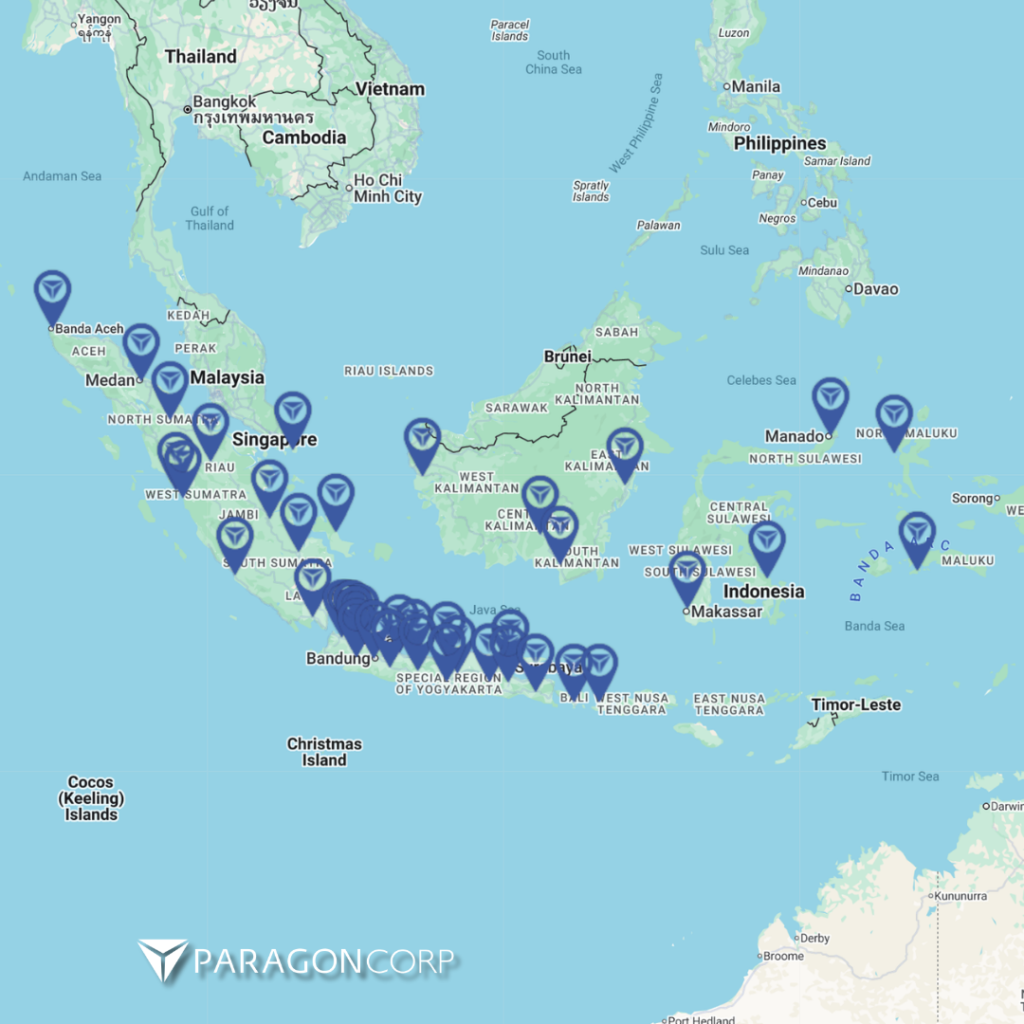
When the pandemic reached Indonesia in 2020, the company committed Rp40 billion to the response. “We began distributing aid in early March 2020,” Subakat said as it started.
“To date, we have channelled aid to more than 40 referral hospitals across several provinces.”
The gift matched the principle she has stated for the way she works. “So, surely with hardship comes ease,” she told the World Intellectual Property Organization, quoting the verse her late father lived by, the same principle she reached for the night the factory burned.
The work she would have given away
None of the work behind the products was what Subakat dreamed of. She wanted women to have affordable cosmetics in keeping with their faith. The work that puts a cosmetic on a shelf is regulated, and it grew as the company grew. Every cosmetic sold in Indonesia is notified to the Badan Pengawas Obat dan Makanan (BPOM, National Agency of Drug and Food Control) before it may circulate, and each product has its own safety and stability file.
The halal assurance Subakat chose voluntarily in 1995, through the assessment body of the Indonesian Council of Ulama, is now a statutory regime under the 2014 Halal Product Assurance Law, administered by the Halal Product Assurance Organising Agency (BPJPH), and halal certification becomes mandatory for cosmetics from October 2026. The Wardah name and the brands beside it are protected as registered marks under the 2016 Trademarks and Geographical Indications Law.
The company itself is the largest piece of that work. Paragon exists as a Perseroan Terbatas (PT, limited liability company), a separate legal person under the Company Law, which is why the brand and the jobs survived the fire and why the company could pass to Subakat’s children in an orderly way. The ownership is recorded in a register of shareholders that the directors are required to keep under Article 50 of that law, the record a bank or an investor reads to see who owns the company.
Product notification, halal certification, trademark protection, corporate governance and the register are each renewed and maintained year after year, and almost no founder builds a business in order to do them.
The figures on women-led enterprise in Indonesia
Subakat’s scale is rare, and the ground she built on is not. Women own a large share of Indonesian enterprise. Women-owned businesses make up 64.5 percent of the country’s micro, small and medium enterprises, and those enterprises together contribute around 60 percent of national gross domestic product, according to a 2024 survey of over 500 women entrepreneurs by Boston Consulting Group and Stellar Women. Seventy percent of the women surveyed named financing and unclear regulation as a significant challenge.
The financing obstacle is a gap on the lenders’ side as much as the founders’. The International Finance Corporation put the credit gap for women-owned businesses in Indonesia at USD 21.2 billion in 2023, a figure that measures unmet demand from creditworthy women-owned businesses. Across the wider economy, micro, small and medium enterprises account for 97 percent of employment, so the enterprises that credit constraints affect are most of the country’s employers.
Evidence from outside Indonesia points one way on performance, with limits that should be stated. A 2018 study by Boston Consulting Group and the MassChallenge accelerator found that businesses founded or co-founded by women generated 78 cents of revenue for each dollar of funding, against 31 cents for those founded by men, while raising less on average, USD 935,000 against USD 2.1 million. That finding describes a single accelerator cohort rather than the whole market, and it predates the current period, so we present it as a 2018 result rather than a rule for every business.
Building a team wider than the payroll
A study of leadership style qualifies the common idea that women lead differently. A meta-analysis by Eagly and Johnson found that women, on average, adopt a more participative and democratic approach than men and a less directive one, while most other differences in style were small. That is an average across many people rather than a rule for any individual, and gender alone does not decide how a founder leads.
In Subakat’s own company, she built the business with her two housemaids, credited the young employees with the products, kept her staff through the fire, and handed the decisions to a team and then to her children.
Mixed leadership also accompanies strong results, though the link is a correlation rather than a proven cause. In its 2023 study, McKinsey found companies in the top quartile for gender diversity on their executive teams were 39 percent more likely to outperform their peers financially, up from 25 percent in 2020, so it is fairer to say diverse leadership accompanies strong performance than to say it produces it.
Building a capable team is the pattern, and a great team includes people beyond the payroll. No founder has every function a growing company needs inside her own training. A pharmacist knows formulation and safety, and she still needs people who know corporate governance, tax, product registration, halal certification and the protection of a brand across borders. The founders we work with treat outside advisers as part of that team rather than as a transaction, which is what we mean when we say our team is your team, and why we treat a client’s business as a personal undertaking rather than a file. Business is personal because the person who built it is the reason it exists.
The dream, and the part TraceWorthy plays
Subakat is one founder, and this series will profile others, Indonesian and foreign, who built enterprises in Indonesia. What we look for in each of them is the specific unlikely thing she did and the people she did it with, rather than her gender. A pharmacist who could not find a job made shampoo with her two housemaids, rebuilt from a fire rather than lay anyone off, and built the largest cosmetics company in the country by trusting the young people who worked for her. Determination decided that, and so did the way she treated the people around her.
The work she would have given away is the work we do. The incorporation and the governance that let a company outlive a bad year, the product registrations and safety files behind every cosmetic, the halal certification that is now the law, the trademarks that protect a brand in other countries, and the tax and reporting that keep a company registered and compliant, all of it is separate from the thing a founder loves. Our founder, Tracy Wilkinson, hears the larger thing a person is building before she hears the compliance question, and she will say the hard thing early, that a company protects the people inside it only when its structure is sound ahead of the loss rather than after it. The lawyers, accountants, tax specialists and compliance professionals she leads build that structure and keep it, which leaves a founder free to do what she loves. She does what she loves. We look after the rest.
If you have an idea you have not yet said out loud, we would like to hear it.
Tell us about the business you dream of.
This article is general information current as at 22 July 2026. Company, tax, and regulatory rules change, and the position for any business depends on its own facts, so obtain advice for your own situation before you act. It is not legal, tax, or financial advice, and it does not create an advisory relationship or reach any conclusion on a particular reader’s position.
Quoted statements are reproduced from the published interviews cited, and translated quotes are given in the wording of the cited source. Company figures are drawn from the sources linked and change over time.
Frequently Asked Questions
Who founded Paragon, and what does the company do?
Nurhayati Subakat began the business now registered as PT Paragon Technology and Innovation from her home in 1985, and it is today the largest cosmetics company in Indonesia. It launched Wardah in 1995 as one of the earliest halal-certified cosmetics ranges in the country, and its brands include Wardah, Make Over, Emina and Putri. The company employs around 14,000 people, and Subakat’s children now run it as a registered Perseroan Terbatas.
What share of Indonesian businesses are owned by women?
Women-owned businesses comprise 64.5 percent of Indonesia’s micro, small and medium enterprises, according to a 2024 survey of over 500 women entrepreneurs by Boston Consulting Group and Stellar Women. Those enterprises together contribute around 60 percent of national gross domestic product. The same survey recorded that 70 percent of the women surveyed named financing and unclear regulation as a significant challenge.
Do women-led businesses perform well against the funding they raise?
A 2018 study by Boston Consulting Group and the MassChallenge accelerator found that businesses founded or co-founded by women generated 78 cents of revenue for each dollar of funding, against 31 cents for those founded by men, while raising a lower average sum than men-founded businesses. That finding describes one accelerator cohort over five years rather than the whole market, and it predates the current period, so it is a 2018 result rather than a present-day rule.
What does it take to make a small business in Indonesia fundable?
A lender or an investor assesses a registered entity, the ownership recorded on the share register, the licensing and the financial records. An informal trade has none of these. Registration as a Perseroan Terbatas creates a legal person separate from the founder, a Nomor Induk Berusaha issued through the Online Single Submission system records the business and its licensing, and the share register required by Article 48 of the Company Law records the ownership. Together these let an outsider assess the business.
Does TraceWorthy advise only foreign investors?
We advise Indonesian founders and foreign founders operating in Indonesia. This series profiles both, from an Indonesian national who built a national company to foreign nationals who built enterprises here. Our structuring work covers the entity, the ownership, the governance and the compliance a growing business needs, whichever side of that description a founder is on.