

Part of the series: Women Founders in Indonesia
- Women Founders in Indonesia: Nurhayati Subakat, Who Rebuilt After the Fire
- Women Founders in Indonesia: Formalising a Small Business in Indonesia
- Women Founders in Indonesia: Building a Foreign-Owned Business
- Women Founders in Indonesia: Own It in Your Own Name
- Women Founders in Indonesia: Structuring for Impact
- Women Founders in Indonesia: Making a Woman-Led Business Bankable
- Women Founders in Indonesia: The Merits of Bootstrapping a Business
- Women Founders in Indonesia: The Art of Reinvention
- Women Founders in Indonesia: When a Business Has to Close
Current as at 21 July 2026.
Elora Hardy designed prints for Donna Karan in New York before she moved back to Bali in 2010 to build houses out of bamboo. She had a fine-arts degree and a fashion career, and no training as an architect. “I needed to be part of something sustainable,” she has said of the change. “It really came down to that.” The studio she founded, IBUKU, has since built over 60 bamboo structures in Bali, among them Green Village and the Sharma Springs house.
Hardy is one of three women who came from overseas and built substantial businesses in Bali, beyond the tourist trade. Michela Foppiani moved from Italy in 2001 and makes ceramics with a family of around 100 craftspeople in Ubud. Susanna Perini founded a fashion house in Bali in 1994 and runs eight boutiques today. None of the three set out to learn Indonesian investment law. Each of them had to, because a foreign founder who builds here takes a structural route no local founder needs, and getting it wrong is expensive.
The print designer who built in bamboo
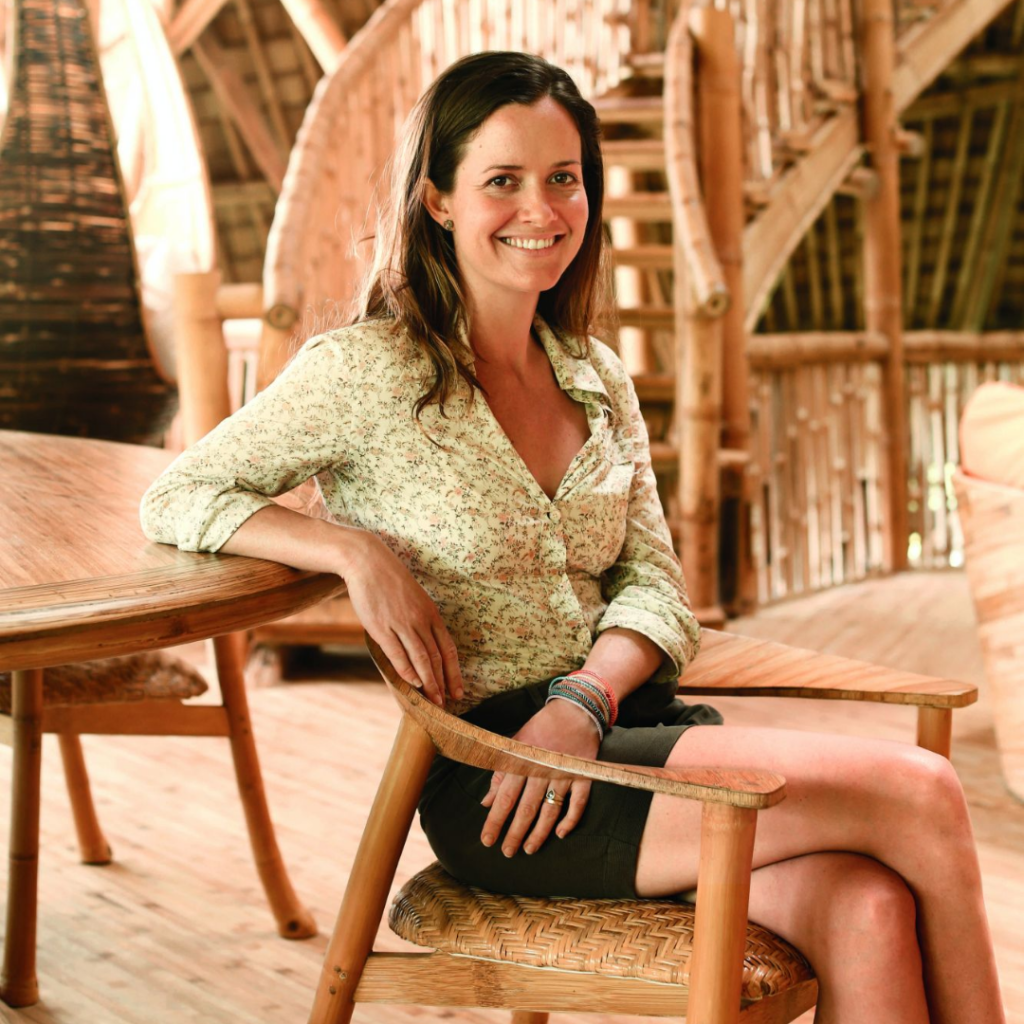
Hardy grew up in Bali, moved to the United States at fourteen, took a fine-arts degree at Tufts, and worked as a textile print designer, including for Donna Karan in New York. A visit home changed the direction. Her father, the jeweller John Hardy, had helped create the Green School in Bali, and the design-build team behind it had learned to raise large structures in bamboo. In 2010 she returned to continue that work and founded IBUKU. She did not begin from nothing, and she says so. The craftspeople already there had, in her words, “developed several really key structural concepts for how to work with the material”, and she built the studio on that skill rather than around herself.
IBUKU designs and builds homes, hotels, schools and event spaces from bamboo, and it has completed over 60 structures. Hardy was named an Architectural Digest Innovator in 2013, and her 2015 TED talk, “Magical houses, made of bamboo”, took the work to a wide audience. The studio now works with a design team alongside the builders and makers who shape each structure by hand, which is the point she returns to when the credit is given to her alone.
The potter who trained a village
Michela Foppiani and her husband Marcello Massoni left Italy for Bali in 2001. “We moved from Italy to Bali in 2001 to establish Gaya Ceramic and Design and to start throwing pots under the tropical sun of this magic island,” she has said. The workshop makes handmade ceramics for hospitality and design clients around the world, and a family of around 100 skilled craftspeople make the work by hand, from forming to firing.
In 2010 the founders opened the Gaya Ceramic Arts Centre, a school running regular ceramic classes and an artist-in-residence programme, with intensive workshops through the year. The apprenticeship became a route into the business itself, and villagers trained through the centre have become employees. Foppiani built the company by teaching the craft to the people around her and then employing them, which is the second pattern common to every founder in this piece, the people she built with.

The designer who became Indonesian

Susanna Perini was born into a family of couturiers in Italy and founded BIASA in Bali in 1994, a resort-wear label made from natural materials. “I conceived the brand as my idea of a tropical lifestyle, made of precious simplicity, natural materials and detailed craftsmanship, rather than commercial fashion,” she has said. She opened BIASA Art in 2005, and for over 30 years her studios have employed artisans, weavers, dyers and designers side by side. The label runs eight boutiques in Bali and Jakarta.
Perini differs from the other two on one point of law. She is a naturalised Indonesian citizen, so she owns and runs her business as an Indonesian, not as a foreign investor. Citizenship is one lawful path, and it is a different route from the one a founder who remains a foreign national takes. The sections that follow set out that second route, the one Hardy and Foppiani’s positions illustrate and the one most foreign founders in Bali need.
The route a foreign founder takes
A foreigner invests in Indonesia through a foreign investment company, a Perseroan Terbatas Penanaman Modal Asing (PT PMA). Foreign investment has to take the form of an Indonesian limited liability company, under Article 5 of the Investment Law. A limited liability company is established by at least two shareholders, under Article 7 of the Company Law, so a PT PMA has two or more shareholders. The single-shareholder individual company set out in our earlier article is available only to a micro or small domestic enterprise, not to a foreign investment company.
A PT PMA has a total investment value above Rp10 billion for each line of business at each location, excluding land and buildings, and an issued and paid-up capital of at least Rp2.5 billion for the company, under the 2025 investment regulation. That regulation replaced the earlier rule, which set the paid-up figure at Rp10 billion, so a founder working from an older guide will overstate the capital required. These are the current thresholds, and the figure a specific project meets turns on its classification and location, so we confirm the position for a named business rather than reading a threshold in the abstract. The line of business also has to be open to foreign investment. The Positive Investment List, set by Presidential Regulation 10 of 2021 as amended, opens most sectors to foreign investment and names the few that are closed, with others reserved for cooperatives and small enterprises or open only on conditions such as a limit on foreign ownership.
A foreign founder who works in the company needs a permit to stay and a permit to work. The stay permit is a limited stay permit, an Izin Tinggal Terbatas (ITAS), evidenced by the card known as a KITAS. To employ a foreign worker, including a foreign director, the company needs an approved foreign worker plan, a Rencana Penggunaan Tenaga Kerja Asing (RPTKA), under the 2021 regulation on the use of foreign workers. A shareholder who invests without working in the company has different requirements from a founder who takes an operating role, so the permit follows what the founder does in the business.
Why the nominee shortcut fails
A nominee arrangement records an Indonesian as the shareholder for and on behalf of the foreigner. Indonesian law prohibits it. Article 33 of the Investment Law forbids an agreement that places company shares in another person’s name for a foreigner, and declares such an agreement null and void by operation of law. The foreigner is left with a claim the courts will not enforce, while the shares are recorded in the Indonesian’s name on the register. Beyond the nullity, a false ownership record exposes both sides to administrative and criminal risk, and the company records its beneficial owner under Permenkumham 2 of 2025 and keeps that record current. We decline nominee arrangements, and we set out in writing why one gives a foreign buyer nothing a court will enforce.
What the compliant route protects
A compliant foreign investment company gives the founder an ownership the register recognises and a court will enforce. The company can open a bank account, sign contracts, employ staff on formal terms and bring in an investor, each in its own name. Premises and land are governed by a separate set of rules for a foreign-owned business, which our guidance on foreign land ownership in Bali sets out. Where an Indonesian business partner takes a share, a compliant structure records that share in the partner’s own name.
The people these founders employ, the craftspeople in Ubud and the artisans in a BIASA studio, and the buyers who place orders from abroad, deal with a business the law recognises. That is what the founders built once the structure was right, and it is what a nominee arrangement or informal structure cannot provide.
The dream, and the part we play
Hardy wanted to build something sustainable. Foppiani wanted to throw pots and teach the craft. Perini wanted a tropical lifestyle made of natural materials. None of them wanted the investment classification, the paid-up capital, the work permit and the beneficial-owner record, and each of them needed all of it in place first.
No foreign founder has Indonesian investment law, immigration and tax inside her own training, so a capable founder builds a team around herself, and that team includes advisers beyond the payroll, who supply the parts of the business she does not need to be involved in. That is what we mean when we say our team is your team, and why we treat a client’s business as a personal undertaking rather than a file.
Business is personal because the founder is the reason it exists.
Our team are Indonesian lawyers, accountants, tax specialists and compliance professionals, recruited and trained by our founder, Tracy Wilkinson, to a standard set against international practice. Tracy hears the larger dream a founder is building before she hears the compliance question, and she will say the hard thing early, that the nominee shortcut gives a foreign buyer nothing a court will enforce, and that the structure is cheapest to build correctly before a deposit is paid and a notary is appointed. The TraceWorthy team then structures and forms the company, confirms the field is open to foreign investment, arranges the capital, the licensing, the permits and the beneficial-owner record, and keeps the company’s registrations current. A founder is then free to do what she loves.
She does what she loves. We look after the rest.
Speak with our team before any company is formed, because engaging us after a nominee arrangement has been signed narrows the options and raises the cost of putting the ownership right.
Our team is your team.
This article is general information current as at 22 July 2026. Investment, company, immigration, and tax rules change, and the position for any business depends on its own facts, so obtain advice for your own situation before you act. It is not legal, tax, or financial advice, and it does not create an advisory relationship or reach any conclusion on a particular reader’s position.
Quoted statements are reproduced from the published interviews cited, and company figures are drawn from the sources linked and change over time.
Frequently Asked Questions
Can a foreigner own a business in Bali?
Yes, through a foreign investment company, a Perseroan Terbatas Penanaman Modal Asing (PT PMA). Foreign investment has to take the form of an Indonesian limited liability company, under Article 5 of the Investment Law, and a limited liability company is established by at least two shareholders. The line of business also has to be open to foreign investment under the Positive Investment List.
How much capital does a PT PMA need?
Under the 2025 investment regulation, a PT PMA has a total investment value above Rp10 billion for each line of business at each location, excluding land and buildings, and an issued and paid-up capital of at least Rp2.5 billion for the company. An older figure of Rp10 billion paid-up capital is from the superseded rule and no longer applies.
Is a nominee company legal in Indonesia?
No. Article 33 of the Investment Law forbids an agreement that places company shares in another person’s name for a foreigner, and it declares such an agreement null and void by operation of law. The foreigner is left with a claim the courts will not enforce, and the company discloses its true beneficial owner under the beneficial-ownership rules in any event. A compliant PT PMA records the real owners.
Do I need a KITAS to run my company in Bali?
A foreign founder who works in the company needs a permit to stay and a permit to work. The stay permit is a limited stay permit, an Izin Tinggal Terbatas (ITAS), evidenced by the card known as a KITAS. To employ a foreign worker, including a foreign director, the company needs an approved foreign worker plan, an RPTKA. A shareholder who does not work in the company has different requirements from a founder who does.
Which businesses are open to foreign ownership?
Most business fields are open to foreign investment. The Positive Investment List, set by Presidential Regulation 10 of 2021 as amended, opens most sectors to foreign investment, names the few fields that are closed, and marks others as reserved for cooperatives and small enterprises or open only on conditions such as a limit on foreign ownership. The classification for the intended activity is confirmed before the company is formed.