
Part of the series: Women Founders in Indonesia
- Women Founders in Indonesia: Nurhayati Subakat, Who Rebuilt After the Fire
- Women Founders in Indonesia: Formalising a Small Business in Indonesia
- Women Founders in Indonesia: Building a Foreign-Owned Business
- Women Founders in Indonesia: Own It in Your Own Name
- Women Founders in Indonesia: Structuring for Impact
- Women Founders in Indonesia: Making a Woman-Led Business Bankable
- Women Founders in Indonesia: The Merits of Bootstrapping a Business
- Women Founders in Indonesia: The Art of Reinvention
- Women Founders in Indonesia: When a Business Has to Close
Current as at 21 July 2026.
Syukriyatun Niamah made her first products in a second-hand gas oven in her university dormitory, from bottle caps she had collected herself. Diajeng Lestari signed up her first designers by knocking on their doors, one label at a time, from a rented room a few metres square. Neither woman set out to run a company. One wanted to stop plastic being thrown away and ignored. The other wanted Muslim women to feel proud of how they looked, and Indonesian designers to be seen. A recycled-design studio in Surabaya and a modest-fashion marketplace in Jakarta began from those wishes, not from any thought of registering a business.
The designer who monetised what others threw away
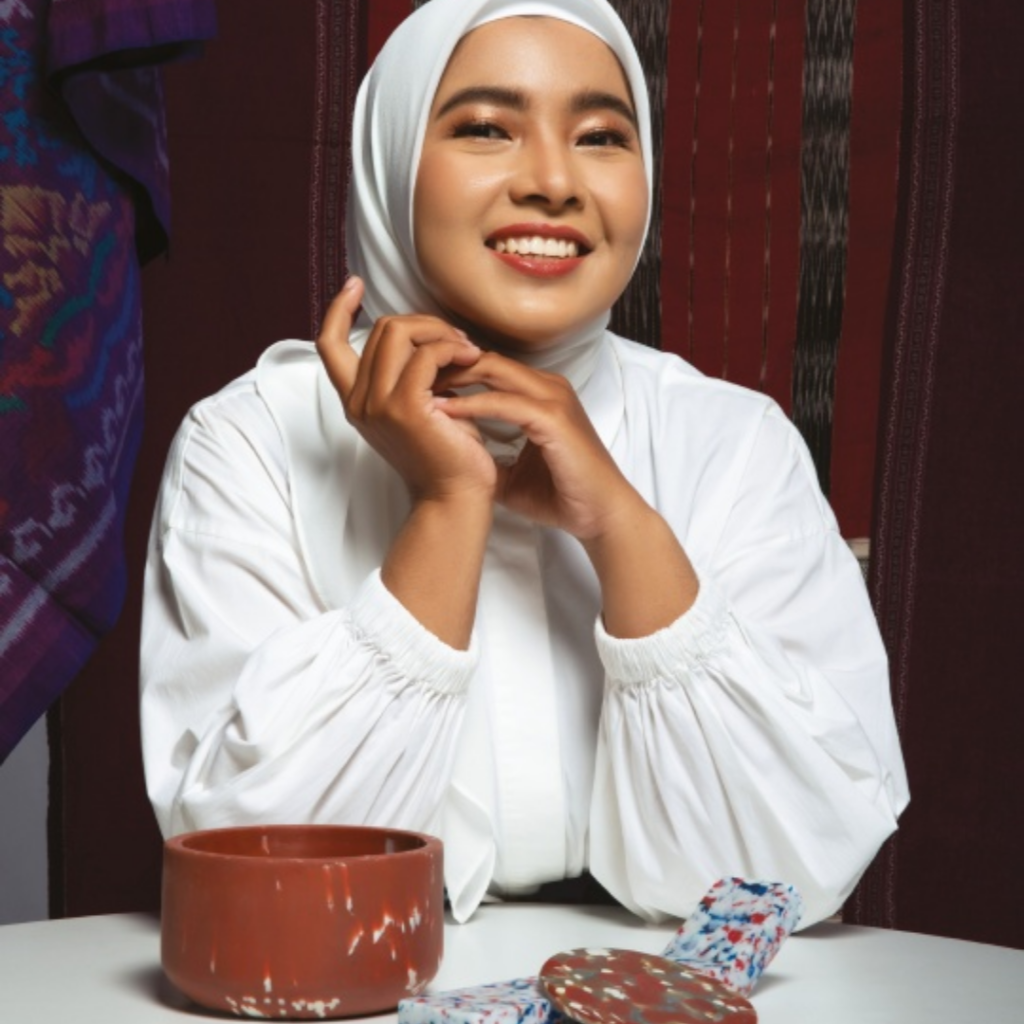
Niamah studied product design at the Sepuluh Nopember Institute of Technology in Surabaya. What set her on her path was her father, a schoolteacher who led a nature club, and the plastic he showed her along the trails.
“My father was a high school teacher and a nature-club advisor,” she has said, “but you could see plastic waste’s impact on our natural resources, and I could see it made my father sad.”
She could not understand why no one else seemed troubled. “I kept asking people around me why they don’t care about plastic waste,” she told an interviewer.
Indonesia had no working system to deal with the waste, so she made one of her own, at the smallest possible scale. She gathered what others discarded and pressed it into coasters, keychains and small clocks. People thought it a waste of an education. “They said, why go to higher education if you’re just going to work with waste,” she has recalled. She kept going, because the objects were good, and because she refused to hide poor material behind additives. “We don’t add any fillers,” she has said. “For us, the colour is 100 percent from the bottle caps themselves.”
In 2018 she founded Robries in Surabaya with three colleagues. The studio moved from small pressed objects to furniture and homeware, and it has since processed over 200 million bottle caps, over 64 tonnes of plastic, into over 10,000 products. Its work sells at home and abroad, to Singapore, Australia and Europe, and in 2022 she was named one of Her World’s Women of the Year. “In the last five years, we kept doubling growth annually,” she has said. “In 2023, we grew by more than 2.5 times.” Growth is not how she measures it. “Sustainability for me is about balance,” she has said. “Live, behave, and consume in a state of balance and a cycle.”
The marketplace she built for other women
Diajeng Lestari studied political science at the University of Indonesia, and left it convinced that economics decides a nation’s strength. “For countries to flourish,” she has said, “one needs to produce more than they consume.” She wore a hijab to a professional job, and she saw something in the market that the market had missed. “I noticed a lot of large players were coming to Indonesia and setting up their brands,” she has said. “However, what was surprising is that none of them was focused on pleasing the majority Muslim community here.” The gap was one she felt herself. “It was first triggered by my own needs as a professional and woman who wears hijab,” she has told kr-asia.
What she wanted was larger than a shop.
“I want to make Muslim women feel proud of who they are,” she said at London Fashion Week in 2016, “neither inferior, nor superior, just their ultimate self, with style and pleasing themselves.”
She built HijUp to lift other people’s work, not her own. “I’m not creating my own brand,” she has said, “but instead pushing local fashion designers and their creations out to the world.”
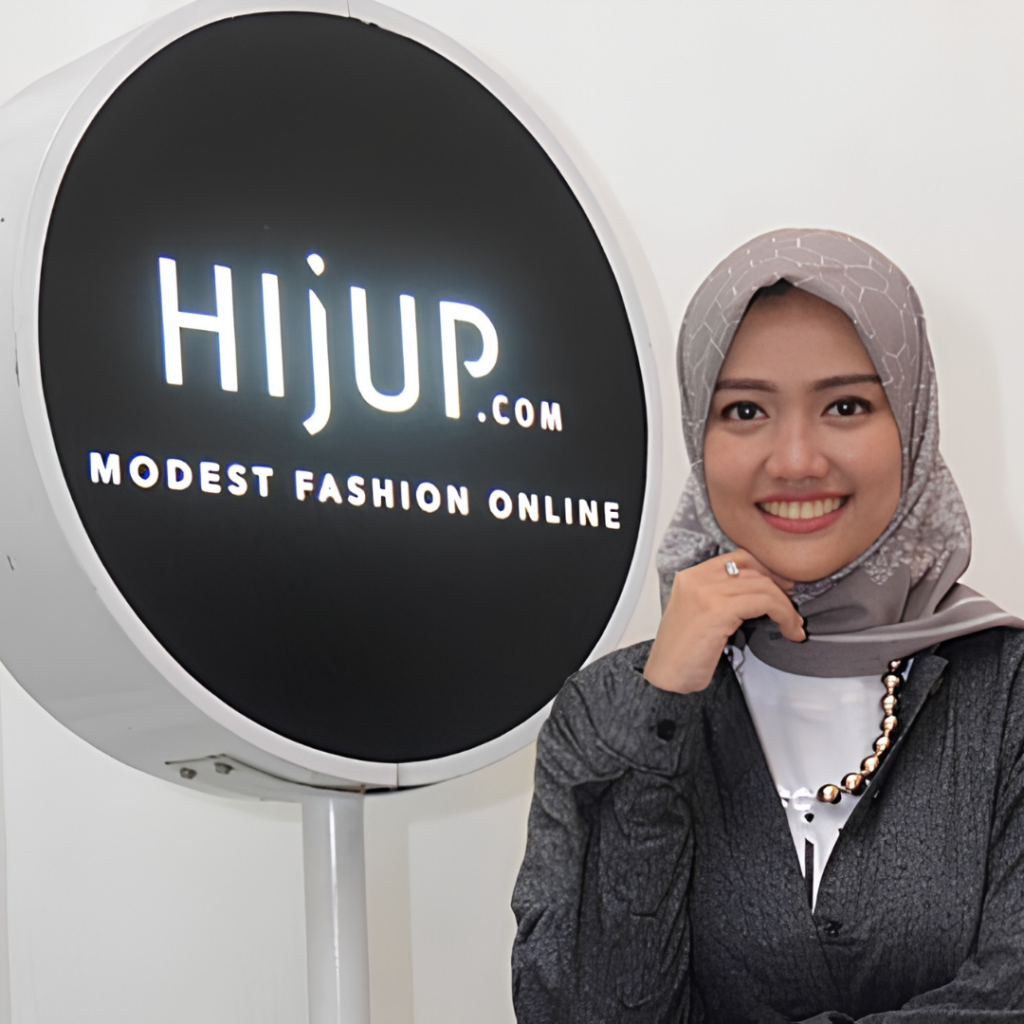
She left her job in 2011 and started with roughly Rp5 million, two members of staff, and fourteen designers who agreed to be listed. Two years on there were twenty employees, and later over a hundred, with the platform hosting hundreds of Indonesian designers and reaching customers in dozens of countries. HijUp took Indonesian modest fashion to London and to New York, and in 2018, with the Malaysian group Aidijuma, it took a majority stake in Haute Elan, a modest-fashion platform in London, to open a route into the United Kingdom. Not everyone made it easy. Lestari has said that several of her early investors, most of them from Japan, underestimated women. She built through it, at one point while pregnant with her second child, and she remains the founder of the company she built.
Nobody dreams of NIB and OSS
Neither Niamah nor Lestari dreamed of the paperwork. No founder does.
Niamah wanted to turn waste into things people would want to own. She was not thinking of the certification a manufacturer needs to prove its products are safe and durable, the environmental and safety permits that come with melting plastic at scale, the registration that lets her sell, and the documents that let a pallet of furniture clear customs in Singapore.
Lestari wanted Muslim women to feel proud and Indonesian designers to be seen. She was not thinking of the rules that govern an online marketplace, the licensing of its payments, the trademark that protects a brand, and the cross-border work of buying a company in London while taking investment from Tokyo.
People build structure because they have to, not because they want to. The dream is the part that lights a founder up, and the rest is the part she would give to someone else if she could.
What formalisation changes
An informal trade and a registered company differ in law, not only in size. A business trading informally is not a separate legal person, and it has neither a registered identity nor accounts that an outsider can rely on. A registered company is a separate legal person that can own property and borrow in its own name, distinct from the person who runs it, and its ownership and accounts are recorded. That difference decides whether a bank, a supplier or an investor can deal with the business on formal terms.
Formalisation is the set of steps that gives an informal trade the status of a registered business: forming an entity, obtaining a business identification number, registering for tax, and keeping records.
The individual company: a limited company one person can form
The route that fits a small business is the Perseroan Perorangan (individual company), a form of limited liability company introduced for micro and small enterprises. One person may establish it, acting as both the sole shareholder and the director, under Articles 2, 6 and 7 of Government Regulation 8 of 2021. It is formed by filing an electronic statement of establishment, a Pernyataan Pendirian, rather than by a notarial deed, which lowers the cost and the time to register. The form is available where the business meets the micro or small enterprise criteria set in Government Regulation 7 of 2021, which define a micro enterprise by capital up to Rp1 billion and a small enterprise by capital above Rp1 billion up to Rp5 billion, in each case excluding land and buildings.
Where the business later takes on a second shareholder or outgrows those criteria, it converts to an ordinary Perseroan Terbatas (PT, limited liability company), and that conversion is made by a notarial deed.
Registration and the business identification number
Every business actor registers through the Online Single Submission (OSS) system and receives a Nomor Induk Berusaha (NIB, business identification number). The NIB is the registered identity of the business, and for lower-risk activities it also serves as the operating licence. Registration runs under the risk-based licensing regime, which is now governed by Government Regulation 28 of 2025, the regulation that replaced the 2021 licensing rules. An individual company completes this registration as part of its formation.
Tax registration and the small-business rate
A registered business has a Nomor Pokok Wajib Pajak (NPWP, taxpayer identification number), and since 2024 an individual’s national identity number also serves as the taxpayer number. A micro or small business pays a final income tax of 0.5 percent of its gross turnover, under Government Regulation 55 of 2022, which replaced the earlier 2018 rule. This rate is available for a limited period, seven years for an individual and three years for a company, after which the business is taxed under the ordinary income-tax rules. An individual taxpayer using this small-business regime pays no income tax on the first Rp500 million of annual turnover, under the 2021 Harmonisation of Tax Regulations Law, and that relief applies to individual taxpayers rather than to a company.
A business with annual turnover reaching Rp4.8 billion registers as a taxable entrepreneur for value-added tax, a Pengusaha Kena Pajak (PKP), and charges value-added tax from that point. These are the general figures, and the amount a specific business pays turns on its own facts, so we set out the position for a named business rather than reading a threshold in the abstract.
The credit pathway a formal status opens
Formal status changes the credit a business can obtain. A bank assesses the registered entity, its NIB, its tax record and its accounts, and an informal trader can present none of these. Formalisation supplies them, which is why registration is the step that opens formal lending. One route is Kredit Usaha Rakyat (KUR, people’s business credit), a government-subsidised credit scheme delivered through appointed banks, which lends to micro and small businesses at a subsidised interest rate. Access to it depends on a registered business identity and orderly records, the same records that formalisation produces.
When to formalise
Formalisation has costs as well as gains, and the point at which a business incorporates decides which of them apply and when. Incorporating creates a separate taxpayer, so the individual relief on the first Rp500 million of turnover no longer applies once the business trades through a company, and the reduced 0.5 percent rate runs for three years for a company before ordinary corporate tax applies. A company also files annual reports and keeps formal accounts.
The gains against those costs are limited liability, access to formal credit, the ability to take on a shareholder or an investor, and a business that can pass to new owners.
A trader with modest turnover and no near-term need for credit may reasonably wait. Formalising sooner suits a business that wants to raise finance, take on sizeable contracts, bring in a partner or attract an investor. We set out the position for a specific business rather than a general rule.
The areas of law behind each business
A founder in Niamah’s position faces a different set of obligations from one in Lestari’s, and neither set is small. Robries sells furniture pressed from recycled plastic, so a buyer in Singapore or Europe asks for proof that the product is safe and sound. That proof involves product standards, including the national standard system (Standar Nasional Indonesia, SNI), the environmental approval that processing plastic at volume requires, a customs classification for each shipment that leaves the country, and a trademark registered in the name and used on the goods.
HijUp runs an online marketplace, so it operates as an electronic system operator that registers under the 2019 Electronic Systems and Transactions Regulation, it works within the payment-system licensing that Bank Indonesia supervises, it protects the platform name as a registered trademark, and, when it took a majority stake in a company in London while its investors were in Japan, it needed the foreign-investment structuring and the drafting a cross-border acquisition requires. A foreign investor entering an Indonesian structure does it in the open, because a nominee arrangement, where an Indonesian is named as the shareholder in place of the foreign owner, is prohibited under the Investment Law and unenforceable.
Neither founder built alone. Niamah founded Robries with three colleagues and grew a studio. Lestari started with two members of staff and fourteen designers, and she built a platform that now hosts hundreds of them, at one point while pregnant with her second child. Building a team around the idea is the pattern, and the team includes people beyond the payroll. The obligations behind both businesses were handled by people the founders never had to become, our lawyers, accountants, tax specialists and compliance professionals, which is what we mean when we say our team is your team, and why we treat a business as a personal undertaking.
Business is personal because the founder is the reason it exists.
The dream is hers, the rest is ours
Niamah stayed with the bottle caps and Lestari with the designers. The certification, the permits, the customs work, the licensing and the drafting were done by people they never had to meet. Our founder, Tracy Wilkinson, works out which obligations a given business faces and in what order, and she tells a founder early which obligations she will meet before her next market, so nothing surfaces as a surprise at the border or the bank. The team she leads then does the work itself, from the first permit to a cross-border acquisition, which leaves the founder free to do what she loves.
She does what she loves. We look after the rest.
If you are building something, and there is a set of obligations you never wanted between you and the people you want to reach, that set is ours. Book a consultation, and tell us what you are building.
Our team is your team.
This article is general information current as at 22 July 2026. Company, tax, and regulatory rules change, and the position for any business depends on its own facts, so obtain advice for your own situation before you act. It is not legal, tax, or financial advice, and it does not create an advisory relationship or reach any conclusion on a particular reader’s position.
Quoted statements are reproduced from the published interviews cited, and quotes translated from Indonesian are given in the wording of the cited source. Company figures are drawn from the sources linked and change over time.
Frequently Asked Questions
These answers are general and depend on your own facts.
Can one person set up a company in Indonesia?
Yes. A Perseroan Perorangan, an individual company, is a limited liability company that one person may establish for a micro or small enterprise, under Article 2 of Government Regulation 8 of 2021. It is formed by filing an electronic statement of establishment rather than a notarial deed. The founder acts as both the sole shareholder and the director.
What is the difference between an informal trade and a registered company?
A business trading informally is not a separate legal person, and it has neither a registered identity nor accounts that an outsider can rely on. A registered company is a separate legal person that can own property and borrow in its own name, and its ownership is recorded on a share register under Article 48 of the Company Law. That standing is what lets a bank, a supplier or an investor deal with the business on formal terms.
How is a small business taxed in Indonesia?
A micro or small business pays a final income tax of 0.5 percent of its gross turnover, under Government Regulation 55 of 2022, and that rate is available for a limited period, seven years for an individual and three years for a company. An individual trader pays no income tax on the first Rp500 million of annual turnover, under the 2021 Harmonisation of Tax Regulations Law, and that relief applies to individuals rather than to a company. A business with annual turnover reaching Rp4.8 billion registers for value-added tax as a Pengusaha Kena Pajak.
What is an NIB, and how does a business get one?
A Nomor Induk Berusaha (NIB) is the business identification number and the registered identity of a business, and for lower-risk activities it also serves as the operating licence. A business obtains it through the Online Single Submission system, under the risk-based licensing regime governed by Government Regulation 28 of 2025. An individual company receives its NIB as part of its formation.
Does formalising help a business get credit?
Yes. A bank assesses the registered entity, its NIB, its tax record and its accounts, and an informal trader can present none of these. One route is Kredit Usaha Rakyat, a government-subsidised credit scheme for micro and small businesses delivered through appointed banks. Access to it rests on a registered business identity and orderly records, the same records that formalisation produces.