

Part of the series: Outposition Your Competition
- Competitive Advantage in Indonesia: Winning the Position Your Rivals Cannot See
- Most Operators Compete by Doing the Same Thing as Their Rivals: Slightly Better or Slightly Cheaper
- Supply Chain Control in Indonesia: How a Domestic Operator Secures Its Place in a Foreign Joint Venture
- Brands Built to Multiply: How an Indonesian Enterprise Scales Without Parting With Capital or Control
- Raising Growth Capital in Indonesia: The Decision That Converts a PT PMDN to a PT PMA
- Service Level Auditing in Indonesia: How a Measured Standard Becomes a Competitive Position
An enterprise that competes at one point in a supply chain depends on every other point staying open to it. The grower depends on the buyer it sells to, and a partner inside a joint venture depends on a co-venturer who can replace it with a cheaper grower or a cheaper manufacturer once the venture is running and the route to market is known. Supply chain control in Indonesia changes that exposure into authority, because the party that controls the chain sets the terms across it rather than accepting the terms at a single stage.
This article centres the domestic operator, because in a foreign joint venture the domestic partner is the one most often left exposed, and the control that protects it is ownership of the part of the chain the other parties cannot replace. One structure shows how that ownership is built and defended.
This is the third article in the series for established operators of the PT PMDN (Penanaman Modal Dalam Negeri, Domestic Investment Company), Outposition Your Competition. The earlier articles set out how knowledge from other sectors finds a position, and how a domestic enterprise takes the gap a foreign operator leaves. This article takes supply-chain control and the market authority that comes with it, centred on the domestic operator, because the domestic partner is the one most often under-rated in a foreign investment project.
The chain a beverage network controls
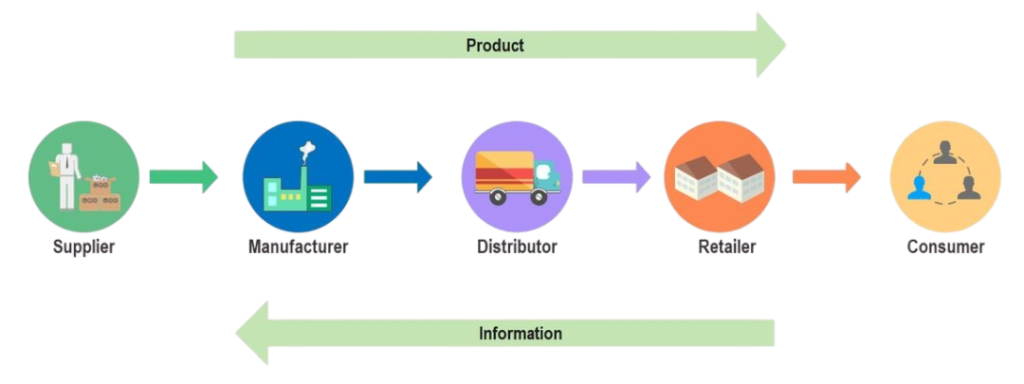
TraceWorthy spent several years designing and refining a beverage business that runs as a network rather than a single company. The business makes and sells a botanical drink. TraceWorthy built it as a joint venture across several entities, with domestic-capital companies, each a PT PMDN, owning the upstream stages, and foreign-capital companies, each a PT PMA (Penanaman Modal Asing, Foreign Investment Company), owning the downstream stages. The supply chain runs in four stages. Domestic capital owns the first two, farming and manufacturing. Foreign capital owns the next two, wholesale distribution and retail distribution. The chain runs from the grower in the field to the product on the shelf, and the structure connects every stage.
The first version of the structure collapsed the stages together in theory and controlled none of them in practice. Ownership was pooled in a way that looked unified on paper and gave no party a defended position, so the chain could come apart at any stage without a remedy. The model TraceWorthy built in its place gives each stage a defined owner and a defined asset, and it protects the domestic partners without taking from the foreign partners the control they require to run the brand and the distribution.
The protection rests on how the intellectual property is distributed. The domestic side owns the farming knowledge, which carries the quality control the crop depends on and the export pathways the growers have built. The foreign side owns the botanical recipes and the brand. Neither side owns the whole, and neither side can run the business without the other, which is the design that locks both into the venture.
A structure of this design is built for the single business it serves. The number of entities, the placement of capital, the distribution of intellectual property, and the governance between the parties were drawn for this chain and this set of partners, which is how TraceWorthy works. It designs each venture to fit the business in front of it, drawn to an international standard for that business alone.
The agreements that build the structure
A venture is only as strong as the documents that constitute it, and the network rests on a set of agreements drafted to fit each stage.

The joint venture agreement governs the relationship across the network. It sits at the apex, and it sets out how the parties co-operate, the way decisions are taken, the ownership and licensing of intellectual property between the entities, and the route by which a dispute is resolved without collapsing the chain. Beneath it, each entity has its own company constitution, the articles that establish the company and define its shares and its organs. A shareholders agreement binds the shareholders of each company to that company’s constitution and to one another within that entity, which is a commitment at the level of the single company rather than across the venture.
A domestic operator should confirm that a joint venture agreement governs the venture, because a shareholders agreement binds only within a single company and leaves the relationship across the network ungoverned.
The people and the operations are documented to the same standard. The directors of each entity give their consents and statements to act, recorded for the company’s deed. Employment agreements engage the people each entity needs, on terms that meet Indonesian manpower law. A manufacturing agreement sits between the PT PMA on the wholesale side and the manufacturer, governing how the product is made and the quality and terms on which it passes into distribution.
The intellectual property is distributed by a combination of assignment and licence, because different parts of the chain own different rights. The farming knowledge, with the quality control and the export pathways it carries, is owned on the domestic side, the recipes and the brand on the foreign side, and licences move the right to use each where the business needs it without moving the ownership. The beverage brand is registered as a trademark with the Direktorat Jenderal Kekayaan Intelektual (DJKI, the Directorate General of Intellectual Property), so the brand the foreign side owns is protected on the public register rather than by private agreement alone.
The distribution end carries its own work. TraceWorthy conducted due diligence on the retail locations before the venture committed to them, and it negotiated the commercial leases for the premises the retail entities occupy. The chain is documented from the field to the shelf, and each agreement governs the stage it belongs to.
Why the domestic partner is usually under-rated
In a foreign investment project, the domestic partner brings what the foreign partner cannot bring from outside, the access to land, the relationships with growers, the knowledge of how the crop behaves, and the route to market inside the country. That contribution is often treated as a service rather than as an asset, priced as a fee and replaced once the foreign partner has learned the ground.
A domestic partner that lets its knowledge be used without owning it inside the structure can be removed from the structure, and projects across the country have removed domestic partners exactly this way. The under-rating is not an accident. It follows from a structure that records the domestic contribution as help rather than as property.
How the structure protects the domestic partner
Supply chain control protects the domestic partner by turning its knowledge from a service into owned property inside the venture. The farming knowledge is registered as an asset the domestic entities own, together with the quality control and the export pathways it carries, rather than as a set of tasks they perform. The foreign partner cannot replace that asset without losing access to the crop and the export route the brand depends on. Ownership of the recipes and the brand keeps the foreign partner equally necessary, so the venture depends on both sides at once. The domestic partner is secure because removing it breaks the chain, and the design makes that plain to every party from the start.
A domestic operator entering a venture should require its contribution to be registered as owned property in the agreements before it signs, rather than recorded as a service it will provide.
Control without breaking competition law
Control across a supply chain meets the law that governs competition, and the structure was tested against that law as it was built. Law No. 5 of 1999 on the Prohibition of Monopolistic Practices and Unfair Business Competition prohibits agreements and conduct that foreclose competition, including exclusive arrangements that shut other parties out and the abuse of a dominant position. The Komisi Pengawas Persaingan Usaha (KPPU, the Business Competition Supervisory Commission) enforces it.
Exclusionary contracts that lock other parties out invite the attention of that law. This structure avoids them, because its control comes from genuine equity and owned intellectual property rather than from contracts that foreclose a competitor, and Indonesian competition law treats agreements connected to intellectual property rights differently from restrictive agreements in general.

The control here comes from ownership. Each party owns real equity and owns real assets, and the venture contains no nominee arrangement and no proxy arrangement, both of which are illegal in Indonesia. Control built on owning real assets sits within the law. The law instead targets the locking of competitors out of a market, which this venture does not do, and whether any given structure stays within the law turns on its specific facts, which is the assessment TraceWorthy carries out as it designs each one. The parties have authority over their own chain without taking authority over the market from anyone else.
Market authority from controlling the chain
Market authority comes from supply chain control rather than from competing at one stage of the chain. A rival that makes a similar drink competes at the manufacturing stage alone, and it depends on growers it does not control and distributors it does not own. The network sets the quality at the farm and carries it through to the shelf through distribution it owns, so the quality a buyer receives is consistent in a way a single-stage competitor cannot guarantee. Pricing follows the same control, because a business that owns its inputs and its route to market is not squeezed between a supplier and a distributor that can each take a margin. Market authority of this kind is durable, because a competitor cannot match it without building or buying the whole chain.
The even-handedness that makes it work
A joint venture survives only when every party trusts the structure, and that trust comes from even-handed advice. TraceWorthy structures the venture so that the domestic partners and the foreign partners each carry a defended position, rather than advising one side to gain at the expense of the other. A design that advantages one party invites the disadvantaged party to leave or to litigate, and the venture built that way does not last. The even-handedness is a feature of the design, because a chain that depends on every party staying in is strongest when every party has a reason to stay.
TraceWorthy builds a structure both sides can trust, and that durability is part of what the domestic partner depends upon.
The services across the life of the business
Structuring a venture is the start of the work rather than the whole of it. TraceWorthy carried this business from formation into operation, and the range of services is the reason a domestic operator engages one firm rather than assembling a different adviser for each stage.

The permits and licensing for each entity were obtained and kept current, so every company in the network operates on a valid basis. Tax was structured across the network, so the entities meet their obligations and the transfers between them are priced and recorded correctly. For the people the entities engage, TraceWorthy put manpower and employment compliance in place and maintained it. Due diligence investigated the land and the premises, and the leases were negotiated on terms the retail entities could carry. Dispute-resolution mechanisms were written into the agreements at the start, so a disagreement is resolved by a defined process rather than by the collapse of the chain.
This is the work a business needs across its life, and the domestic partner experiences the advantage of TraceWorthy performing that work rather than drawing the design and departing. The breadth is the protection, because a chain supported at every stage by the same firm does not fail at the stage no one was watching.
Tracy Wilkinson and the team that designs the structure
A structure of this kind is an output TraceWorthy implements for a single business, and designing it draws on experience across company law, intellectual property, distribution, and the design of joint ventures, and on the judgement to see how a chain fits together before it is built. Tracy Wilkinson has set up and scaled well over two hundred businesses across many sectors and several countries, and the structuring of ownership and intellectual property is work she has done throughout her 40-year career. The advice is delivered by the team she has trained, native Indonesian speakers – highly experienced lawyers, accountants and compliance specialists, who work across legal drafting, finance, tax, and compliance. A full account of Tracy’s record and the work TraceWorthy does can be found in the first article of this series.
When a domestic operator engages TraceWorthy, we will design a structure to protect it, even in a market where the domestic partner is often the party left least protected. It is an area of vulnerability for domestic enterprises, so an expert advisor with the breadth of international experience TraceWorthy delivers is the strategic advantage for such enterprises.
Find your position in the chain
A domestic operator that is entering a joint venture, or that is already inside one, can have its position assessed before the structure becomes difficult to disassemble. TraceWorthy begins with a structuring review that maps the supply chain, identifies the assets the domestic partner should own, tests the structure against the competition law that governs it, and sets the ownership of each link in the chain in agreements a notary can convert into deeds.
To protect your position in a supply chain or a joint venture, contact the TraceWorthy team.
Frequently asked questions
What is supply chain control in Indonesia?
It is ownership or governance across the stages of a supply chain, from the raw input to the point of sale, so that one party sets the terms across the chain rather than accepting the terms at a single stage. For a domestic operator, it means owning the part of the chain that other parties cannot replace, which converts exposure at one stage into authority across the whole.
How does a domestic partner avoid being cut out of a foreign joint venture?
By owning its contribution as an asset inside the structure rather than providing it as a service. When the domestic partner’s farming knowledge, including the quality control and export pathways it carries, is registered as owned property, the foreign partner cannot replace it without losing access to the crop and the route to market. Removing the domestic partner then breaks the chain, which secures its place.
Is controlling a supply chain legal under Indonesian competition law?
Yes, when the control comes from owning real equity and real assets rather than from contracts that lock competitors out. Law No. 5 of 1999 on the Prohibition of Monopolistic Practices and Unfair Business Competition prohibits foreclosure and the abuse of a dominant position, and the Komisi Pengawas Persaingan Usaha (KPPU) enforces it. A structure built on genuine ownership, with no nominee or proxy arrangement, sits within the law.
Who is Tracy Wilkinson?
Tracy Wilkinson is the Founder of TraceWorthy. Her work spans forty years, thirty-five of them in the private sector across for-profit and not-for-profit enterprises in several countries, and four in the public sector on projects she chose in order to bring integrity to the work. She has set up and scaled well over two hundred businesses since 1995, and she has been a business and life coach since 1996. The full account of her record sits in the first article of this series.
Who is TraceWorthy?
TraceWorthy is an advisory firm based in Bali and operating across Indonesia, with a presence in Jakarta. It works in legal drafting, compliance, finance, tax, and immigration, and it advises domestic and foreign-owned companies on building and growing a business. The team are native Indonesian speakers who carry Tracy Wilkinson’s method into each engagement, which is why TraceWorthy describes its team as the client’s team. It carries over one hundred services across the life of a company.
This article provides general information on supply-chain control, joint ventures, competition law, and business structuring in Indonesia as at June 2026 and does not constitute legal, tax, accounting, or other professional advice. Regulations and licensing requirements change, and the position for any individual company depends on its sector, its structure, its agreements, and its circumstances. Obtain advice specific to your circumstances before acting on any point set out above.