

Current as at 25 October 2026.
The costly mistakes when starting a business in Bali happen before incorporation, not after it. A founder who engages a notary before resolving the business classification, the capital structure, the premises and the land has already taken on the risks this article describes. Conditions in 2026 are stricter than the guides written a year ago suggest, because Bali now blocks new foreign-owned companies in a range of classifications, the capital figures are widely misread, and the arrangements some newcomers treat as shortcuts are unlawful. Confirm the classification, the capital, the premises and the land for your own project, and the rest of the process becomes orderly.
What follows sets out the failures we see most often, and the step that prevents each one. It is written for the foreign founder planning a business in Bali, whether a first venture or an addition to an existing group. Each section links to the deeper TraceWorthy article on that topic, so you can move from the pitfall to the detail that applies to your own case.
What is the single most expensive mistake when starting a business in Bali?
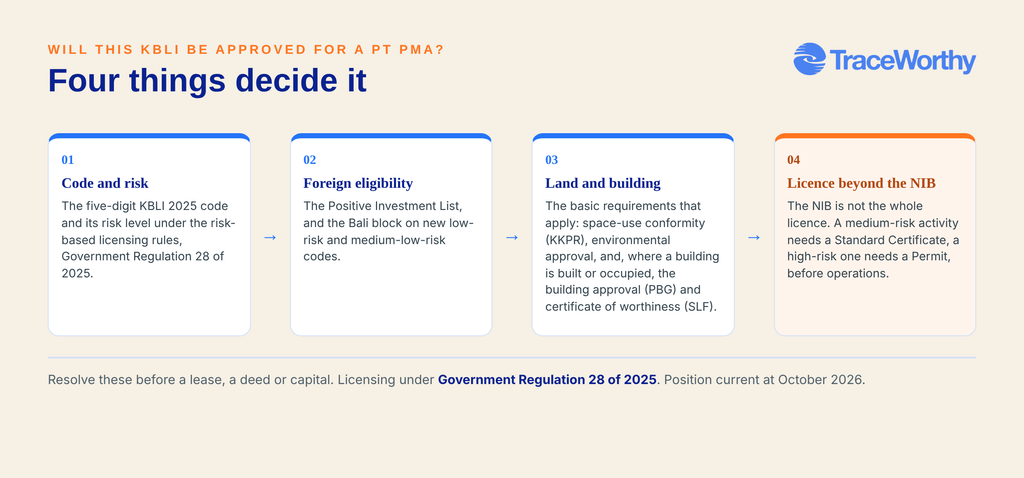
Engaging a notary before the business classification is settled is the most expensive error, because the classification decides almost everything that follows. The Indonesian Standard Classification of Business Fields, known as the KBLI, assigns a five-digit code to each activity, and that code sets the risk level under the risk-based licensing rules (Government Regulation Number 28 of 2025), the eligibility for foreign ownership, the capital expected, the licence the activity needs beyond its business identification number (NIB), and, in Bali, whether a foreign-owned company can register at all. A deed drafted around the wrong code has to be amended, the fees are paid a second time, and the Ministry of Law ratification and the business licence that depend on it are obtained again.
Resolve these before you instruct a notary or commit to a lease:
- the KBLI code and its risk level;
- whether the activity is open to foreign investment under the Positive Investment List, and available to a PT PMA at a Bali address;
- whether the site can meet the basic requirements that apply, the space-use conformity (KKPR), the environmental approval, and, where a building is constructed or occupied, the building approval (PBG) and the certificate of worthiness (SLF);
- the licence the activity needs beyond the NIB, since a low-risk activity operates on the NIB, a medium-risk activity needs a Standard Certificate (Sertifikat Standar), and a high-risk activity needs a Permit (Izin).
The NIB alone does not authorise operations for most activities available to a foreign-owned company in Bali. Our article on forming a new PT PMA in Bali sets out this pre-formation sequence in full. The migration to the 2025 edition of the KBLI closed on 18 June 2026, so advice written against the earlier codes is already out of date, a change covered in our guide to the KBLI 2025 migration.
Why does Bali now reject some foreign-owned company registrations?
Since May 2026, the online single submission system rejects a new foreign-owned company, a PT PMA, that applies at a Bali Province address in a low-risk or medium-low-risk business classification. The Bali Provincial Government requested the control in a letter to the Ministry of Investment in January 2026, the Ministry approved it, and the rejection is now automatic for a covered classification. The provincial government has described the aim as protecting micro, small and medium local enterprises from classifications that were being used as an entry route into local trades.
The classifications affected include self-owned or leased real estate, management consulting, vehicle and motorcycle rental, travel agency activities, and the retail of clothing, textiles and food, among others across the low-risk and medium-low-risk bands. Medium-high and high-risk classifications are not subject to the block, though they still have to clear the Positive Investment List set by Presidential Regulation 10 of 2021. An existing company that already has a valid business identification number can continue to operate, and the provincial authorities have signalled closer inspection of those that remain, so a dormant or thinly staffed company is the one most exposed.
Two responses that look like solutions do not work. Registering the company in Jakarta while the real activity runs in Bali does not avoid the restriction, except in the narrow case where the main activity is truly based in Jakarta. Naming an Indonesian to own the shares does not cure it either, and that arrangement is itself unlawful. Confirm the current status of your intended KBLI code for a Bali address before you commit to a lease or a deed.
How much capital does a PT PMA really require?
The capital question produces two recurring errors: confusing the planned investment with the paid-up capital, and setting the shareholding without planning for the immigration threshold. The figures are distinct, and each has its own source. Under Investment Ministry Regulation Number 5 of 2025, the planned investment value is above IDR 10 billion (ten billion rupiah) for each five-digit KBLI code at each project location, excluding land and buildings, declared through the online single submission system and reported each quarter. The paid-up capital, the money placed into the company, is IDR 2.5 billion (two point five billion rupiah), deposited into an Indonesian corporate account, where it funds the company’s operations and is not available for free withdrawal in the first year.
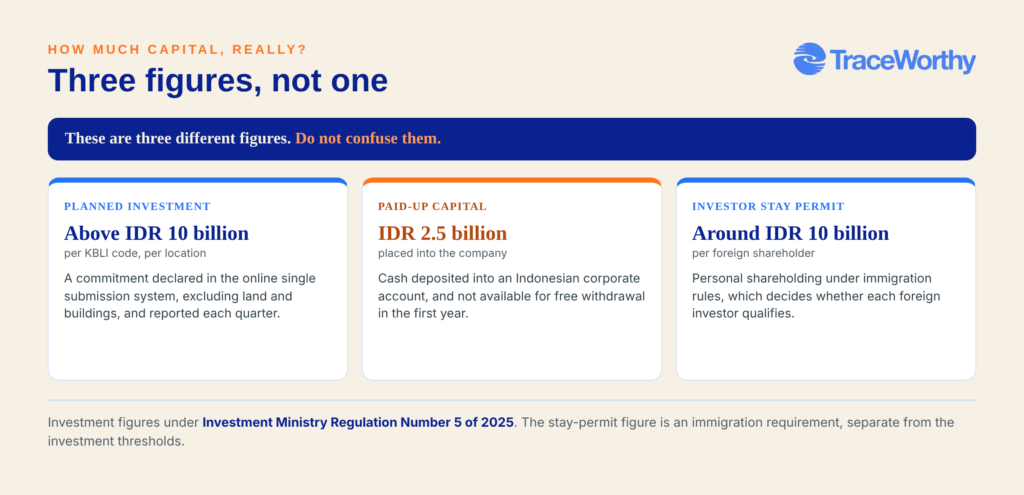
The planned investment is a commitment recorded in the system, not a sum that has to be banked on the first day, while the paid-up capital is cash the company receives. A founder who reads older guidance stating IDR 10 billion (ten billion rupiah) of paid-up capital overstates what is required today, and may abandon a viable plan on a wrong figure. A separate threshold comes from immigration rather than investment: a foreign shareholder who wants an investor stay permit is generally expected to own share capital of around IDR 10 billion (ten billion rupiah) in personal ownership, so the way the shares are divided in the deed can decide whether each foreign shareholder qualifies. Dividing the shareholding without that in view is the error that forces a costly amendment later. A proposal to raise the paid-up figure for Bali specifically has been discussed at the national level, so confirm the current position for your company at the point of formation rather than relying on a figure from a guide. For the compliant route in full, see our article on the foreign founder in Bali.
Is a nominee arrangement or a villa-rental business a lawful shortcut?
Two shortcuts circulate widely in Bali, and both fail. One is the nominee arrangement, where an Indonesian is named as the shareholder or the landowner for a foreigner. Article 33 of the Investment Law voids an agreement that places shares in one person’s name on behalf of a foreigner, so the foreigner is left with a claim no court will enforce, and the company discloses its real beneficial owner under the reporting rules in any event, a duty covered in our article on beneficial ownership reporting. A nominee does not make the hidden control lawful, and it does not cure the Bali classification restriction.
Another shortcut is the daily villa or guesthouse rental run through a foreign-owned company. Short-term accommodation of that kind is reserved for Indonesian micro, small and medium enterprises, and no foreign-ownership classification currently lets a PT PMA operate daily villa rentals, though a hotel operation remains open to foreign investment under the applicable classification and premises rules. Confirm the activity against the current classification for your own case, because the line between a permitted hotel operation and a reserved short-term rental turns on the specific licence. These rules are enforced. The Bali authorities reported 423 company sanctions for licensing breaches across 2025 and early 2026, and Bali Immigration recorded 342 deportations in the first half of 2026, with the monitoring focused on overstay, permit misuse and unlicensed economic activity. A business built on a shortcut meets that enforcement first.
What land and premises checks are skipped too often?
A Bali business needs a real place to operate, and the checks on that place are skipped more often than any other. Begin with the premises. A virtual office address does not meet the physical-premises requirement for a PT PMA, and the provincial authorities treat a virtual-only registration as a marker of a shell company, so an address with no real operation is a standing invitation to inspection. A serviced office or a co-working space with a staffed presence is the workable minimum for a modest operation.
The land needs its own check, and the gap between what a notary does and what a buyer needs is where money is lost. A notary authenticates documents and a land deed official records the transaction, and neither role extends to the investigation a buyer needs, so TraceWorthy performs the land due diligence itself. Every title has to be read with its spatial-planning information, the Informasi Tata Ruang or ITR, which confirms the zoning and the land-use compatibility for the intended use, the same compatibility that the space-use conformity (KKPR) settles for the business licence, and the access and the utilities have to be confirmed separately, because a clean certificate does not authorise building and a title does not include a right of access or a water and power supply. A moratorium announced by the Governor of Bali in September 2025 on converting productive agricultural land to commercial construction adds a further check for any site near farmland. Our article on foreign land ownership in Bali sets out that due diligence in full.
Which obligations trip up a business after it is set up?
Incorporation is the start of the compliance calendar rather than the end of it, and a new business that treats the licence as the finish line meets the next pitfall within a year. Four obligations deserve a place in the plan from the outset:
- the quarterly investment activity report, the LKPM, which the online single submission system expects from a PT PMA, and whose absence moves the company towards supervision and, in time, licence suspension;
- the beneficial ownership report to the company registry, which names the real individual behind the company and has to be kept current, since an out-of-date report can block an ordinary corporate change;
- tax registration and the monthly and annual filings that follow, administered through Coretax, the tax authority’s online system, which apply from the moment the company exists rather than from its first profit;
- any sector duty that attaches to the product or the customer, such as halal certification for a consumable product or the personal data protection rules where the business keeps customer records.
Each of these has a lead time, and each becomes harder to resolve once a deadline has passed. Building them into the first-year calendar, with a named owner for each, turns a cluster of surprises into routine administration. A business that keeps its reports current also keeps the clean record that a bank, an investor or a landlord checks before it deals with the company.
How does TraceWorthy help a founder avoid these pitfalls?
Before a founder commits money, TraceWorthy resolves the pre-formation questions: the KBLI classification and its Bali status, the fit with the Positive Investment List, the capital and the shareholding against both the investment and the immigration thresholds, and the land due diligence where a site is involved. That work is shared among qualified and experienced lawyers, accountants, tax specialists, compliance experts and immigration specialists, with the community, business and people development skills that Tracy Wilkinson brings herself.
The team advises on the cross-border position, Indonesian-qualified practitioners handle questions of domestic law, and a founder receives one coordinated view rather than a set of disconnected opinions.

TraceWorthy works for its clients in Indonesia and overseas, and many engage the team for an Indonesian entity first and return for offshore and international questions as the business grows. With the human-centred approach, a founder works with the same people across the setup and the years that follow, so the background does not have to be explained again each time a new question arises.
Bring your plans to a discussion with TraceWorthy, and the order of work can be set correctly from the start
This article is general information and is current as at 25 October 2026. Indonesian investment, company, land, immigration and tax rules change, and the Bali provincial position is developing, so the result for any business depends on its own classification, site and facts. Obtain advice for your own situation before you act. This article describes common failure modes rather than a checklist to follow unaided, and it is not a substitute for advice on a specific business. It does not constitute legal, regulatory, immigration, tax or financial advice, and it creates no advisory relationship.
Frequently asked questions
Yes, though the available activity is narrower than before. Since May 2026, the online single submission system rejects a new foreign-owned company at a Bali address in low-risk and medium-low-risk classifications, while medium-high and high-risk activities remain open if they clear the Positive Investment List. Confirm the status of your intended classification for a Bali address before you commit.
The paid-up capital is IDR 2.5 billion (two point five billion rupiah), placed into an Indonesian corporate account. That is separate from the planned investment value, which is above IDR 10 billion (ten billion rupiah) for each KBLI code at each location, excluding land and buildings. An older figure of IDR 10 billion paid-up capital is from a superseded rule and overstates what is required today.
No foreign-ownership classification currently lets a PT PMA operate daily villa or guesthouse rentals, because that short-term accommodation is reserved for Indonesian micro, small and medium enterprises. A hotel operation remains open to foreign investment under the applicable classification and premises rules, so confirm the specific activity and licence for your own case.
A nominee arrangement is not lawful. Article 33 of the Investment Law voids an agreement that places company shares in another person’s name for a foreigner, so the foreigner is left with a claim the courts will not enforce, and the company discloses its real beneficial owner under the reporting rules in any event. A nominee does not cure the Bali classification restriction.
Not for most activities. The business identification number (NIB) is the base registration, and the risk level decides what else is needed before the business may operate: a low-risk activity operates on the NIB, a medium-risk activity needs a Standard Certificate, and a high-risk activity needs a Permit. In Bali, where low-risk and medium-low-risk codes are closed to a new foreign-owned company, the available activities need a licence beyond the NIB.