

Current as at 24 October 2026.
How do you check whether your beneficial ownership report is correct?
Your beneficial owner, the pemilik manfaat, is the real individual who ultimately owns, controls or benefits from the company, and your report names that person to the Directorate General of General Legal Administration (AHU) through the AHU Online system. To check the report, identify that individual, test the conclusion against the criteria, and reconcile the declaration with the supporting documents. A company owned by one or two named individuals faces a short confirmation. A layered or cross-border structure is a larger piece of work.
Start this month with a concrete step. Open the latest filing, confirm who it names and on what basis, and check that AHU Online access is open, because a blocked account stops the company from filing ordinary corporate changes. Where the named person or the basis looks wrong, or where the arrangement has changed since the previous filing, treat that as the start of a review rather than a quick edit.
A business can keep the same trading name and the same directors while the economic arrangement behind it changes. A new investor may negotiate appointment rights, a parent company may change owners, or an earlier declaration may have rested on incomplete information. Reviewing the underlying arrangements gives the company a reasoned answer when its records are checked, rather than a name copied forward without explanation.
Who counts as a beneficial owner of an Indonesian company?
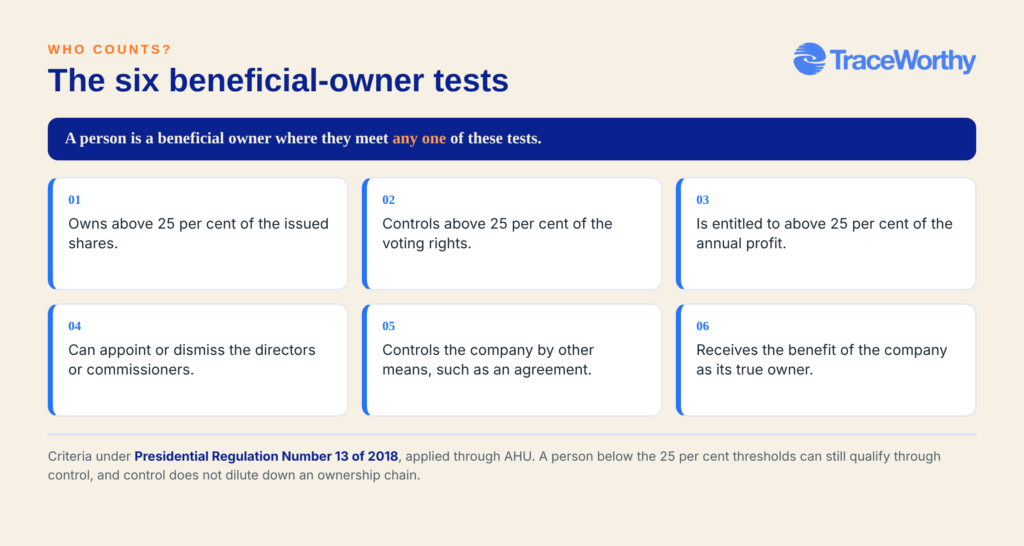
A person is a beneficial owner where they meet any one of these tests, and not only where they meet all of them. Under Presidential Regulation Number 13 of 2018, applied through AHU, the tests for a company are that the person:
- owns above 25 per cent of the issued shares;
- controls above 25 per cent of the voting rights;
- is entitled to above 25 per cent of the annual profit;
- can appoint or dismiss the directors or commissioners;
- controls the company by other means, such as an agreement; or
- receives the benefit of the company as its true owner.
Any one of these makes a person a beneficial owner, so a person below the 25 per cent thresholds can still qualify through control, and the named director is not automatically the answer. For an indirect interest, multiply the percentages along each branch to find the economic interest. Trace control separately, because control does not dilute down a chain: a person who controls each company in a chain controls the company at the end, whatever the percentages multiply to.
How do you trace a layered or overseas structure?
Build the ownership chart from the company upward, one level at a time, until each branch ends at an individual. At each level, record the entity, its owners and the percentage each one owns, multiply the percentages along a branch for the economic interest, and test control at each level on its own. A branch that ends at a foreign company needs the same treatment in that jurisdiction, using the local register and, where available, that country’s own beneficial ownership record.
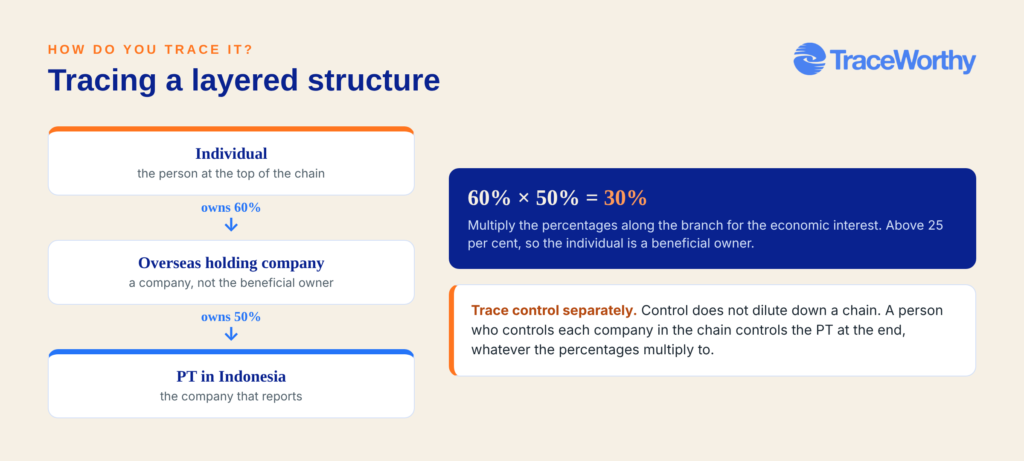
Use a foreign register as a source of the ownership facts, and then test those facts against the Indonesian criteria, because a foreign register answers its own country’s question under its own thresholds, which do not match Indonesia’s. Some branches end at a foundation, a trust or a similar arrangement rather than a company. In that case, identify the people who control it or benefit from it, because the reporting concept reaches the individual behind the structure rather than stopping at the entity. Where a branch cannot be completed from the documents available, record the gap and the person responsible for closing it, so the chart shows what is known and what is outstanding rather than presenting a guess as a conclusion.
What changed under the verification rules?
Ministry of Law Regulation Number 2 of 2025 took effect on 4 February 2025 and replaced the 2019 reporting rules. It requires a corporation to determine its beneficial owners, maintain supporting documents, update the information annually, and complete the relevant questionnaire. It provides for verification by the corporation, notaries, the minister and other competent authorities within their respective roles, and it allows the minister to determine the beneficial owner where the corporation’s report differs from the findings.
A later regulation tightened the link between the declaration and everyday filings. Ministry of Law Regulation Number 49 of 2025, in force from 17 December 2025, treats the beneficial ownership information as a required element when a company is established, amends its articles, or changes its corporate data, and it subjects those filings to substantive verification through the company administration system. The beneficial ownership record is now part of the filings a company cannot complete without, so an out-of-date report can delay an ordinary corporate change, and not only a compliance review.
For the business owner, the operational consequence is that a declaration needs an evidence trail. Someone should be able to explain how each person was identified, which criterion applied, and what documents support that conclusion. An old submission receipt establishes that something was filed, while leaving those questions unanswered. Where the company finds a mismatch itself, preserve the previous record and work through a documented correction with advice, because replacing one name without understanding why it was wrong can leave the next reviewer with the same problem.
Where do declarations most often go wrong?
A few errors recur in these declarations, and each has a straightforward remedy once it is named:
- a corporate shareholder is recorded as the owner, and the chain behind it is never traced to an individual;
- control exercised through a shareholder agreement or appointment right is overlooked because the share register looks ordinary;
- an undisclosed arrangement puts real control with someone who is not on the register, which the reporting rules exist to surface;
- an earlier declaration is copied forward each year without anyone re-testing whether it is still accurate.
The undisclosed-arrangement case needs particular care. Nominee and proxy arrangements are unlawful in Indonesia, because Article 33 of the Investment Law voids an agreement that places share ownership in one person’s name for and on behalf of another. A nominee arrangement does not make the hidden control lawful, and it does not remove the duty to identify the true owner. That creates a trap worth naming. An honest declaration that identifies the real controller is also a dated record, filed with the State, of an arrangement the law prohibits, so where a nominee structure exists the right order is to put the structure right, by restructuring or regularising the shareholding with advice, before or as part of the declaration, rather than to file it as it stands and treat the question as settled.
What belongs in the evidence file?
The file should scale to the structure. A company owned by one or two named individuals needs little beyond the deed, the register and a short note of the basis for each person. A layered or foreign-owned company needs the ownership chart, the shareholder agreements and the chain documents, kept with secure access because these records contain personal information.
For each proposed beneficial owner, write a short explanation of the criterion relied on and the source of the conclusion. Where the company has an overseas shareholder, record how the chain was traced. Where a document is unavailable, identify the gap and the person who must obtain it, rather than treating the absence of evidence as proof that nobody qualifies.
Keep the filing acknowledgement and the underlying assessment together. Record the review date, the person who prepared it and the person who approved the conclusion internally. These are governance practices that make the statutory work reproducible, and they do not replace the required forms or professional verification. A folder named notary documents that contains several conflicting versions gives a new director little help in deciding which record is current.
What does a defensible declaration look like?

TraceWorthy treats a defensible declaration as one that meets a single standard. It names an individual for each criterion that applies, keeps a document behind each name, records a dated review and an internal approver, and agrees with the deed, the ownership chart and the filing, so a reviewer who starts from any one of those reaches the same people. Where a judgement was finely balanced, the file records the reasoning rather than only the result.
This standard is modest to meet for a simple domestic company, and it is a larger piece of work for a layered or foreign-owned one, which is the company most likely to be asked for it. The business that can produce it answers a bank, a tax office, or an investor from one file, and it treats the annual update as a short confirmation rather than a fresh investigation each year.
When should the information be reviewed?
The annual update is a recurring obligation, and it is a re-test rather than a copy-forward. A share of profit can cross the 25 per cent line from one year to the next because the company’s distributable profit or a dividend arrangement changed, with no change to the share register at all, and the annual update is the check that catches a beneficial owner created that way. A transaction or a change in rights should also prompt an assessment of whether the information needs to change.
Build the check into the preparation for a share transfer, a new investment, a restructuring or a succession. Confirming that the beneficial ownership report has been accepted, and that AHU Online access is open, is necessary, and it is separate from the filing that makes a transaction legally effective. A share transfer takes effect when the change of shareholder data is recorded by the minister through the company administration system, which is a different filing from the beneficial ownership declaration, so a transaction-readiness check covers both. Where records differ, establish which change occurred and what still needs to be corrected before the transaction depends on them.
An annual calendar entry works better when it names an owner and the evidence required. Asking an administrator to renew the beneficial ownership report, without providing current ownership and control information, turns a substantive assessment into a guessing exercise.
Can incomplete reporting affect corporate services?
The 2025 regulation provides three administrative sanctions: a warning, blacklisting on the official website, and the blocking of AHU Online access. AHU Online is the gateway for most corporate filings a notary makes for the company, so a block does not only delay a single report, it suspends the company’s capacity to transact through the system. A company planning an urgent corporate action should therefore check its position well ahead, because a block discovered on the day of a transaction is difficult to resolve at speed.
If access is blocked, establish the reason through the official process and confirm the current correction requirements before you act, because those requirements change. Reopening is handled manually, and the time it takes is not fixed, so a transaction that depends on the system needs a buffer measured against the worst case rather than a single week. A company is generally asked to supply its proof of report, a statement letter and a power of attorney, and this article does not quote a reopening fee or a processing time, because those depend on a current case-specific check.
How does this connect to capital and due diligence?
TraceWorthy’s recent article on paid-up capital examines whether company records agree with the financial evidence. That discipline applies here. Compare the declaration with the real arrangement, identify the inconsistencies, and correct them through the proper process. A company that keeps its capital records and its ownership records on the same evidence standard presents one coherent story to a tax office, a bank or an investor, and that coherence is what a reviewer looks for first.
For an investor, a clear beneficial ownership file frames the due-diligence questions and shortens the review. For existing owners, it reduces the chance that a corporate change becomes the first occasion on which nobody can explain the records, and it keeps the discussion grounded in documents when several advisers have handled the company at different times. Bring the current ownership chart, the agreements and the latest acknowledgement to a discussion with TraceWorthy if you need to reconcile the position.
This article is general information and is current as at 24 October 2026. Corporate rules and filing procedures change, and the position for any company depends on its own structure and facts, so obtain advice for your own situation before you act. This article does not constitute legal advice, and it creates no advisory relationship.
Frequently asked questions
The reporting concept concerns individuals. Where shares are owned through another entity, assess the chain and the relevant control or benefit criteria to identify the appropriate people behind it.
A shareholding above 25 per cent is one test. The rules also use voting, profit, appointment and control tests, and any one of them qualifies a person, so the percentage alone does not settle it, and a person below the threshold can still qualify on control.
No, the rules require annual updating, and a change in the underlying position needs assessment and the appropriate reporting action. An incorporation filing is the start of the obligation rather than the end of it.
The rules assign verification roles to both corporations and notaries. The company still supplies the information and keeps the records, and the test TraceWorthy applies is whether the declaration meets the defensible-declaration standard: a named person for each criterion, a document behind each name, a dated review, and an approver.