

Why paid-up capital in Indonesia can create corporate, investment and tax exposure when company records do not reconcile
An Indonesian limited liability company may have corporate records showing that a specified amount of capital has been placed and fully paid, while its banking and accounting records show a lower contribution. This issue can arise in both foreign investment companies, or PT PMAs, and domestic investment companies, or PT PMDNs.
The applicable investment rules differ between the two. PT PMAs have been subject to specific foreign investment capital requirements that changed materially in 2018, 2021 and 2025. PT PMDNs operate under the general company capital framework together with any sector-specific or other requirements applicable to the business.
The underlying corporate and tax question is broader:
Can the company substantiate the amount recorded as paid-up capital,
and what does any unexplained shareholder balance actually represent?
In brief
A PT PMA or PT PMDN may have corporate records showing that capital was fully paid while its financial records show a lower contribution.
The resulting discrepancy can affect the company’s corporate records, accounting treatment, investment reporting, Coretax disclosures and related-party tax position.
For PT PMAs, the historical foreign investment capital rules add another layer because the minimum capital requirement has changed over time.
Tax treatment depends on the transactions that created the balance and the evidence available to support them.
Paid-up capital in Indonesia: the corporate rule for PT PMAs and PT PMDNs
Government Regulation No. 8 of 2021 provides that at least 25 per cent of a limited liability company’s authorised capital must be placed and fully paid, supported by valid evidence of payment. The amount of authorised capital is generally determined by the founders, although companies operating in business activities governed by separate capital requirements must also comply with those requirements.
This general company-law framework applies to Indonesian limited liability companies regardless of whether their investment status is PMA or PMDN.
Current corporate-registration rules also recognise several forms of evidence for cash capital contributions.
Article 6 of Ministry of Law Regulation No. 49 of 2025 permits evidence including a deposit slip, a bank certificate in the company’s name or a joint account of the founders, or an original declaration stating that the company’s capital has been contributed and signed collectively by all directors, founders and commissioners.
A signed declaration therefore has a recognised role in the corporate-registration process.
When the financial history of an existing company is reviewed, the deed, declarations, shareholder records, bank movements and accounting records may all be relevant to establishing what capital was actually contributed.
The first question for any PT
What amount is currently recorded as placed and paid-up capital, and what evidence supports the contribution of that amount?
PT PMAs have an additional investment-capital history
The foreign investment capital rules have changed several times.
| Regulatory period | General minimum placed and paid-up capital for a PT PMA |
|---|---|
| BKPM Regulation No. 6 of 2018, as amended | IDR 2.5 billion |
| BKPM Regulation No. 4 of 2021, effective 2 June 2021 | IDR 10 billion |
| Minister of Investment and Downstream Industry/Head of BKPM Regulation No. 5 of 2025, effective 2 October 2025 | IDR 2.5 billion per PT PMA |
PT PMAs established or recapitalised during these periods can therefore have different capital amounts recorded in their corporate documents.
The current Regulation No. 5 of 2025 also retains a separate general minimum investment requirement exceeding IDR 10 billion per five-digit KBLI business activity per project location, excluding land and buildings, subject to specific calculation rules for certain business activities.
The current IDR 2.5 billion figure concerns the general minimum placed and paid-up capital for a PT PMA. The minimum investment-value requirements are separate.
A reduction in the regulatory minimum also does not automatically change a company’s existing articles of association. Ministry of Law Regulation No. 49 of 2025 treats a reduction of placed and paid-up capital as an amendment requiring ministerial approval.
What is different for a PT PMDN?
The PT PMA-specific IDR 2.5 billion minimum in BKPM Regulation No. 5 of 2025 does not apply to a PT PMDN merely because it is an Indonesian limited liability company.
A PT PMDN is generally governed by the company capital framework under PP No. 8 of 2021, together with any separate capital requirements applying to its particular business activity. A domestic company can nevertheless have the same underlying discrepancy.
For example, a PT PMDN deed may state that IDR 5 billion has been placed and fully paid while the company’s records substantiate shareholder contributions totalling IDR 3 billion.
The IDR 2 billion difference requires investigation for the same fundamental reason as a discrepancy in a PT PMA: the company’s registered capital position and its financial history do not fully reconcile.
The tax analysis discussed below can apply to both forms of company.
Paid-up capital, investment value and LKPM perform different functions
For PT PMAs, several figures can appear across the company’s records.
| Item | What it relates to |
|---|---|
| Placed and paid-up capital | Equity recorded as contributed to the company |
| PMA investment value | Investment calculated under the applicable foreign investment requirements |
| LKPM investment realisation | Investment expenditure and realisation reported through the investment reporting system |
Under BKPM Regulation No. 5 of 2025, LKPM reporting records investment realisation according to the prescribed reporting categories, including fixed-capital expenditure and, where applicable, working capital.
These figures should be reviewed according to their individual regulatory definitions.
For PT PMDNs that are subject to LKPM reporting requirements, the same principle applies to the relationship between corporate capital and reported investment realisation.
The exercise is therefore one of reconciliation rather than simply expecting every system to contain the same number.
A simple example
Consider a company whose deed records:
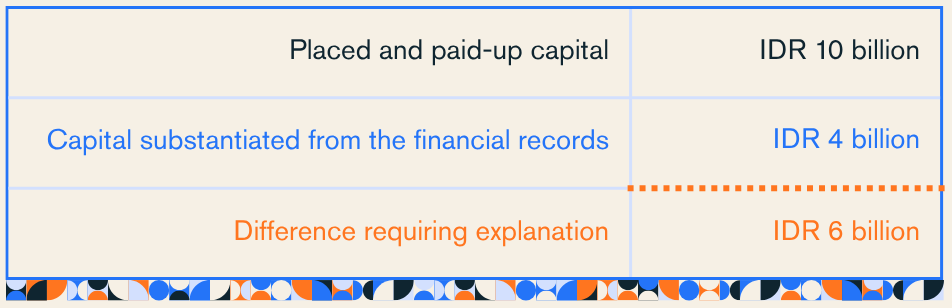
For a PT PMA, the IDR 10 billion figure may have arisen during the regulatory period beginning in June 2021.
For a PT PMDN, the amount may simply reflect the capital structure adopted by its shareholders.
In either case, the IDR 6 billion needs to be traced.
The company’s accounting records may describe it as unpaid capital, a shareholder receivable, piutang pemegang saham, another receivable or an opening balance carried forward from an earlier period.
The next task is to establish which transactions created that balance.
Three situations that require different tax analysis
1. A shareholder did not contribute all of the capital recorded as paid
Suppose a company’s deed records IDR 10 billion as placed and paid-up capital while the financial records substantiate shareholder contributions of IDR 4 billion. The remaining IDR 6 billion appears as a receivable from the shareholder. This factual situation can arise in either a PT PMA or PT PMDN.
Despite social media reporting, available legislation does not contain a general provision converting every unpaid capital balance into an ordinary shareholder loan. Indonesian Tax Court research is relevant here though.
A 2025 study by Dian Tri Handayani, Lith Alfansuri and Sekar Mayangsari examined Tax Court decisions involving interest-free related-party financing. The researchers identified cases where shareholder receivables represented capital contributions that had not been fully paid even though the deed recorded the share capital as fully paid.
The Directorate General of Taxation (DJP) lost both decisions in that category.
According to the study, the judicial panels accepted evidence that there had been no corresponding inflow of funds and that the receivable represented a shortfall in paid-in capital.
These reported outcomes provide useful evidence about the treatment of this fact pattern. They remain findings from an academic analysis of individual Tax Court decisions and do not create a statutory rule for every company.
2. A shareholder separately lends money to the company
A separate issue arises where a shareholder has an outstanding capital obligation and also transfers funds to the company as an interest-free shareholder loan. This rule is relevant to both PT PMAs and PT PMDNs.
Article 12 of Government Regulation No. 94 of 2010 applies to an interest-free loan received by a taxpayer in the form of a limited liability company from its shareholder. Four cumulative conditions must be satisfied.
- The funds must belong to the lending shareholder and must not have been obtained from another party.
- The capital required to be contributed by that shareholder must have been fully paid.
- The lending shareholder must not be in a loss position.
- The borrowing company must also be experiencing financial difficulty affecting continuation of its business.
Where the requirements are not satisfied, Article 12(2) provides that the loan bears interest at a reasonable rate for tax purposes.
The requirement for the lending shareholder’s capital contribution to have been fully paid has obvious relevance where an unpaid capital balance already exists. A company can therefore have an unresolved capital contribution and a separate shareholder financing arrangement at the same time. Each requires its own accounting and tax treatment.
3. The company transferred funds to a shareholder or affiliate
Related-party financing also arises where a PT PMA or PT PMDN transfers funds to a shareholder, parent company or another affiliated party.
Article 18(3) of the Income Tax Law gives DJP authority to redetermine income and deductions in related-party transactions according to the arm’s-length principle. Minister of Finance Regulation No. 172 of 2023 provides the current detailed framework for transactions influenced by related-party relationships. Its application is based on the existence of a related-party relationship and the transaction involved. Foreign investment status is not a prerequisite.
For related-party loan transactions, the regulation requires examination of matters including the commercial need for the financing, use of the funds, legal and economic recognition of the debt, maturity, principal repayment obligations, repayment schedules, borrower capacity, loan documentation, consequences of default, creditor rights and the economic benefit received by the borrower. These elements provide a framework for examining the actual financing arrangement.
What evidence can become relevant?
Banking records can establish the dates, amounts and direction of transfers.
Accounting records can show how capital contributions and shareholder balances were classified over time.
Corporate documents can establish what the shareholders formally agreed to contribute.
Financing documents can establish whether separate transactions were intended to operate as loans.
Tax records can show how related-party balances were reported to DJP.
Investment records can assist with reconciliation of OSS and LKPM information where those reporting requirements apply.
What the Tax Court research shows
The Handayani, Alfansuri and Mayangsari study identified different outcomes according to the facts surrounding related-party balances.
Unpaid capital recorded as shareholder receivables
Cases identified by the researchers: 2
DJP outcome: lost both
The researchers report that the judicial panels accepted evidence showing that the balances represented capital contributions that had never been received.
Funds transferred to affiliates for proposed future capital contributions
Cases identified by the researchers: 5
DJP outcome: succeeded in all five
The study reports actual transfers of funds to affiliated parties in this group of cases.
The comparison makes the transaction history particularly important. The financial records need to establish whether money was never contributed, whether money entered the company and was later advanced elsewhere, or whether a separate financing transaction occurred.
Why the issue deserves attention in 2026
Indonesia’s current corporate income tax return captures information relevant to shareholder capital and related-party financing. DJP’s Coretax corporate-return framework includes shareholder and paid-in capital information together with specific sections covering investments in, debts to and receivables from affiliated parties.
These reporting requirements apply according to the taxpayer’s circumstances rather than according to PMA status alone. A PT PMDN with related-party balances can therefore face the same Coretax disclosure and related-party tax questions as a PT PMA.
The available official material does not establish a specific national automated process designed to identify unpaid capital by cross-matching AHU, OSS, LKPM and banking records.
The current supervision framework
Minister of Finance Regulation No. 111 of 2025 took effect on 1 January 2026 and provides the current framework for taxpayer compliance supervision based on data and information available to DJP. Supervision can involve requests for explanations, discussions, visits, supporting information and transfer-pricing documentation where applicable. One mechanism is an SP2DK, or Surat Permintaan Penjelasan atas Data dan / atau Keterangan (Letter of Request for Explanation of Data and / or Information).
Received an SP2DK about capital or a shareholder balance?
A taxpayer generally has up to 14 days to respond under the current framework.
A written extension of up to seven additional days may be available where the applicable requirements are met.
The company should identify the period and amount DJP is questioning, reconstruct the shareholder contributions and other fund movements, and gather the corporate, banking, accounting and tax records supporting its explanation.
The purpose of the response is to explain what occurred using evidence that corresponds with the company’s records.
What could the corporate income tax exposure be?
Where DJP validly determines that a related-party financing transaction should have produced arm’s-length income, the resulting adjustment can increase the taxable income of either a PT PMA or PT PMDN.
The general Indonesian corporate income tax rate is 22 per cent in 2026. The resulting tax payable depends on the company’s wider tax position, including available tax facilities, losses and other relevant adjustments.
Withholding tax requires its own analysis
The appropriate withholding treatment depends on the financing arrangement and the parties involved.
- For a PT PMA, the related party may be an overseas shareholder, which can introduce PPh Article 26 and tax treaty considerations.
- A PT PMDN may have domestic shareholders or affiliates, which can produce different withholding consequences.
The legal character of the payment, the identity and tax residence of the recipient, and the applicable withholding provisions need to be established before the tax treatment is determined.
Does every company need full transfer-pricing documentation?
PMK No. 172 of 2023 contains specific thresholds for Master File and Local File requirements. The thresholds apply to taxpayers with related-party transactions according to factors including previous-year turnover, the type and value of related-party transactions and the tax jurisdiction of the affiliate. The arm’s-length principle can continue to apply where the formal Master File and Local File thresholds are not met.
This framework applies to qualifying PT PMAs and PT PMDNs.
Capital reconciliation checklist
A review of paid-up capital in Indonesia should bring the company’s corporate, financial, investment and tax records into one exercise. A PT PMA or PT PMDN can begin by reviewing the records that establish its corporate and financial history.
| Record | Question to answer |
|---|---|
| Deed and amendments | What amount is currently recorded as authorised, placed and paid-up capital? |
| Capital-payment evidence | What evidence supports each contribution recorded as paid? |
| Shareholder register | What shares and payments are recorded for each shareholder? |
| General ledger | How were capital contributions and outstanding shareholder balances recorded? |
| Financial statements | What shareholder or affiliate debts and receivables appear? |
| Bank statements | What funds moved between shareholders, affiliates and the company? |
| Loan agreements | Which transactions were intended to constitute financing? |
| Coretax return | What shareholder capital and affiliate balances have been reported? |
| OSS records | What company and investment information is currently recorded? |
| LKPM, where applicable | What investment realisation has been reported? |
The review should produce a dated reconciliation showing the amount recorded as capital, the contributions that can be substantiated, later shareholder or affiliate transactions, the accounting treatment applied to those balances and any unresolved differences.
What can be done when the records do not reconcile?
The appropriate response depends on the factual history.
Subscribed capital remains unpaid
The company should establish the amount actually contributed and gather the evidence supporting those contributions. Possible further work can include additional capital contribution or examination of whether a formal capital reduction is appropriate.
- For a PT PMA, any proposed capital reduction also needs to be tested against the current foreign investment capital requirements.
- For a PT PMDN, the company must consider the general company-law requirements and any additional capital rules applying to its business activity.
A genuine shareholder loan exists
The company should review the source and direction of the funds, loan documentation, repayment obligations, interest treatment, Article 12 of PP No. 94 of 2010 where applicable, PMK No. 172 of 2023 and the relevant withholding-tax position.
Company money was transferred to an affiliate
The purpose and terms of the transaction should be established from the financial and contractual records and reviewed under the related-party tax rules.
Historical accounting does not accurately describe the transactions
The financial history should be reconstructed from the available evidence before corrections are made. Corporate, accounting, investment and tax records can then be addressed according to the transactions that actually occurred.
The question every company owner should be able to answer
Can your company reconcile the paid-up capital recorded in its corporate documents with evidence showing what its shareholders actually contributed?
For many PT PMAs and PT PMDNs, the records will provide a straightforward answer. Other companies may identify unpaid capital, subsequent contributions, separate shareholder financing or balances requiring further investigation.
The Tax Court research examined for this article demonstrates the importance of fund movements and supporting evidence in related-party disputes. Indonesia’s current tax reporting and supervision framework also places shareholder capital and related-party financial balances within formal reporting and review processes.
How TraceWorthy can assist
TraceWorthy works with both PT PMAs and PT PMDNs.
A Business Health Check can review the company’s deed and amendments, capital-payment evidence, shareholder accounts, financial statements, banking history, Coretax reporting, OSS information and LKPM records where applicable.
Where a discrepancy is identified, the review can establish the transaction history and identify the work required. Depending on the circumstances, this can include corporate amendments, capital contributions, accounting corrections, related-party financing analysis, tax review or preparation of an SP2DK response.
If the paid-up capital recorded for your company cannot be readily reconciled with its financial records, schedule a consultation with TraceWorthy or request a Business Health Check.
The immediate objective is to establish the company’s documented position and identify any corrective action required under the applicable Indonesian corporate, investment and tax rules.
Regulatory position reviewed as at 6 October 2026. This article provides general information. Indonesian corporate, investment and tax treatment depends on the facts, documentation, business activity and transactions of the individual company.