

Current as at 24 October 2026.
A foreign investor in Indonesia receives a letter from the tax office concerning the company’s capital. The letter is a Surat Permintaan Penjelasan atas Data dan/atau Keterangan (SP2DK, a request for an explanation of data and information). It asks for an explanation and is a supervision step ahead of any assessment. The tax office raises a claim to interest on capital that was recorded as paid and may not have been.
We wrote this for the foreign shareholder who has an Investor ITAS, a limited stay permit granted to a foreign investor on the strength of the shares owned, as well as the director who signed the company’s deed, the accountant who prepared the return, and the adviser answering a tax letter for a client. It covers the claim the tax office makes and why the funding gap arises. It sets out the right to answer the letter and to appeal an assessment.
What the tax office is chasing
Where a company records capital as issued to a shareholder and the money was not paid in, the company has a receivable from that shareholder, which in plain terms is money the shareholder still owes the company for the shares. Under the arm’s length principle in Article 18(3) of the Income Tax Law and Minister of Finance Regulation Number 172 of 2023, which requires related parties to deal with each other as unconnected parties would, a receivable between related parties should earn interest at a market rate. The tax office treats the company as having earned interest income on the unpaid balance and taxes that income.
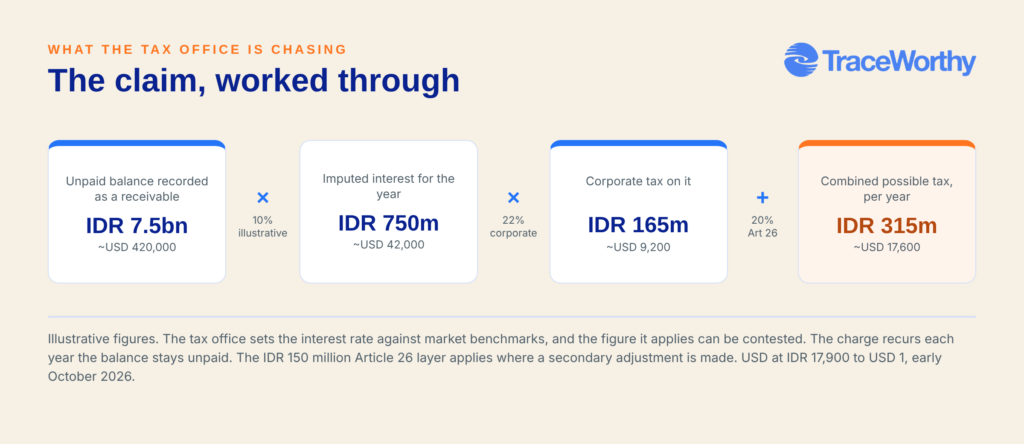
What is at stake is the interest on the unpaid balance, which comes to around IDR 165 million a year in the worked figures. The IDR 10 billion of capital is not what the letter demands.
Consider the figures for an investor registered with IDR 10 billion of shares for the permit, of which IDR 2.5 billion was paid and IDR 7.5 billion was recorded as paid on a directors’ statement:
| Item | Amount (IDR) | Indicative USD |
|---|---|---|
| Shares registered for the permit | 10 billion | 560,000 |
| Paid into the company | 2.5 billion | 140,000 |
| Recorded as paid, a receivable from the investor | 7.5 billion | 420,000 |
| Imputed interest for the year, at 10 per cent | 750 million | 42,000 |
| Corporate tax on it, at 22 per cent | 165 million | 9,200 |
| Possible withholding on a deemed dividend, at 20 per cent | 150 million | 8,400 |
| Combined possible tax for the year | around 315 million | 17,600 |
Imputed interest is interest the law treats as earned, though no cash was received. The corporate tax of around IDR 165 million is the charge in a year where the company is in profit, and where the company has losses brought forward, the imputed income reduces those losses and defers the cash tax. The charge recurs for each year the IDR 7.5 billion stays unpaid, so a balance left unfunded for several years produces several years of tax, and only funding the balance stops it. TraceWorthy reads an SP2DK of this kind as a claim to interest on an unfunded balance under Article 18(3) and Minister of Finance Regulation Number 172 of 2023.
A transfer-pricing correction can have a further consequence. Where the tax office adjusts the company’s income under Minister of Finance Regulation Number 172 of 2023, it can treat the benefit the shareholder received as a deemed dividend, which is a distribution the tax office treats as made to the shareholder though none was declared. For a foreign shareholder, that deemed dividend attracts Article 26 withholding tax, the tax withheld on income paid to a non-resident, at 20 per cent or a lower treaty rate. On those figures, that layer is around IDR 150 million, so the combined tax for the year can reach around IDR 315 million. The correction and the withholding can be averted where the taxpayer repatriates the corresponding funds to Indonesia under the same regulation.
A second route reaches a similar result from the other direction, and it falls on a different taxpayer. Where a shareholder lends the company money with no interest, Government Regulation Number 94 of 2010 (as amended by Government Regulation Number 45 of 2019), Article 12, accepts the interest-free treatment only where four conditions are met together, one of which is that the shareholder’s capital has been paid in full. Where the capital is unpaid, that condition fails, and the loan is treated as bearing a market rate. The imputed interest on that loan is income of the shareholder who made it, and for a foreign shareholder it attracts Article 26 withholding tax at 20 per cent, or a lower treaty rate. That is a deemed-interest charge on the shareholder, distinct from the deemed-dividend charge above, though both reach a foreign shareholder through Article 26. An investor whose capital is unfunded, and who also lends the company money without interest, meets both routes together, on two separate tax bases.
Immigration capital and company capital
The gap the tax office is chasing has an immigration driver, and investors routinely confuse the immigration figure with the company figure.
To obtain or renew an Investor ITAS, the foreign individual owns shares with a nominal value of at least IDR 10 billion registered in their own name in the company deed. A foreign-owned company answers to three separate figures, set out here:
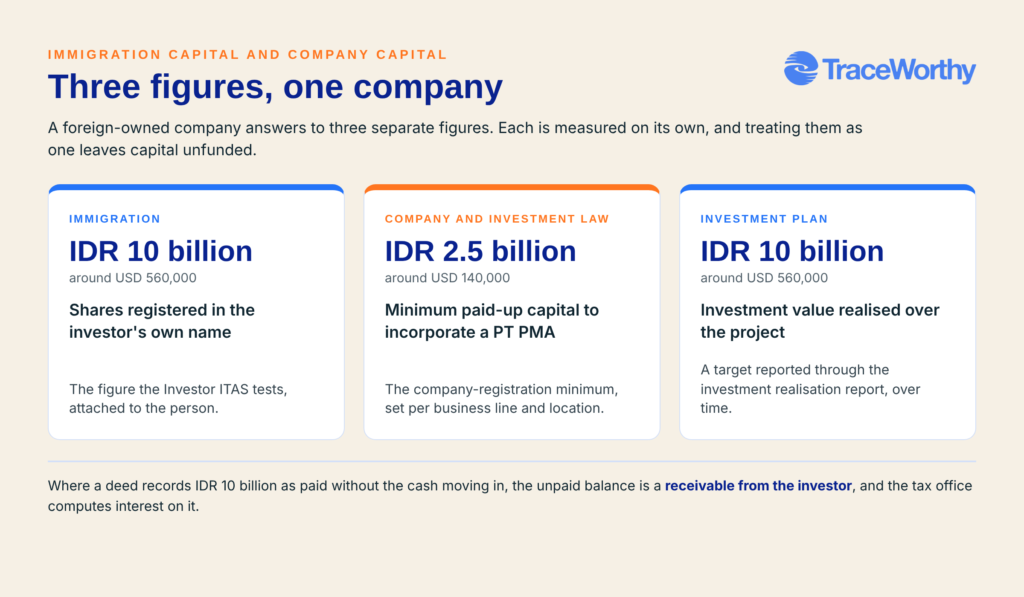
Paid-up capital is the money paid into the company for its shares. Under the investment rules in BKPM Regulation Number 5 of 2025, the IDR 2.5 billion is the minimum to incorporate, set per business line and per location. The investment value of IDR 10 billion is a target realised over the life of the project, also set per business line and per location. The funding obligation attaches to the shares the company has issued. Indonesian company law does not allow partly-paid shares, so once IDR 10 billion of shares is issued in the investor’s name, the company funds the full IDR 10 billion, and the IDR 2.5 billion minimum does not discharge that obligation.
The deed can record IDR 10 billion as paid because the registration process accepts a directors’ signed statement as proof of payment under Ministry of Law Regulation Number 49 of 2025, without a bank record. Where the money was not paid, the unpaid balance is a receivable from the investor, and the tax office computes interest on that receivable. Company law allows the shares to be paid for in money or in kind. Where the investor settles the subscription with appraised assets, an in-kind contribution (inbreng) valued by an independent appraiser, the shares are paid in full and the permit shareholding is satisfied, and no cash receivable arises. Meeting the separate investment value with assets does not satisfy the permit shareholding, so the two figures must stay distinct.
An SP2DK requests an explanation
An SP2DK is answered with evidence, and that answer shapes the tax position and the permit together. The tax office issues it where its data suggests an obligation may be outstanding, and it invites the taxpayer to explain. An SP2DK is a supervision step. It sets no tax, and nothing is payable on receipt of it. Where the explanation shows the position was correct, no tax follows.
The taxpayer answers the SP2DK, in a meeting or in writing, with the records that address the point, within the period the letter sets. The current supervision rules, in Minister of Finance Regulation Number 111 of 2025, set that period at 14 days, extendable by seven, and the period stated in the letter itself governs. Where a taxpayer does not respond, the tax office proceeds to an examination and may treat the data in the letter as correct, so a non-response tends to concede the position.
Paying the amount the letter refers to, before any assessment exists, is a choice and not an obligation. Where the records show the capital was paid, those records answer the letter and no tax follows. Where part of the capital was unpaid, a voluntary correction to the return (pembetulan, a taxpayer’s own amendment) is open at this stage and attracts lower administrative sanctions than an amount assessed after an examination. Answering with evidence that confirms an unpaid balance puts that position on the tax office’s record, so the decision to answer, to correct, or to pay depends on the facts and is taken with advice.
Your right to object and to appeal
Where the explanation is set aside and an examination produces a tax assessment (Surat Ketetapan Pajak, SKP) that the taxpayer disagrees with, the law provides a formal route to contest it, and a foreign-owned company has that right on the same terms as a domestic one.
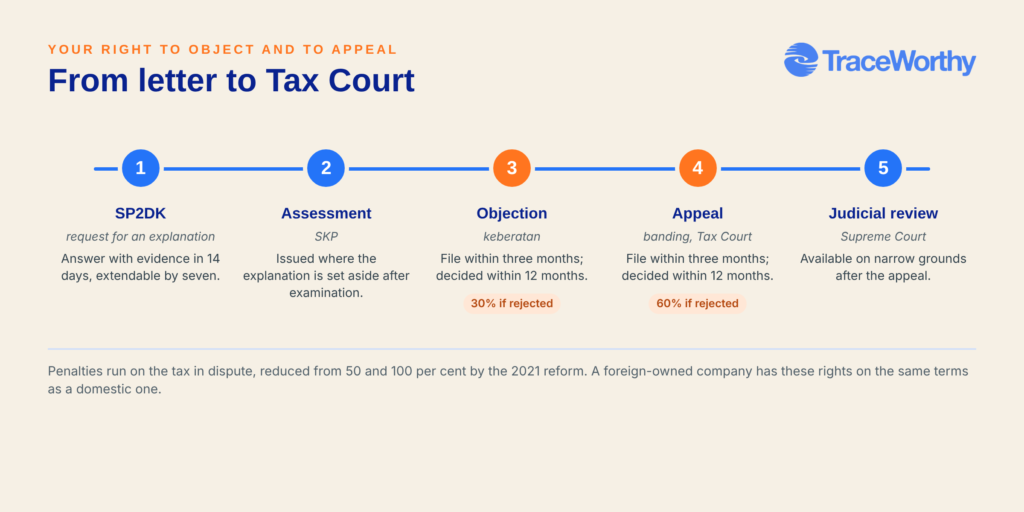
An objection (keberatan) to the Directorate General of Taxes is filed within three months of the assessment, and the tax office decides within 12 months.
A rejected objection opens an appeal (banding) to the Tax Court (Pengadilan Pajak), filed within three months of the objection decision. The Tax Court decides within 12 months, and a further judicial review by the Supreme Court is available on narrow grounds after that.
Contesting an assessment has a defined cost if it fails. Where an objection is rejected and not appealed, a penalty of 30 per cent of the tax in dispute applies, under Article 25 of the General Provisions and Tax Procedures Law as amended by the 2021 Harmonisation of Tax Regulations Law. A rejected appeal attracts a penalty of 60 per cent, under Article 27. On the example figure, the 30 per cent is around IDR 50 million and the 60 per cent around IDR 99 million, each on top of the tax and the cost of representation. The 2021 reform reduced those rates from 50 and 100 per cent, so the cost of losing is lower than before, and it remains significant.
The merits can be stronger than the letter suggests. The Tax Court has, on its facts, cancelled imputed-interest corrections where no money passed between the parties and the company drew no economic benefit, treating a receivable that exists only as a book entry as insufficient to support the interest. Each case turns on its evidence, and the evidence is what a proper answer to the SP2DK puts on record.
Paying one year, and contesting one year, each answer a single assessment while the receivable stands, so the charge returns the following year. Funding the IDR 7.5 billion is the largest of the three outlays, and it is the one response that removes the receivable the charge is computed on. Whether to fund turns on the use the IDR 7.5 billion would otherwise serve, because the capital was owed to the company in any event.
What a strong answer puts on record
A resolving answer draws on the company’s own records and avoids bare assertion. It traces to the company’s bank records what was paid for the shares, and when. It sets the paid-up position against the figure in the deed. It establishes whether a receivable exists in fact or only as a book entry, and whether the company drew any benefit from it. Where the capital was paid in full, the receivable the tax office assumed does not exist, and no interest arises on it. Where part was unpaid, the answer quantifies and addresses the position, which protects the taxpayer better than paying a figure no one has tested.
The tax answer and the permit record must agree
TraceWorthy reads the three records, the tax answer, the company deed, and the investment report, as one funding story. Evidence that resolves the tax question also bears on the permit and on the investment report, so the three records must agree on what was funded.
Where the answer to the tax office states that IDR 7.5 billion was never paid, that same fact describes a shareholding the Investor ITAS was granted on, and a directors’ statement that recorded the capital as paid. The permit is tested on the shares registered in the investor’s name. A record that those shares were not funded can expose the permit on renewal. A directors’ signed statement that the capital was paid is a representation with its own consequence where it was inaccurate, separate from the tax receivable.
The investment realisation report records its own account of what was funded. Where that report shows IDR 10 billion of equity as realised, an answer to the tax office that only IDR 2.5 billion was paid contradicts it, and the investment authority can see the contradiction. Where the report shows IDR 2.5 billion of equity and IDR 7.5 billion of other realised investment, the tax answer and the report agree.
For that reason the evidence for an SP2DK is assessed for its effect on the permit and on the investment report before it is filed. Where the gap exists in fact, funding the balance removes the receivable from that point on and protects the permit, because it makes the deed, the permit, and the report agree. Funding does not erase imputed interest already assessed for earlier unfunded years, and the tax office can still examine those years.
How we help
The TraceWorthy team treats an SP2DK on capital as a reconciliation of the three records before any question of payment. We verify the paid-up capital against the company’s bank records, quantify any gap between the deed and the cash, and build the response to the SP2DK on what the records show. Where an assessment follows and the facts support it, we take the objection and, where it is needed, the appeal to the Tax Court. Where a gap exists, we correct the funding position so the same exposure does not return the next year.
If you have an Investor ITAS, signed a company deed that records capital as paid, or received a letter from the tax office concerning your capital, speak with our team before you respond, and before you pay. We set out how the gap arises in our article on unpaid share capital.
This article is general information and is current as at 24 October 2026. Tax rules, immigration rules, and the figures in them change, and the position for any company and any letter depends on its own facts, so obtain advice for your own situation before you act or pay. This article does not constitute legal, tax, or immigration advice, and it creates no advisory relationship and reaches no conclusion on a particular reader’s position.
Frequently Asked Questions
No. An SP2DK is a request for an explanation of data the tax office has. Nothing is payable on receipt of it, and where the explanation shows the position was correct, no tax follows. It becomes a payable amount only if an examination later produces a tax assessment.
The interest on the capital, not the capital itself. Where capital is recorded as paid and was not, the company has a receivable from the shareholder, and the tax office imputes market-rate interest income on that unpaid balance and taxes it, under the arm’s length principle. The charge is computed for each year the balance stays unpaid.
The IDR 10 billion is a shareholding figure the immigration rules require in your name. Indonesian company law requires shares to be paid for in full and does not allow partly-paid shares, so IDR 10 billion registered to you should be Rp10 billion funded. The minimum paid-up capital to incorporate a PT PMA under the investment rules is IDR 2.5 billion, and the IDR 10 billion investment value is realised over time, so the three figures are different. Recording IDR 10 billion as paid for the permit, without funding it, is what creates the receivable the tax office taxes, and that same unfunded status can affect the permit on renewal.
Not at that stage. An SP2DK is answered with evidence, within the period the letter sets. Paying before any assessment exists is a choice, not an obligation. Where part of the capital was genuinely unpaid, a voluntary correction with lower sanctions is open at this stage, so whether to answer, correct, or pay depends on your facts and is decided with advice. Where you do not respond at all, the tax office can treat its data as correct and proceed to an examination.
Yes. Where an assessment is issued and you disagree, you can file an objection to the Directorate General of Taxes within three months, and then appeal to the Tax Court within three months of the objection decision. A rejected objection attracts a 30 percent penalty and a rejected appeal a 60 percent penalty on the disputed tax, so the merits should be weighed, and the Tax Court has cancelled these interest corrections where no real funds flowed.
The tax office proceeds to an examination and may treat the data in the letter as correct, which is the weakest position to be in. The result of any answer depends on the facts, and answering with evidence, even where part of the capital was unpaid, protects the position better than silence or an untested payment.
It can. The permit is tested on the shares registered in your name, so evidence that those shares were not funded speaks to the permit as well as to the tax. The tax answer, the company deed, and the investment realisation report should tell one funding story, which is why the evidence is assessed for its effect on the permit before it is filed.