

Current as at 24 October 2026.
Does your product need halal certification?
Begin with scope, because not every product falls inside the mandatory regime, and a product outside it is not always free of a labelling duty. Under the Halal Product Assurance Law and Government Regulation Number 42 of 2024, a product that enters, circulates or is traded in Indonesia has to be halal-certified unless it is made from a forbidden material, and the categories reach well beyond food. They cover food and beverages and the slaughter and processing services behind them, drugs, cosmetics, chemical, biological and genetically engineered products, and consumer goods that are used, worn or utilised, such as apparel, household goods, worship supplies and packaging, where these come from or contain animal material. Medical devices follow on their own phased dates.
A product made from or containing a forbidden material is not required to be certified, and it still has to show a standardised non-halal mark, set by BPJPH Regulation Number 3 of 2026, which took effect on 23 July 2026, with an adjustment period for stock already in circulation to 23 July 2027. A missing certificate does not by itself make a product non-halal, so the label has to show the position rather than a default.
Category and composition decide whether certification applies, rather than the product’s name, and the category also sets the date. Where a company sells several product types, each one needs its own answer, so confirm the category before you plan anything else.
What should a business do if its halal certification is unfinished?
If your product falls within Indonesia’s halal-certification programme and the paperwork is incomplete, confirm which phase and deadline apply to that product under the rules as they now stand, verify whether a certificate has been issued or only applied for, and secure a documented route to completion. A change in October 2026 moved several categories to October 2028, so a product that looked overdue a fortnight ago may now have time. Confirm your category first, because the category decides the date.
Start with the product and its evidence, so the next decision rests on something firmer than a message forwarded between suppliers. An application receipt does not establish that a certificate exists, and a headline does not tell you which date now applies to your product.
Did the October 2026 halal deadline move?
For many categories the date moved, and the change is now law. Government Regulation Number 40 of 2026 took effect on 14 October 2026 and amended Articles 160 and 161 of Government Regulation Number 42 of 2024, moving several categories to October 2028. Mandatory certification otherwise proceeded on 18 October 2026, as the agency had confirmed, so the new regulation sets the timetable category by category rather than postponing everything.
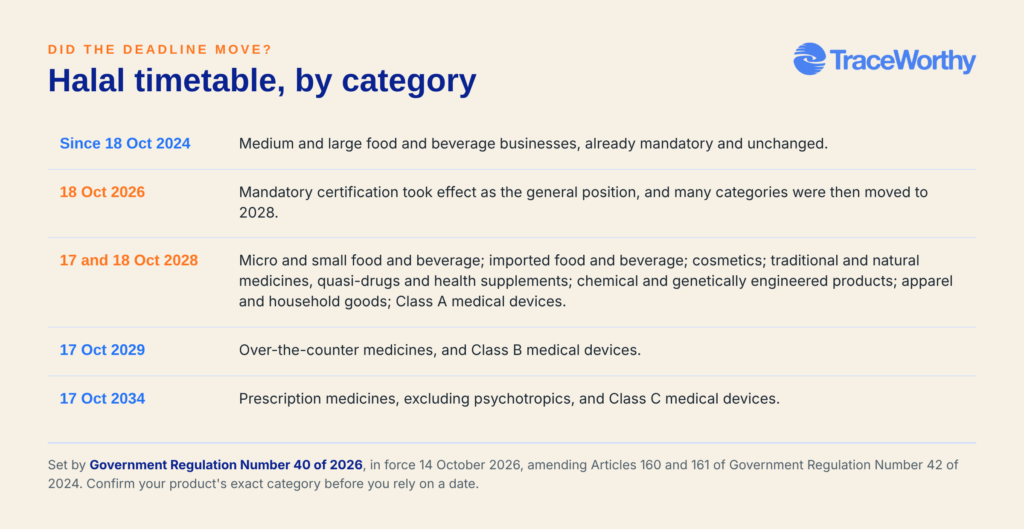
The categories now due in October 2028 are:
- food, beverages and slaughter products of micro and small enterprises;
- imported food, beverages and slaughter products, where the mutual recognition cooperation is completed;
- traditional and natural medicines, quasi-drugs, which are borderline medicinal products, and health supplements;
- cosmetics, chemical products and genetically engineered products;
- apparel and accessories, household health products, household equipment, worship supplies and office supplies;
- Class A medical devices, which are the lower-risk device class.
Two groups keep later dates. Over-the-counter medicines and Class B medical devices fall on a 2029 date, and prescription medicines, excluding psychotropics, and Class C medical devices fall on a 2034 date. Medium and large food and beverage businesses have been within the mandatory regime since 18 October 2024, and that position is unchanged.
The regulation is recent, and its official text was slow to appear on the national legal databases, so confirm the final wording for your category before you act on a date. That same regulation also revoked the earlier import-conformity rule for foreign halal products, and no replacement import-verification procedure had been published, so an importer should treat the border process as in transition, monitor BPJPH guidance, and confirm the current step before a shipment.
What does mandatory certification require of a product?
Where a phase is in force for a category, a product in that category needs a valid halal certificate to be produced, circulated or traded in Indonesia, and its labelling has to reflect the certified position. The non-halal marking duty does not move with the certification timetable, so a category that shifted to October 2028 does not lose it.
The supervisory posture the agency described is guidance-led rather than punitive, so the sensible aim is an orderly file and a clear completion plan. For a category whose date has moved to 2028, the pressure is lower and the task is to confirm the category and keep the file current. Where a category’s phase is in force now, the certificate and the label need confirming without delay, because an in-force phase leaves no grace period of its own.
Does the same date apply to every product?
Product classification determines the timetable, and a company that sells several product types can face several different dates. Start with a simple product register. For each item, record its name, manufacturer, ingredients, intended use, sales channel and certificate status. If you import, add the overseas producer and the certification body. Where you sell across categories, obtain an answer for each category rather than treating the company as a single product.
Classification is finer than a product name suggests. A finished product can shift category on a change of ingredient, a change of claim, or a change of manufacturing partner, and an ingredient from a new supplier can raise a question the previous version did not. A loose description such as wellness products can conceal materially different categories, each with its own date and its own evidence. Resolve the classification before you commission replacement packaging or promise a date to a distributor.
What evidence should you check first?
Create one working file that your operations team and your adviser can both read. It should show the product being assessed, the certificate and its scope where one exists, application references, correspondence, outstanding documents, and the person responsible for the next step.
Check that the names and product descriptions match what the business sells. A certificate that relates to a supplier, a different item or a different manufacturing arrangement needs further examination. You should be able to connect the product in front of the customer to the evidence in the file, and the scope on the certificate should cover the item as it is made and sold.
A simple internal status system helps, with four descriptions used consistently: certificate verified, application in progress, position unresolved, and not yet assessed. These are management labels for your own team, and they are separate from any official legal category. They stop one team member describing several different situations to a retailer as already sorted, and they give a director a single view of where the gaps are.
Is a foreign halal certificate enough for Indonesia?
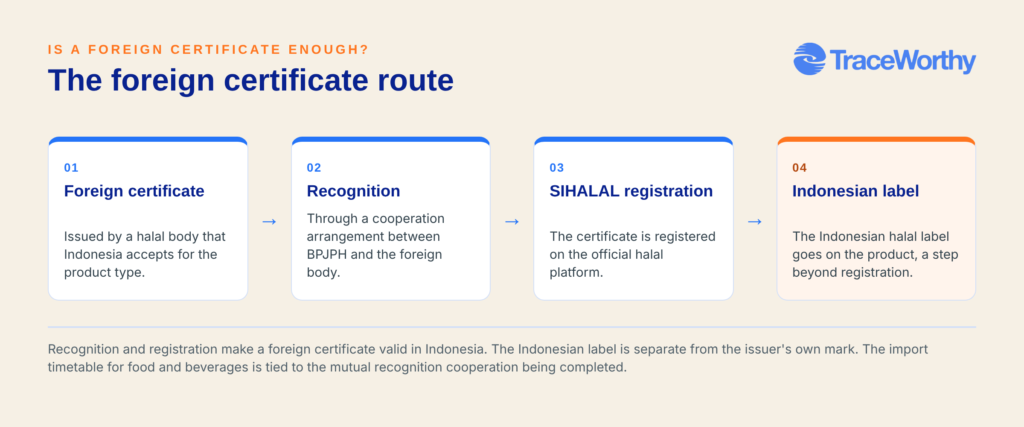
A foreign certificate needs an Indonesian recognition and registration check. BPJPH treats the overseas route as recognition of certificates issued by accepted foreign halal bodies, followed by registration through the SIHALAL system, which is the official halal registration platform. The recognition depends on a cooperation arrangement between BPJPH and the foreign body, so the first question is whether the issuer is one Indonesia accepts for your product type, and the import timetable for food and beverages is itself tied to that mutual recognition being completed.
Recognition and registration make the foreign certificate valid in Indonesia, and the Indonesian halal label is a further step, because the issuer’s own mark is separate from the Indonesian label on the product. Ask your supplier for the actual certificate, the issuer and the products it covers, then confirm the applicable Indonesian steps and who is responsible for completing them. Put that responsibility into the commercial discussion before the next shipment, especially where the producer assumes the importer will arrange everything and the importer assumes the producer already has.
This is also a purchasing-control question. Your team needs a rule for approving a new ingredient, supplier or product variation, so that a purchasing decision does not quietly undo the assumptions made during the compliance review. A change agreed by the buying team on a Monday can invalidate a certificate scope that the compliance team confirmed the week before.
How should you manage the gap while it is resolved?
Concentrate effort where a date is close. A category that moved to 2028 gives the business time, so avoid rushed applications or replacement packaging for it before the category and the date are confirmed. The category whose phase is in force now, including medium and large food and beverage since 2024, deserves the attention first, because that is where an exposure is live today.
Where stock in an in-force category is already in the channel with a wrong or unverified claim, treat it as a commercial exposure rather than a labelling note, because a recall, relabelling or a write-off is a cost that extends across stock the owner no longer physically controls. Have the responsible adviser assess what the business may manufacture, import, distribute or represent to customers in its own circumstances, because a general article cannot settle those product-specific decisions. Appoint someone to obtain the missing records, give each item an internal completion date, and agree the point at which an unresolved issue must reach a director.
BPJPH has also warned of impersonation, including demands for payment connected to alleged fines or certification problems. Verify the sender and the payment route through official channels before you respond, because an urgent message is a reason to check a request carefully rather than to act on it at once.
How does this connect to TraceWorthy’s work?

A halal certificate depends on the records around it: the import documentation, the supplier contracts, the product labelling and the company’s wider compliance record. A gap in one of those often explains a gap in the certificate file, so TraceWorthy reconciles the halal position with those records. Its work on regulatory compliance and business due diligence covers the same ground, and the certification question is resolved with those contracts and records in view, rather than as an isolated form-filling task.
For an importer or distributor, the value is a single reconciliation that connects the product, the overseas certificate, the Indonesian registration and the commercial agreement, so that no party assumes another has completed a step. For a manufacturer, it is a classification and evidence file that remains usable after a change of ingredient or supplier, and a purchasing rule that keeps the two in step.
What should the business owner ask this week?
Bring the product register and the evidence together, and work through five questions for each product line:
- which products fall in a category whose phase is in force now, and which moved to October 2028;
- which certificates the team has verified against the issued document and its scope;
- which applications are still open, and what action each one needs next;
- which categories cannot be certified as halal and therefore need a non-halal label now;
- who owns the next decision for each product and category.
These are management questions, and they are separate from any certification procedure. They turn a changing timetable into work that can be assigned and checked. A small business may keep the record in one spreadsheet, while a larger operator may need several departments to reconcile their records.
TraceWorthy’s earlier halal guide sets out the preparation sequence for certification. If you are now assessing an incomplete position, bring your product list and documents to a discussion with TraceWorthy, so the remaining work can be ordered correctly and the category rules that apply to your product are confirmed before you act.
This article is general information and is current as at 24 October 2026. Halal rules and their timetables are developing, Government Regulation Number 40 of 2026 is recent and its implementing detail is still being settled, and the position for any product depends on its category and its own facts, so obtain advice for your own situation before you act. This article does not constitute legal or regulatory advice, and it creates no advisory relationship.
Frequently asked questions
It may have. Government Regulation Number 40 of 2026, in force from 14 October 2026, moved several categories to October 2028, including micro and small enterprise food and beverages, imports, cosmetics, traditional medicines, quasi-drugs, health supplements and Class A medical devices. Confirm your product’s exact category against the regulation before you rely on the 2028 date.
Describe it as an application in progress until you have verified an issued certificate that covers the product, because submission and certification are different stages. A receipt confirms that something was filed, and it does not confirm that a certificate has been granted.
A 2026 date does not apply to every product, because the timetable is set by category. Several categories moved to October 2028, over-the-counter medicines fall on a 2029 date, and prescription medicines, excluding psychotropics, fall on a 2034 date, so confirm your product’s category before applying a date.
Start with the product, the overseas certificate and its issuer, and the Indonesian recognition and registration steps. The earlier import-conformity rule was revoked by the 2026 regulation, and no replacement procedure had been published, so monitor BPJPH guidance and confirm the current border step before the next shipment, and agree which party completes each remaining step.