
Part of the series: Bali Property Compliance
- SLF, KBLI 2025, and Short-Stay Villas
- Nominee Arrangements in Property Monetisation
- KBLI 2025 and Your PT PMA: What Is Now Live and What You Must Verify
- Indonesia Residence Pathways: A Decision Framework for Foreign Nationals Planning Long-Term Stays
- Property Acquisition in Bali: A Due Diligence Framework for Foreign Nationals
- PT PMA Restrictions in Bali: Why the Property Workarounds No Longer Work
- Foreign Land Ownership in Bali: The Lines a Lawful Structure Will Not Cross
Position confirmed on 11 August 2026.
The 2025 edition of the Klasifikasi Baku Lapangan Usaha Indonesia (KBLI, the Indonesian Standard Industrial Classification) has been the operative business classification in the government’s licensing and legal-entity systems since 15 June 2026. For most companies the change of code happened automatically and required no filing. The task now is to confirm that the 2025 code your registration was converted to still describes what your company actually does, and to act where it does not. This article sets out who the change reaches, how to check your own position, when action is required, and how TraceWorthy conducts the review.
KBLI 2025 was established by Badan Pusat Statistik (BPS, the Central Bureau of Statistics) Regulation No. 7 of 2025, which came into force on 18 December 2025 and revoked KBLI 2020. The earlier framework sat under BPS Regulation No. 2 of 2020. The two classifications then ran side by side while the government adjusted its systems, and KBLI 2025 became the live standard for licensing and corporate administration on 15 June 2026.
The migration reached companies in different ways. Where a 2020 code converted to 2025 without a change in the activity it describes, the conversion was automatic and no company action was needed. Where a single 2020 code was divided into several 2025 codes, or where the description of a code was re-scoped, a company has to decide which 2025 code reflects its real operations. That decision, and the checks that follow it, are the subject of this article.
Who the KBLI Migration Reaches
The KBLI framework is universal. Every business entity registered in Indonesia records its KBLI codes on its Nomor Induk Berusaha (NIB, Business Identification Number), whether it is a foreign-owned company, formally a Perseroan Terbatas Penanaman Modal Asing (PT PMA, Foreign Capital Investment Limited Liability Company), a domestic company, an individual enterprise, or a micro or small business. The migration therefore reaches all of them on the same basis, and the automatic conversion in the Online Single Submission (OSS) system and the Ministry of Law’s Administrasi Hukum Umum (AHU) system applies to every entity, not the PT PMA alone.
What differs is the set of conditions attached to a code once it converts. For a PT PMA, each code has a foreign-eligibility position and an investment threshold. For a domestic company, those two tests do not apply, and the review is narrower.
A purely domestic company, a Perseroan Terbatas Penanaman Modal Dalam Negeri (PT PMDN, a domestic-capital limited liability company), is outside the PT PMA capital rules. Its modal dasar (authorised capital) is set by the founders under the Company Law as amended by the Job Creation Law, with no fixed statutory minimum unless a sector imposes one. The standing rule that a quarter of the authorised capital be issued and fully paid still applies. A micro or small enterprise, defined by Government Regulation No. 7 of 2021, sits under a lighter-touch, risk-based licensing regime in which the NIB alone serves as the licence for many low-risk activities.
| Enterprise size | Business capital, excluding land and buildings | Annual sales |
|---|---|---|
| Micro | Up to IDR 1 billion | Up to IDR 2 billion |
| Small | Above IDR 1 billion to IDR 5 billion | Above IDR 2 billion to IDR 15 billion |
| Medium | Above IDR 5 billion to IDR 10 billion | Above IDR 15 billion to IDR 50 billion |
A domestic company and a foreign-owned company both need to confirm their converted codes, and a foreign-owned company takes on the added checks on eligibility and investment.
What KBLI Determines for a PT PMA
KBLI is Indonesia’s national standard for classifying business activities. Every company registered in Indonesia has one or more KBLI codes. Those codes define what the company is permitted to do, how the OSS risk-based licensing system rates its operational risk, which licences it may apply for, and whether an activity is open to foreign investment or restricted under the investment rules.
For a PT PMA, the KBLI code has direct consequences across three areas. It is the reference through which the OSS system determines whether an activity is open to foreign capital under the Positive Investment List, governed by Presidential Regulation No. 10 of 2021 as amended by Presidential Regulation No. 49 of 2021, keyed to the five-digit code. It sets the applicable investment position, which under Badan Koordinasi Penanaman Modal (BKPM, the Investment Coordinating Board) Regulation No. 5 of 2025 requires an investment plan exceeding IDR 10 billion per five-digit KBLI code per project location, excluding land and buildings, with paid-up capital of IDR 2.5 billion. It also fixes the risk classification, from which the licences and permits the company must obtain before operations begin are derived.
A change to a KBLI code therefore revises the legal foundation on which the company’s licences, investment commitments, and compliance position rest. That is why a numbering change that looks administrative can change the licensing and investment position of a foreign-owned company. The mechanics of the paid-up capital position are set out in our note on the IDR 10 billion paid-up capital question.
What BPS Regulation No. 7 of 2025 Changed
The regulation aligned Indonesia’s classification with the International Standard Industrial Classification of All Economic Activities, Revision 5. The revision reflected shifts in the structure of the economy, in digital services, platform-based models, climate-related and green-economy activities, and health-related wholesale trade. The number of top-level categories rose from 21 to 22. New codes appeared for activities that KBLI 2020 did not separate, among them electric-vehicle charging, renewable and non-renewable power generation set apart from each other, and medical-device wholesale.
Across the code structure, the changes took five forms, and only some of them are automatic. A company should know which form applies to each of its codes.
| Change type | What happens | Company action |
|---|---|---|
| Direct renumbering | A 2020 code receives a new five-digit number with no change to the activity it describes. | Automatic in OSS. No action. |
| Consolidation (merge) | Several 2020 codes combine into one broader 2025 code. | Automatic in OSS. No action. |
| Split | One 2020 code divides into two or more narrower 2025 codes. | Assessment required. The company decides which resulting codes apply. |
| New code | A code is created for an activity not separately classified under KBLI 2020. | Check whether the new code describes an activity the company performs. |
| Revised description | The number is unchanged, though the scope or wording of the activity is re-defined. | Check whether the company still sits within the re-scoped description. |
BPS published an official conversion table mapping every 2020 code to its 2025 equivalent, released on 27 April 2026, alongside the KBLI 2025 access point at s.bps.go.id/perbanKBLI2025. The table records each relationship as one-to-one for a renumber, one-to-many for a split, or many-to-one for a merge.
How to Check Your Own Codes
The check is the same for a foreign-owned and a domestic company, and it runs in two steps.
- Read your current codes from OSS. Sign in at oss.go.id with your access credentials (Hak Akses), open the Perizinan Berusaha menu, and open the NIB record. The registered activities appear under the business-data section (Data Usaha, listing each Bidang Usaha by KBLI code, title, location, and risk level). The labels in the OSS interface are revised from time to time, so the anchor is the sequence: sign in, open licensing, open the NIB, read the business-activity list.
- Map each code through the BPS conversion table. Locate your existing five-digit code in the 2020 column and read across to its 2025 equivalent. Where one 2020 code shows a single 2025 row, the conversion was automatic and needs only confirmation. Where one 2020 code shows several 2025 rows, that is a split, and you select the 2025 code whose description matches what you actually do. This selection is the step the system cannot perform for you.
The Split-Code and Re-Scope Risk
Where a KBLI 2020 code splits into several 2025 codes, or where a description is re-scoped, the company has to determine which resulting code reflects its actual business. This is a legal and commercial decision, not a mapping exercise, and three checks follow from it.
The first is the investment position. The threshold under BKPM Regulation No. 5 of 2025 applies per five-digit KBLI code per project location. A company whose activity under one 2020 code now maps across two 2025 codes should confirm that its declared investment plan supports both codes at the required level. Registering a code the declared plan does not support creates a gap between the investment position and the registered scope.
The second is foreign eligibility. The status of each resulting code has to be confirmed against the Positive Investment List. A split can place one resulting 2025 code in an open category and another in a restricted or closed category. A PT PMA that takes both codes forward without this review may find itself registered for an activity no longer open to foreign capital.
The third is licensing and risk. The risk class of a code sets its licensing output under Government Regulation No. 28 of 2025 on risk-based business licensing: a low-risk activity needs only the NIB, a medium-low activity adds a self-declared Sertifikat Standar (Standard Certificate), and the higher tiers add a verified certificate or an Izin (licence). Where a split produces a 2025 code with a higher risk class than the 2020 original, a licensing product may now be required that was not required before. Operating under the higher-risk code without it leaves a licensing gap that surfaces during any regulatory interaction referencing the OSS record.
A worked example
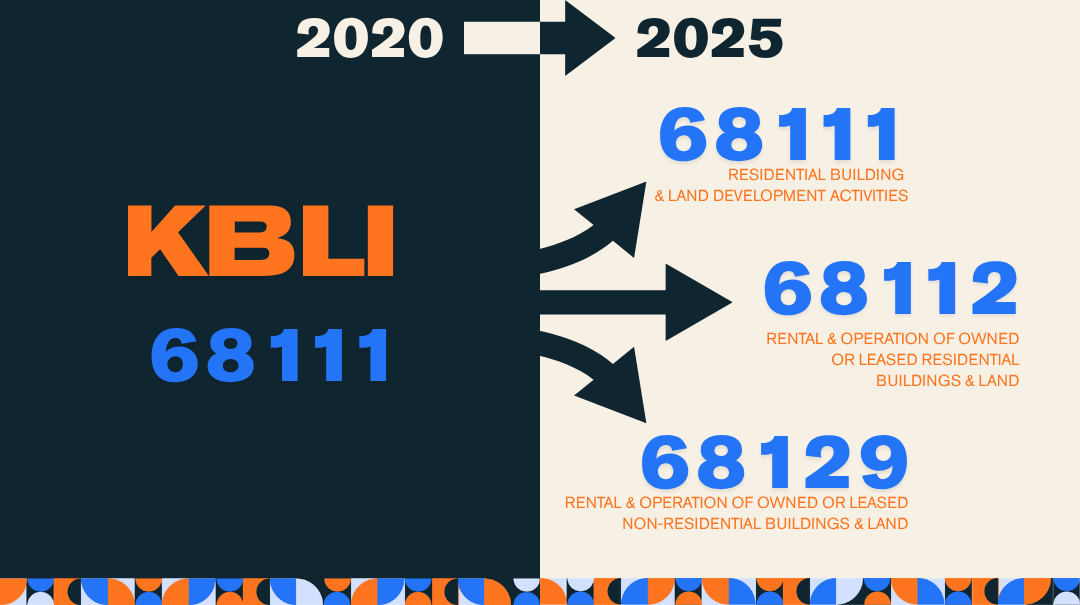
Real estate is one of the codes that split, and it reaches foreign-owned property companies in Bali. Under KBLI 2020, a single code covered self-owned or leased real estate of every kind, residential and non-residential together. KBLI 2025 divides it into three codes.
| Vintage | Code | Activity |
|---|---|---|
| KBLI 2020 | 68111 | Real Estat yang Dimiliki Sendiri atau Disewa: real estate owned or leased, residential and non-residential in a single code. |
| KBLI 2025 | 68111 | Aktivitas Pengembangan Bangunan dan Lahan Hunian: development and sale of residential buildings and land. |
| KBLI 2025 | 68112 | Aktivitas Penyewaan Bangunan dan Lahan Hunian Milik Sendiri atau Sewa: letting and operation of residential buildings and land, owned or leased. |
| KBLI 2025 | 68129 | Aktivitas Real Estat (Bangunan dan Lahan) Nonhunian Lainnya Milik Sendiri atau Sewa: other non-residential real estate, owned or leased, such as warehousing, malls, shopping centres, and data centres. |
A company that develops and sells residential buildings under the old code moves to 68111. A company that lets a dwelling it owns or leases moves to 68112. A company that owns or leases non-residential space moves to 68129. A company active in several of these now sits across the matching codes, and it should register each, then check the investment plan and the foreign-eligibility position for every code. A related change runs through short-stay accommodation, where the 2020 villa code (Vila, 55193) was renumbered to 55203 (Aktivitas Vila) inside a regrouped short-term accommodation group, an automatic renumber rather than a split.
If a split moves you into a restricted line
Where a split re-scopes an activity into a code that is restricted or closed to foreign capital, the position depends on whether the company is continuing an already-approved activity or registering something new. A prior, more favourable foreign-ownership position is protected for an existing investment. Under Article 6(4) of Presidential Regulation No. 10 of 2021, a foreign-ownership limitation does not apply to an investment already approved before the regulation took effect, as recorded in the company’s business licensing, unless the current rule is more favourable.
That protection is narrow. It covers the existing, unchanged activity and its ownership position. It does not create a right to run a newly restricted activity the company was not already approved for, and it does not extend to a field that is fully closed. Once the company amends its deed, applies for a licence, changes or expands an activity, or reconciles the code on its next report, the resulting 2025 code is screened against the current Positive Investment List as though it were proposed for the first time. Where a split places an activity in a capped or closed line, the realistic responses are to adjust the ownership to a lawful level, to bring in a licensed local partner, or to place the activity in a separate vehicle. Because the outcome turns on exactly which activity the existing licence covered, this calls for individual advice.
A small set of fields is closed to all investment under Article 2 of the same regulation, among them Class I narcotics cultivation, gambling and casinos, capture of fish species listed in Appendix I of the Convention on International Trade in Endangered Species (CITES), extraction of coral from nature, chemical-weapons manufacture, and industrial chemicals and ozone-depleting substances. Other fields are reserved for domestic investors or open only in partnership with cooperatives and micro or small enterprises.
The Articles of Association Dimension
Where the migration, or a change in the company’s activities, requires a stated business activity in the articles of association to be added, removed, or replaced, the amendment runs through the Ministry of Law by way of the Sistem Administrasi Badan Hukum (SABH, the Legal Entity Administration System). This is a notarial process. It requires notarial minutes, a notarial deed of amendment, and SABH registration.
Peraturan Menteri Hukum (Permenkum, a Minister of Law Regulation) No. 49 of 2025 came into force on 17 December 2025 and replaced Peraturan Menteri Hukum dan Hak Asasi Manusia (Permenkumham) No. 21 of 2021. It applies stricter documentation standards to SABH submissions, and it sits alongside the Ministry’s move to substantive examination of company changes rather than automatic self-declaration. The practical effect is that an articles-of-association amendment now takes longer to clear than it did before December 2025. A company that needs an amendment should therefore allow for a longer processing window and begin the work when the need is identified rather than when a filing falls due.
Where a code change does not alter the substance or scope of the company’s business, the conversion was handled by the system without any amendment to the articles of association. A deed amendment is required where the company genuinely adds or changes an activity, not where a code was renumbered around an unchanged business.
Your Licences and NIB After the Change
The change of classification does not reissue your registration. The NIB stays the same, and the KBLI codes are updated within the existing NIB rather than replaced by a fresh one. Licences and permits issued before the KBLI 2025 implementation remain valid and do not need to be re-applied for, as BPS confirmed on 27 April 2026.
One point needs a check by hand. After the 15 June go-live, the automatic conversion notification did not appear in OSS for every company. The absence of a notification does not remove the duty to reconcile the codes. The documented causes include a registration still resting on an older KBLI version, a mismatch between the codes in the deed and the codes in OSS, an incomplete business-data verification, an unresolved prior permit, and a data disconnect between the new OSS records and older permits. Where the notification has not appeared, the practical steps are to read the KBLI version and codes shown on the NIB, to reconcile them against the articles of association at AHU, to review each attached permit for outstanding verification, and, for manufacturers, to confirm the industrial record in the Sistem Informasi Industri Nasional (SIINas, the National Industrial Information System) has updated. Where the position does not resolve, a manual check with OSS support or an advisor closes it.
The LKPM Connection
Every PT PMA files a quarterly Laporan Kegiatan Penanaman Modal (LKPM, Investment Activity Report) through OSS. The report records capital investment, employment, and operational activity for the quarter against the declared investment plan, and it is filed under the company’s registered KBLI codes. Under BKPM Regulation No. 5 of 2025 the quarterly filing is due by the fifteenth of the month following each quarter, a change from the tenth under the earlier schedule.
An LKPM filed under codes that no longer describe the company’s licensed activities produces a data inconsistency in OSS. The next quarterly filing after this article, for the July to September 2026 period, falls due on or before 15 October 2026. A company that reconciles its codes before that filing avoids reporting under a classification that no longer aligns with its OSS record. BKPM cross-references the LKPM against the company’s tax filings and its Badan Penyelenggara Jaminan Sosial (BPJS, the Social Security Administrator) employment records, so an inconsistency in one source can draw attention to the others.
The Joint Circular of 25 March 2026 and the 18 June 2026 Date
On 25 March 2026 the Minister of Investment and Downstream Industry, the Minister of Law, and the Head of BPS jointly issued a Surat Edaran Bersama (SEB, Joint Circular Letter) on the implementation of KBLI 2025 across risk-based licensing. The circular addressed the Direktorat Jenderal Administrasi Hukum Umum (Ditjen AHU, the Directorate General of General Legal Administration) at the Ministry of Law and the OSS system at BKPM.
The 18 June 2026 date that has circulated widely comes from this circular. It is the date by which the Ministry of Investment and the Ministry of Law were required to complete the KBLI 2025 adjustment in the OSS and AHU systems. It was a deadline on the government’s own systems, not a self-execution cut-off imposed on every company. The systems went live on KBLI 2025 on 15 June 2026, ahead of that date. Read against the primary instrument, the widely repeated idea that every PT PMA faced a personal 18 June compliance deadline overstates the position.
The company obligation is different in character. It is event-driven. It arises where a split, a new code, or a re-scoped description means a company’s registered codes no longer describe what it does, and it comes to a head at the next event that references those codes: a deed amendment, a licence or permit application, a change or expansion of activity, or a quarterly LKPM filing. That obligation did not expire on 18 June 2026. It attaches to the company until its codes and its actual activities are reconciled.
The Consequences of Misalignment
The classification change itself is a light-touch process. In its statement of 27 April 2026, BPS confirmed that KBLI 2025 requires no new permits, that licences issued before implementation remain valid, and that KBLI 2020 and 2025 ran in parallel until conversion completed. BPS Regulation No. 7 of 2025 prescribes no administrative sanction for the migration itself. A company should not read the absence of a penalty as the absence of exposure.
The exposure is operational and structural. OSS processes licence applications, permit renewals, import approvals, and Rancangan Penggunaan Tenaga Kerja Asing (RPTKA, the Expatriate Utilisation Plan) applications for foreign workers by reference to the company’s registered KBLI codes. Where those codes no longer match the company’s activities, whether through the migration or through activities that evolved without an OSS update, the mismatch can produce administrative flags on OSS transactions, delays in permit approvals and renewals, and complications during regulatory audits or due-diligence exercises. The migration review is frequently the point at which a longer-standing gap comes to light, between the codes a company registered at incorporation and the activities it actually conducts now.
The Four-Step Assessment TraceWorthy Conducts
TraceWorthy’s KBLI 2025 migration assessment follows a structured sequence applied consistently across every PT PMA client engagement.

Extraction
Pulling the company’s KBLI codes from its NIB and OSS record, and confirming they match the articles of association.

Mapping
Applying the BPS conversion table to identify how each code moved into KBLI 2025: renumber, consolidation, split, new code, or revised description.

Assessment
For each split or re-scoped code, determining which 2025 code reflects the company’s actual activities, whether each resulting code is open to foreign investment under the current Positive Investment List, what risk classification each carries, and whether the declared investment plan supports the threshold for each code at each location.

Implementation
Where the conversion was automatic and correct, confirming the OSS record. Where a correction is needed, preparing the OSS amendment, reconciling the record across OSS, AHU, and, for manufacturers, SIINas, and preparing the notarial documentation for SABH where an articles-of-association amendment is also required.
The assessment is completed in a single advisory engagement. The implementation timeline depends on whether articles of association amendments are required.
Where This Leaves a PT Now
The 18 June 2026 deadline has now passed. BPS Regulation No. 7 of 2025 established it as the mandatory completion date for every entity operating in Indonesia to align its registered business classifications with the KBLI 2025 framework.
KBLI 2025 is live, most conversions were automatic, and no new permits are required for the classification change alone. The open question for a foreign-owned company is whether the code the company was converted to still describes what it does, and whether every resulting code remains open to foreign capital, carries the right licences and / or underlying permits, and sits within a supported investment plan.
Where the answer is yes, the review confirms the position in under a day.
Where a split, a new code, or a re-scoped description has moved the company off its real activities, the correction is worth making before the next licence application or LKPM filing brings the mismatch to the surface.
Schedule a consultation with TraceWorthy’s compliance and legal teams to run a KBLI 2025 review. The review confirms your current classification, identifies any split or re-scoped codes that need a decision, checks the foreign-investment status and licensing of each resulting code, and determines whether an articles-of-association amendment is required. While you are chatting, ask us for a “Business Health Check” to assess your overall compliance with current laws and regulations.
This article is general information on the KBLI 2025 migration and is not individual legal, tax, or investment advice. A company’s position depends on its own codes, activities, articles of association, and investment plan, and should be confirmed against its own records before any filing or amendment.
Frequently Asked Questions
Has the 18 June 2026 deadline passed, and did I miss it?
The 18 June 2026 date was the government’s deadline to complete the system migration, and it was met when KBLI 2025 went live on 15 June 2026. There was no separate company filing cut-off tied to it, and the migration carries no administrative sanction. Your task now is to verify that your converted codes are correct.
Do I need to apply for a new permit?
No new permit is required by the reclassification itself. The BPS statement of 27 April 2026 confirms that KBLI 2025 requires no new permits and that licences issued before implementation remain valid. That confirmation applies where your activity and its risk classification are unchanged. Where a split or a re-scoped description moves your activity into a 2025 code that sits in a higher risk tier, the licensing output can change, which the next answer addresses.
I am a low or medium-low risk business. Is there anything else I should check?
Yes. Two points sit outside the reclassification. First, if your 2020 code split or was re-scoped into a 2025 code with a higher risk level, your licensing output can change: an activity that needed only the NIB can move to needing a Sertifikat Standar or an Izin. Confirm your risk tier in OSS after the conversion. Second, a Sertifikat Standar at the medium-low tier is a self-declaration, and the standards you declare must be genuinely met, because that declaration is open to supervision and can be revoked under Government Regulation No. 28 of 2025. Beyond these, obligations that do not depend on your KBLI risk tier continue regardless of the migration, among them environmental approval through OSS, spatial-suitability confirmation, any supporting licence for import or regulated distribution, halal certification for food and beverage, and periodic LKPM reporting.
Will my NIB change?
No. The NIB stays the same, and no new NIB is issued by the migration. The KBLI codes are updated within it, automatically for a straightforward one-to-one recode, though a company still on an older KBLI version, or one making a substantive change to its activities, has to trigger the update in OSS.
Does this reach a domestic company, or only a PT PMA?
It reaches every company with an NIB. A domestic company migrates on the same basis, without the foreign-eligibility check and the PT PMA investment thresholds that a foreign-owned company carries.
My OSS record shows no conversion notification. What should I do?
The absence of a notification does not remove the duty to reconcile your codes. Read the KBLI codes shown on your NIB, compare them against your articles of association, and correct the record where a code no longer describes what you do.
Glossary
| Indonesian term | Abbreviation | Explanation |
|---|---|---|
| Badan Pusat Statistik | BPS | Central Bureau of Statistics; the agency that issues and maintains the national business classification framework. |
| Daftar Prioritas Investasi | DPI | Positive Investment List; under Presidential Regulation No. 10 of 2021 as amended by No. 49 of 2021, it sets which activities are open to foreign investment, which are reserved for domestic investors, and which are conditional, keyed to the five-digit KBLI code. |
| Direktorat Jenderal Administrasi Hukum Umum | Ditjen AHU | Directorate General of General Legal Administration under the Ministry of Law; runs the AHU system through which corporate amendments, including articles-of-association changes, are registered. |
| Izin | None | Licence; the business-licensing product required for a high-risk activity, approved by the competent authority, above the NIB and the Standard Certificate under risk-based licensing. |
| Klasifikasi Baku Lapangan Usaha Indonesia | KBLI | Indonesian Standard Industrial Classification; updated from KBLI 2020 to KBLI 2025 under BPS Regulation No. 7 of 2025, live in OSS and AHU from 15 June 2026. |
| Laporan Kegiatan Penanaman Modal | LKPM | Investment Activity Report; the quarterly OSS filing recording capital investment, employment, and operational activity against the declared investment plan, due by the fifteenth of the month after each quarter under BKPM Regulation No. 5 of 2025. |
| Nomor Induk Berusaha | NIB | Business Identification Number; the permanent thirteen-digit business identifier issued through OSS, recording the registered KBLI codes, and unchanged by the migration. |
| Online Single Submission | OSS | The integrated government licensing platform through which KBLI codes, NIB, licences, LKPM filings, and permit applications are managed. |
| Perseroan Terbatas | PT | Limited Liability Company; the standard Indonesian company form, whether domestic (PT PMDN) or foreign-owned (PT PMA). |
| Perseroan Terbatas Penanaman Modal Asing | PT PMA | Foreign Capital Investment Limited Liability Company; subject under BKPM Regulation No. 5 of 2025 to an investment plan exceeding IDR 10 billion per five-digit KBLI code per project location, excluding land and buildings, with paid-up capital of IDR 2.5 billion. |
| Perseroan Terbatas Penanaman Modal Dalam Negeri | PT PMDN | Domestic Capital Investment Limited Liability Company; a limited liability company owned by Indonesian capital, outside the foreign-eligibility and investment thresholds that apply to a PT PMA. |
| Rancangan Penggunaan Tenaga Kerja Asing | RPTKA | Expatriate Utilisation Plan; filed through OSS and subject to the same KBLI classification framework as other OSS processes. |
| Sertifikat Standar | None | Standard Certificate; the licensing product for a medium-risk activity, self-declared at the medium-low tier and verified at the medium-high tier, requiring the declared standards to be genuinely met. |
| Sistem Administrasi Badan Hukum | SABH | Legal Entity Administration System at the Ministry of Law; processes articles-of-association amendments under the procedures set by Permenkum No. 49 of 2025. |
| Surat Edaran Bersama | SEB | Joint Circular Letter; issued on 25 March 2026 by the Minister of Investment, the Minister of Law, and the Head of BPS, setting 18 June 2026 as the date for the government to complete the KBLI 2025 adjustment in the OSS and AHU systems. |
| Usaha Mikro, Kecil, dan Menengah | UMKM | Micro, Small, and Medium Enterprises; defined by capital and annual-sales thresholds under Government Regulation No. 7 of 2021, with lighter-touch licensing for low-risk activities. |