

Part of the series: Financial Management
- The Investment Activity Report, and Why it Exists
- The IDR 10 Billion Question: Paid-Up Capital for a PT PMA in Indonesia
- The Villa Question and the Line on Directors' Personal Expenses
- Consultant Tax in Indonesia: PPh Article 23 and the Consultant-Employee Line
- Sending Money Offshore: Outbound Payments from a PT PMA
- Anti-Money Laundering Compliance for a PT PMA in Indonesia
- Taking Money Out of a Company: Dividends, Fees, Salary and Shareholder Loans
- What it Costs to Put an Employee on the Books in Indonesia
- Invoicing Offshore Clients from a Company in Indonesia
- How a Dive School Owner Fell Two Years Behind on Tax and Put His Team at Risk
- The Hidden Price of Idle Cash and Slow-Paying Customers
- Short-Term Lending for Indonesian Businesses: When It Bridges a Gap, and When It Masks a Loss
- Online Gambling and the Indonesian Business: The Exposure to Owners, and the Duty to Employees
Many owners we work with have the same experience. The business is profitable on paper, the order book is full, the team is busy, and the bank balance is still tight at the end of every month. The profit is genuine, and the cash to act on it is somewhere else.
That somewhere else is usually money that belongs to the business, in one form or another. It is the balance kept in the account for safety, the money customers owe you on unpaid invoices, the value tied up in stock that has not sold, and the deposits paid to suppliers ahead of need. Each of these is money, and each one has a price while it stays where it is. That price is rarely shown on any report, which is why we call it the hidden price of idle cash and slow-paying customers.
This article explains what money costs and what it could earn, in plain terms, so you can see where your own money is put to use and where it is left idle. The examples are illustrative. The judgement for your own business is work our team does with you, reading your numbers rather than a general rule.
What money costs, and what it could earn
Money has two prices, and most reports show neither. The first price is what it costs to obtain. For borrowed money that is the interest rate on the loan. For your own capital it is the return you require to justify committing it, rather than keeping it elsewhere. The second price is the opportunity cost, the lens that prices any use of money against its next best alternative. The two come together whenever you weigh what a use of money returns against what it costs and against what else the money could do.
The cost of borrowing in Indonesia is easy to read at the moment, and it moved sharply in mid-2026. The Bank Indonesia policy rate, the BI-Rate, is 5.75 percent as at 18 June 2026, after Bank Indonesia raised it three times in five weeks: by 50 basis points to 5.25 percent on 20 May, by 25 basis points to 5.50 percent on 9 June, and by 25 basis points again to 5.75 percent on 18 June. Any rate you read anywhere, including here, needs a date attached to it.
What a business actually pays is lower than most owners assume. Bank Indonesia reported an average bank lending rate of 8.72 percent at its June 2026 Board of Governors meeting, and its own statistics for working-capital lending specifically run at around 8.6 percent. That is the market average across borrowers, so a strong borrower with security pays less and a small or unsecured borrower pays more.
The mechanism behind that average is worth understanding, because it is where your own rate comes from. Every conventional bank must publish a base lending rate, the Suku Bunga Dasar Kredit (SBDK, prime lending rate), and that published base excludes the risk premium the bank sets for each borrower. Bank Tabungan Negara’s published SBDK at 1 April 2026 was 8.75 percent for retail borrowers, 10.35 percent for small business, and 13.65 percent for the micro segment. Your rate is the base for your segment plus the premium the bank attaches to you, so the segment you fall into changes the price of money by a wider margin than the policy rate does.
A subsidised Kredit Usaha Rakyat (KUR, People’s Business Credit) facility is priced well below all of that. It is set at 6 percent effective per year on facilities up to Rp500 million, with the smallest super-micro facilities lower still at 3 percent. One qualification is left out wherever this is quoted: the 6 percent applies to a first-time borrower, and the rate rises in stages for repeat borrowing. If you have drawn KUR before, check what your next facility would actually cost.
The cash left idle in your account
The most common form of hidden cost is the balance kept idle for safety. A current account pays little or nothing. A one-month term deposit paid 4.26 percent in June 2026, and interest on a bank deposit is subject to a 20 percent final tax, so the return you keep is nearer 3.4 percent. Set that against Bank Indonesia’s inflation target of 2.5 percent plus or minus 1 percentage point, and cash in a term deposit roughly keeps its value and no more, while cash in a current account loses ground every year.
Now put the two prices side by side. A business keeping a large balance idle while paying around 9 percent on a working-capital overdraft is earning 3.4 percent on money it owns while paying 9 percent on money it has borrowed. The gap is over five percentage points, and it runs every day the two exist alongside each other. The cash feels like security, and the overdraft feels like a separate problem, so the two are rarely read together. Read together, they show money leaving the business for no return. This is the pattern our team looks for first when we read a set of accounts.
The money your customers are keeping

Every unpaid invoice is money you have earned and cannot use. While a customer keeps it, that money earns you nothing, and if you are borrowing to cover the gap, it costs you the interest on the loan. The longer the average time to collect, the larger the balance permanently tied up in work you have already done.
There is a simple way to see the size of it. Take the value of your unpaid invoices at any moment, and apply the rate you pay to borrow. A business covering Rp500 million of unpaid invoices with a working-capital loan at around 9 percent pays in the region of Rp45 million a year to finance money its customers owe. That is the upper case, since a business funding part of the balance from its own cash pays less in interest and instead gives up a return on that part, which at a net deposit rate of 3.4 percent is around Rp17 million a year on the same balance.
The figures are illustrative, and the numbers for your own business come from your actual balance and your actual rate. Shortening the time to collect, by invoicing on the day the work is done, setting clear payment terms, following up early, and charging for late payment where the contract allows, releases cash you have already earned. An early-payment discount is worth offering when the discount costs you less than the interest you would otherwise pay to cover the gap.
The money on your shelves
Stock is cash you have converted into goods. Until it sells, it earns nothing, and it can cost you storage, spoilage, obsolescence, and the interest on any money borrowed to buy it. Excess stock is a quiet drain, because it looks like a healthy, well-supplied business rather than money left idle in a store room.
The discipline is to keep enough stock to trade without interruption and no more, and to identify slow-moving lines that tie up cash for months. Money released from overstock can clear an overdraft, fund a faster-moving line, cover a tax payment without new credit, or reduce the amount you borrow at the next cycle.

The money committed too early

A fourth form is money committed ahead of need. Paying a supplier well before the goods or services are required, or ordering in larger quantities than the near-term plan supports, moves cash out of your control earlier than necessary.
Where a supplier offers a genuine discount for early payment, the question is whether that discount exceeds the return the cash could earn, or the interest it could save, elsewhere. Where there is no discount, early payment is a cost with no matching benefit.
Borrow, or use your own cash
When a business needs money for a project, the choice is usually between using its own cash and borrowing. Both have a price. Own cash has an opportunity cost, the return you give up by using it here rather than elsewhere. Borrowed money has its interest rate, whether the subsidised 6 percent of a first KUR facility, or the commercial rate your segment and your risk premium produce.
The test that works for both is a single one. Does the use of the money earn a return greater than the cost of the money you actually use, and greater than the next best use you could put it to. The rate in that test is the cost of the specific money in question, so it is the loan rate when you borrow and the return you give up when you use your own cash, rather than one fixed figure.
The margins here are narrower than most owners expect, and that is the point. A project returning 8 percent a year clears a subsidised 6 percent KUR loan and adds value. Funded instead by a commercial facility at the market average of around 8.7 percent, the same project does not clear its cost, and it destroys value even while it shows a profit on the profit and loss statement, because the profit is smaller than the cost of the money that funded it. The difference between a good decision and a bad one is under two percentage points, which is why the rate has to be read rather than assumed.
These figures illustrate the test, and the rate that applies is the cost of your own money, which our team reads from your accounts. This is the judgement that separates a decision that looks profitable from one that is.
When the rate rises, your business pays

The price of money is not fixed. Bank Indonesia raised the BI-Rate by a full percentage point between 20 May and 18 June 2026, to 5.75 percent, to steady the rupiah and keep inflation inside its target range. When the policy rate rises, commercial lending rates tend to follow, so a working-capital loan or overdraft becomes dearer.
Transmission is slow, and that is the useful part. Bank Indonesia has noted that lending rates have moved far less than the policy rate, with the average lending rate easing only 5 basis points in March 2026 against 150 basis points of policy cuts through the preceding period. The same lag works in reverse, so the increases of May and June will reach borrowers over the coming months rather than immediately.
Two things follow for an owner.
- Borrowing to cover slow receivables or idle-cash gaps is dearer than it was, and the return your money needs to earn to beat its cost also rises.
- A rising-rate period rewards the owner who has already released cash from idle balances, slow invoices, surplus stock, and early prepayments, because that owner depends less on borrowing at the moment borrowing is most expensive.
Moving money across the border
For an owner with foreign shareholders, moving money out of Indonesia has its own price, and the rules tightened three times in 2026. From 1 July 2026, Peraturan Anggota Dewan Gubernur Nomor 15 Tahun 2026 (PADG 15/2026) requires an underlying transaction for any spot purchase of foreign currency against the rupiah above USD 10,000 or its equivalent per month per market participant. The threshold stood at USD 50,000 in April 2026 and USD 25,000 from June, so a figure that moved twice in three months is one to confirm with your bank before a transfer rather than to plan around.
Dividends paid to a non-resident are subject to income tax under Pajak Penghasilan Pasal 26 (PPh 26, Article 26 withholding tax on payments to non-residents) at 20 percent, reduced where a tax treaty applies. Both the timing of the conversion and the tax reduce what actually reaches a shareholder abroad, so the cost of money for a foreign-owned company includes the cost of moving it.
We set this out in more detail in our article on company reserve funds.
Roughly what this is costing you
You can estimate the drag without specialist tools. Take the money that is currently idle or tied up, meaning the balance you keep beyond a working buffer, the value of unpaid invoices, the value of slow-moving stock, and any large prepayments, and apply the cost of that money: the rate you pay to borrow for any part funded by a loan, and the return it could otherwise earn for any part that is your own cash. On mid-2026 figures that means roughly 9 percent on the borrowed part and roughly 3.4 percent on your own part, though your own rates are the ones that count.
The result is a yearly figure for what these balances cost you, in interest paid on borrowed money and in the opportunity cost of what your own cash could otherwise earn. For many businesses the figure is larger than expected, because each balance on its own looks reasonable, and only the total shows the size of the drag.
The figure is an estimate to prompt a closer look rather than a precise account, and the precise work depends on your own numbers.
How we help
Money is personal. It is the capital you built the business with, and the decisions over it affect the plans you have for the business and the people who depend on it. Our work is to translate the language of money into the decisions you actually face, so that a term like opportunity cost becomes a plain question on your own cash.
Our team reads your accounts, your collection cycle, your stock, your borrowing, and your supplier terms, and identifies where money is idle, where working capital is tied up, where the cost of funding a balance runs above its return, and borrowing could safely be reduced.. The TraceWorthy team reads the model for the pattern behind the numbers, the place where the business is quietly paying for money it already owns. From there, we build a plan to release that cash and to size any borrowing against a project that clears its cost.
If your business is profitable and still short of cash, we can review where your money is left idle and what it is costing you, and set out the steps to put it to use.
This article is general information current at the date of publication. Interest rates, tax rules, and Indonesian regulation change, and the right treatment depends on the facts of each business, so obtain advice for your own situation before you act. It is not financial or investment advice.
Frequently Asked Questions
What is the cost of money, in simple terms?
The cost of money is what you pay to have money available to use. When you borrow, it is the interest rate on the loan, so a working-capital loan at the mid-2026 market average of around 8.7 percent means each Rp100 million costs in the region of Rp8.7 million a year in interest. When you use your own cash, the cost is the return you give up by putting it into the business rather than into the next best alternative. Both are real, and both should be counted when you weigh a spending or investment decision, even though neither is shown as a line on a standard profit and loss statement.
What does the opportunity cost of money mean for my business?
The opportunity cost of money is the best return you give up by using it one way rather than another. Cash left in a current account has a high opportunity cost, because it earns almost nothing while it could reduce an overdraft, fund a profitable order, clear a supplier balance, or earn interest in a deposit. Every use of money has an alternative, and the opportunity cost is what that alternative would have returned. Read this way, idle cash stops being something that feels safe and becomes a decision with a price you can weigh.
What does a commercial loan actually cost in Indonesia right now?
Bank Indonesia reported an average bank lending rate of 8.72 percent at its June 2026 Board of Governors meeting, and its working-capital lending series runs at around 8.6 percent. That is the market average, so your own rate depends on your segment and your risk premium. Every conventional bank publishes a base rate, the Suku Bunga Dasar Kredit, which excludes that premium. Bank Tabungan Negara’s published base at 1 April 2026 was 8.75 percent for retail borrowers, 10.35 percent for small business, and 13.65 percent for the micro segment. Ask your bank for its published base for your segment and for the premium it proposes to add, and treat the two together as the price.
Is it better to use my own cash or take a loan?
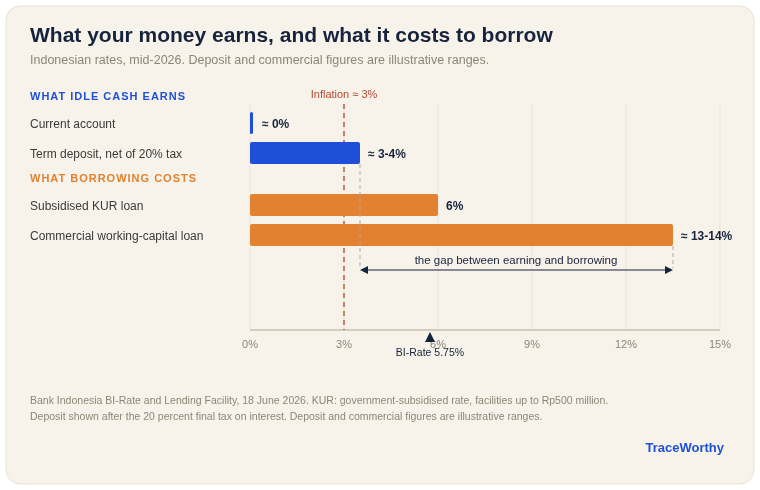
The answer depends on price and return rather than on a preference for one source. Using your own cash avoids interest, though it has an opportunity cost, since that cash could earn or save elsewhere, at a net deposit return of around 3.4 percent in mid-2026. Borrowing keeps your cash available, at the cost of the interest rate, whether a subsidised KUR facility at 6 percent for a first-time borrower or a commercial loan near the market average of 8.7 percent. The test is whether the project returns a rate greater than the money costs. The margins are narrow: a project returning 8 percent clears a KUR facility and does not clear a commercial one.
How do slow-paying customers actually cost me money?
A slow-paying customer keeps money you have already earned. While the invoice is unpaid, that money earns you nothing, and if you borrow to cover the gap, it costs you the loan interest. If you cover Rp500 million of unpaid invoices with a working-capital loan at around 9 percent, financing them costs in the region of Rp45 million a year, and less where you fund part from your own cash, though that part still gives up a return of around 3.4 percent. The figures are illustrative. Invoicing promptly, setting clear payment terms, following up early, and charging for late payment where the contract allows all shorten the time to collect and release cash you have already earned. An early-payment discount is worth offering when it costs you less than the interest you would otherwise pay.
How much cheaper is a KUR loan than a commercial loan?
A Kredit Usaha Rakyat facility, the government-subsidised credit for micro and small businesses, is set at 6 percent effective per year on facilities up to Rp500 million, with the smallest super-micro facilities lower still at 3 percent. The 6 percent applies to a first-time borrower, and the rate rises in stages for repeat borrowing, which is the qualification most often left out. A commercial working-capital loan runs near the market average of 8.6 to 8.7 percent, higher for a small or micro borrower once the risk premium is added. The gap is real and it is narrower than commonly assumed, so a business that qualifies for KUR should still convert both offers to an effective annual rate before choosing.
How can I estimate what idle cash is costing me?
Add up the money that is currently idle or tied up: the balance you keep beyond a working buffer, the value of unpaid invoices, the value of slow-moving stock, and any large prepayments to suppliers. Apply the rate you pay to borrow, or the rate a deposit would earn, to that total. On mid-2026 figures that is roughly 9 percent on any part funded by borrowing and roughly 3.4 percent net on your own cash. The result is a yearly estimate of what these balances cost you, in interest paid or return given up. The figure is a prompt to look closer rather than a precise account, and the detailed work depends on your own numbers.