

Part of the series: KBLI 2025
- KBLI 2025 Scale Restrictions in OSS and Why PT PMAs Feel the Impact First
- KBLI 2025: Real Estate and Accommodation
- Why Governments Set the Rules and Markets Make Them Work: Indonesian Government Objectives of KBLI 2025
- Foreign Ownership and Padel in Indonesia: the KBLI Codes a Foreign Company can Register
Padel is the fastest-growing sport in Indonesia. The clubs that drew its early players were built by foreign founders, who combined a flagship sports facility, a franchise offer, a coaching academy, and a retail line under a single brand. The rules on foreign ownership of padel in Indonesia now turn on one classification fact. The code that operates a padel court carries no large-enterprise scale, and a foreign-owned company can exist only at large-enterprise scale.
A foreign-owned company, in Indonesian law a Perseroan Terbatas Penanaman Modal Asing (PT PMA), can register two genuine roles today, each read on the live Online Single Submission (OSS) system, Indonesia’s risk-based business licensing platform. It can act as the brand and intellectual property licensor, and it can run the coaching academy. The playing facility currently sits with a locally controlled entity, for a reason that rests on the classification system rather than on a rule reserving the sport to Indonesian citizens.
01 · The position now
What a foreign company can register today
Dedicated padel clubs opened in Bali from 2022 and spread across the island and into Java over the seasons that followed. The clubs that drew the early players were built by foreign founders, who carried both the capital and the operating method from outside Indonesia.
A foreign-owned company can register two roles in the licensing system today, and both were read on the live OSS pages in August 2026. The first is the brand and intellectual property licence, under the intellectual property lease code (KBLI 77400). The second is the coaching academy, under the sports and recreation education code (KBLI 85510). Each code shows the large-enterprise scale, and each names the foreign-owned company as an eligible party licensed at ministerial level.
The playing facility follows a different position. The sports-facility management codes and the sports-club codes carry no registrable large-enterprise scale in OSS at the position date, so a foreign-owned company has no scale to register a facility business against for those codes. This is a configuration state in the classification system, not a rule that reserves facility ownership to Indonesian citizens. The sections below set out each code, the reason a local operator runs the facility, and how the relationship is documented.
The workable structure therefore places the brand and the coaching with the foreign-owned company, and the facility with a locally controlled operator. Two readers meet the same structure from different starting points. An operator already trading through a foreign-owned company confirms which of its codes the system will accept. A prospective investor, whether building a greenfield club or taking a franchise, sets the structure to the registrable codes from the start.
02 · The classification
How KBLI 2025 classifies padel
KBLI 2025 carries no dedicated code for padel. The sport is classified by analogy to the codes for court and field facilities, the same codes that carry tennis, badminton, futsal, and basketball. The registrar assigns the operative code at registration, so the code for a specific club is confirmed against the activity it actually conducts rather than assumed.
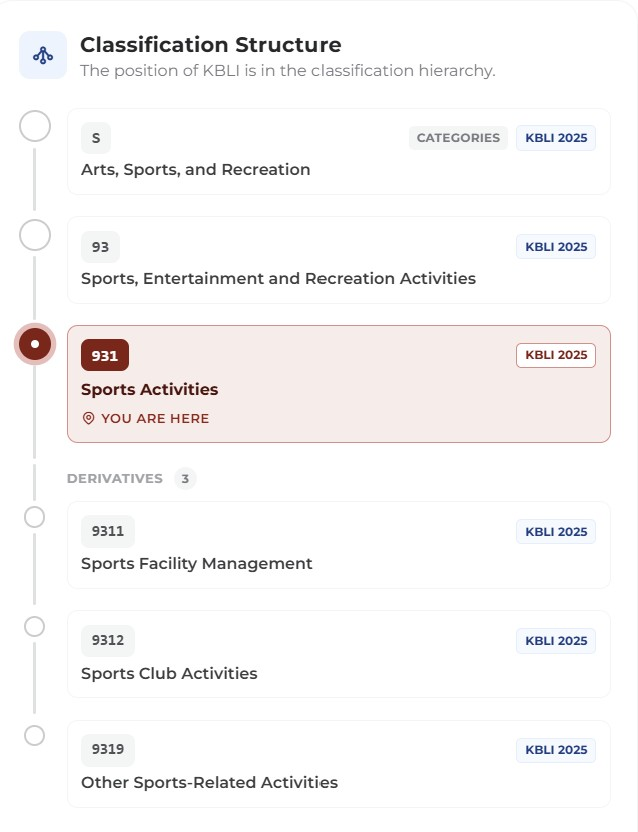
The hierarchy runs from the Arts, Sports and Recreation category, through Sports, Entertainment and Recreation Activities, into Sports Activities, and then into two branches. Sports Facility Management covers the venue, and carries the court and field codes. Sports Club Activities covers the membership club. The education branch, which covers coaching, belongs to a separate part of the classification under Education.
| KBLI 2025 | Activity | OSS configuration at the position date | Position for a foreign-owned company |
|---|---|---|---|
| 93114 | Field facilities (tennis, badminton, futsal, basketball, padel by analogy) | No scale or risk rating configured | No large-enterprise scale to register against |
| 93113 | Court and arena facilities | No scale or risk rating configured | No large-enterprise scale to register against |
| 93119 | Other sports facility management | No scale or risk rating configured | No large-enterprise scale to register against |
| 9312x | Sports club activities (membership club) | No scale or risk rating configured | No large-enterprise scale to register against |
| 85510 | Sports and recreation education (coaching, instruction) | Large-enterprise scale configured; high risk; PMA parameter present | Open; the foreign-owned company registers, licensed by the Minister of Education |
| 77400 | Lease of intellectual property and similar products, not copyrighted works, including franchise-system operations | Large-enterprise scale configured; low risk; PMA parameter present | Open; the foreign-owned company registers, licensed at ministerial level |
NOTES:
Positions read on live OSS in August 2026. Padel carries no dedicated KBLI 2025 code and maps to the court and field codes by analogy.
The facility codes (KBLI 9311 group) and the club codes (KBLI 9312 group) showed no configured large-enterprise scale at that date, and should be re-read as OSS completes its KBLI 2025 configuration.
The education code (KBLI 85510) and the intellectual property lease code (KBLI 77400) were fully configured and named the foreign-owned company as an eligible party.
03 · The open codes
The two codes a foreign company registers
The intellectual property lease code (KBLI 77400), lease of intellectual property and similar products not copyrighted works, is open to a foreign-owned company. Its OSS page shows the large-enterprise scale, a low risk level, and the foreign-owned company as a party licensed by the relevant Minister or Head of Agency. This code covers the brand, the name, the operating system, and the intellectual property licensed to an operator in exchange for a fee. The code description itself references business operations under the franchise system.
The franchise regime applies on top of the code
The intellectual property lease code (KBLI 77400) is the classification for the licence. Where the arrangement meets the definition of a franchise, the Indonesian franchising regime applies separately and on top of the code. It requires the franchisor to lodge a franchise registration certificate (Surat Tanda Pendaftaran Waralaba, or STPW), to provide a franchise prospectus, and to meet disclosure and local-content obligations, under the current franchising instrument, which should be confirmed before the relationship is documented. KBLI 77400 is the licensing code; the franchising regime governs the franchise relationship built on it.
The sports and recreation education code (KBLI 85510) covers the coaching academy. Its OSS page shows the large-enterprise scale, a high risk level, and the foreign-owned company as a party licensed by the Minister of Education. A high risk level means a full business licence with verification rather than a self-declared certificate. No foreign-ownership percentage is recorded against the code on the classification platform, and the education field is not placed on the investment-list schedules that cap or reserve foreign ownership under Presidential Regulation 10 of 2021 as amended.
KBLI 85510 draws one boundary. It routes training delivered by a sports club to the club codes, and training delivered inside a fitness centre to the facility codes. KBLI 85510 fits a standalone coaching academy that operates as an education provider. Coaching delivered inside the club itself belongs to the club, which the local party runs.

Each pillar carries its own capital plan
A foreign-owned company registers at the large-enterprise scale, and each five-digit code carries its own investment plan under Minister of Investment and Downstreaming Regulation No. 5 of 2025. The plan for each code exceeds IDR 10,000,000,000 (ten billion Indonesian Rupiah), excluding land and buildings, with minimum paid-up capital of IDR 2,500,000,000 (two billion five hundred million Indonesian Rupiah). A vehicle carrying both KBLI 77400 and KBLI 85510 therefore plans an investment against each code, rather than a single figure for the pair.
Equipment supply divides along the line in Indonesian trade rules. Wholesale and import of equipment, covering rackets, balls, court systems, and surfacing, is open to a foreign-owned company at the large-enterprise scale, subject to the capital rule and an importer identification number for cross-border supply. Retail falls on the other side of that line. The pro shop that sells to players over a counter is a retail activity, and retail is among the fields restricted for foreign investors, so the pro shop registers with the local operator.
04 · The national position
Why a foreign company cannot register a facility today
A foreign-owned company cannot register a facility business under the sports-facility codes today, for a reason at the national level that applies across Indonesia, before the Bali measure adds a further layer. Neither reason reserves the sport to Indonesian citizens.
The national reason is a configuration state. The sports-facility management codes (KBLI 9311 group) and the sports-club codes (KBLI 9312 group) carry no configured large-enterprise scale in OSS at the position date. A foreign-owned company registers at that scale, so it has no scale to register a facility or club business against for those codes. The investment list under Presidential Regulation No. 10 of 2021, as amended by Presidential Regulation No. 49 of 2021, does not place these codes on a closed, conditional, reserved, or partnership schedule. The position is therefore a configuration state in the classification system rather than a reservation in the investment list, and it should be re-read on live OSS as the KBLI 2025 configuration completes.
So nationally, a local operator owns and runs the facility, because a foreign-owned company has no registrable route in the sports-facility codes at present.
05 · Bali
The provincial block and where foreign capital concentrates
Bali warrants separate treatment, for two reasons of its own. First, it draws the largest concentration of foreign padel investment, and most foreign-founded clubs operate there, so most of the affected operators and prospective franchise investors are in Bali. Second, it adds a provincial closure on top of the national configuration.
The Governor of Bali letter numbered B.27.000/642/PM/DPMPTSP, dated 28 January 2026, closed new foreign-company registration in low-risk and medium-low-risk classifications across the province. The Ministry of Investment applied the request inside OSS, and the block took effect on 13 May 2026. Where the facility codes carry a low or medium-low risk level once configured, the Bali measure closes them to a new foreign-owned company in Bali, independently of the national configuration.
One code offers an opening even in Bali. The court and arena code (KBLI 93113) carries a medium-high risk level, which the Bali measure does not close. So the classification of a specific club, whether it registers as a field facility (KBLI 93114) or a court and arena facility (KBLI 93113), decides whether a foreign-owned company could register it in Bali once the scale is configured.
Bali enforces this actively. The provincial enforcement through 2025 and early 2026 produced administrative sanctions against over 400 foreign companies, and a substance-based enforcement programme runs from June 2026. Bali also regulates the land directly, through Provincial Regulation No. 4 of 2026, which the structure section below addresses.
A foreign brand that licenses to a network of clubs across Bali follows this structure. Each Bali club operates as a locally controlled entity carrying the facility code, the foreign brand licenses under KBLI 77400 and coaches under KBLI 85510, and the local entity owns the facility. The provincial block reinforces that split for the lower-risk codes, and a prospective franchise investor in Bali confirms the operating entity’s code and its configuration before committing capital.
06 · The franchise relationship
Which party registers which function
The foreign-owned company owns the brand and the operating system, licensed under KBLI 77400, with the franchising regime governing the franchise relationship, and it provides the coaching method under KBLI 85510. The local operator owns and runs the facility under the sports-facility codes, and, where a membership club is used, the local entity runs the club under the sports-club codes. The registrable positions decide the role of each party.
For a prospective franchise investor, the structure depends on which party the investor is. A foreign investor taking a franchise acts as the franchisor and brand party, or invests through the brand and academy vehicles, with a locally controlled operating partner operating the facility. A local investor taking a franchise registers the operating entity under the facility codes as a domestic company, and operates the club under licence from the foreign brand.
| Function | KBLI 2025 code | Party responsible | Note |
|---|---|---|---|
| Brand, name, operating system | 77400 intellectual property lease | Foreign-owned company | Franchising regime and STPW registration apply on top where a franchise |
| Coaching method and academy | 85510 sports and recreation education | Foreign-owned company | Full licence; licensed by the Minister of Education |
| Court and facility operation | 93114 or 93113 facility codes | Local operating partner | No configured large-enterprise scale for a foreign company at the position date |
| Membership club | 9312 sports club codes | Local entity | Same configuration state; re-read on live OSS |
| Fee-based management | Contracted output of the franchise and academy | Documented agreement between the parties | Priced at arm’s length |
A prospective franchise investor verifies four points before committing capital:
- The first is the OSS configuration and eligibility of the operating entity’s codes at the date of filing.
- The second is the franchise registration and prospectus, where the arrangement is a franchise.
- The third is the genuine local ownership and capitalisation of the operating entity, tested against the beneficial ownership register.
- The fourth is the tax treatment of the fee flows, set out below.
07 · The structure that works
The owner-principal structure and its controls
The structure follows the owner-principal model, one of the firm’s standing methods for accommodation and now for sports facilities. The locally controlled entity owns and operates the facility. The foreign-owned company owns the brand and intellectual property licence under KBLI 77400 and runs the coaching academy under KBLI 85510. The brand, the system, the coaching method, and a fee-based management role flow to the local operator under separately documented agreements. Each function carries its own contract, its own fee, and its own code.
A locally controlled entity is defined by its corporate mechanics rather than by intent. Control means the Indonesian party owns the shares, appoints the board and directors, controls the signing authority, and retains the veto over reserved corporate actions. The local operator must be genuinely capitalised to own and build the facility. Where the foreign-owned company provides funding, the funding takes the form of an arm’s-length loan or a service and supply arrangement on commercial terms, documented as such, rather than a route through which control returns to the foreign party.

TraceWorthy tests a structure across four gates. The actor gate asks whether the real economic party is the registered party. The asset gate asks whether the land and lease platform fits the model. The building gate asks whether the building record matches the actual use. The business-activity gate asks whether the real activity matches the correct code under a lawful actor.
The nominee shortcut, and the Bali land regulation
The shortcut to avoid is the nominee. A structure that registers the operating entity or the facility land to Indonesian names while a foreign sponsor directs it and takes the economics meets several controls. Article 33 of the Investment Law (Law No. 25 of 2007) voids any agreement that shares or assets are owned for another person. The beneficial ownership register under Presidential Regulation No. 13 of 2018 requires the real controlling party to be disclosed. The Basic Agrarian Law (Law No. 5 of 1960) reserves freehold (Hak Milik) to Indonesian citizens. In Bali, Provincial Regulation No. 4 of 2026, on the control of productive land conversion and the prohibition of nominee land ownership, operationalises that reservation at provincial level. It defines a nominee arrangement as an agreement appointing a person to own or manage land rights in the name of a foreign national, and it prohibits any person from acting as an intermediary or a facilitator that causes a foreign national to control land through a nominee. Its own sanctions are administrative, and extend to written warnings, suspension of activity, closure of the location, revocation of permits, demolition, restoration of the land, and administrative fines, and it preserves criminal sanctions under higher national legislation. A nominee facility therefore carries no enforceable foreign claim, and in Bali exposes the parties, their advisers, and any facilitator to administrative closure and permit revocation, and to criminal liability under national law.
The fee flows carry tax consequences
The structure is a set of cross-border and related-party fee flows, and it is not tax-neutral. A royalty paid to the foreign licensor under KBLI 77400 attracts withholding at the domestic rate or the applicable treaty rate. Coaching and management fees carry their own withholding and value-added tax treatment. Each charge is a related-party transaction, so Indonesian transfer-pricing rules require the fees to be set at arm’s length and documented. The fee income is taxed at source, and the structure should be modelled net of that treatment.
The framework points the sector toward consolidation. A foreign-owned company cannot register a facility business against the sports-facility codes at present, so a chain that wants a single brand across many venues converts its venues into locally controlled operators and concentrates the foreign-owned company on the brand and the coaching. Existing foreign-owned clubs face a review and, in most cases, a restructuring.
08 · The next step
A worked outline and a structure review
An anonymised worked outline sets out the lawful structure, naming each party, the code it registers, and the agreements that connect them. A locally controlled operating company owns the land or a lawful lease and the courts, registers under the facility code, and obtains the building and operating permits. A foreign-owned company carries KBLI 77400 for the brand and KBLI 85510 for the academy. Three documents connect them: a franchise and brand-licence agreement setting the royalty, a coaching and academy-services agreement setting the academy fee, and, where the foreign group funds construction, a loan agreement on commercial terms. Before committing capital, an investor confirms the operating company’s codes on live OSS, the franchise registration where a franchise, the genuine local ownership and capitalisation on the beneficial ownership register, and the withholding and transfer-pricing treatment of each fee.
An operator or an investor can test the structure against the current framework before an inspection or a registration does. The test runs in four steps, adapted to a sports facility.
- Identify the real economic actor behind the facility, and compare it to the actor on the register.
- Identify which function each entity performs, whether facility operation, brand and intellectual property licensing, coaching, or management.
- Test each operating entities’ codes against the current investment and licensing position on live OSS.
- Test the tax and franchise-registration position of the fee flows.
TraceWorthy conducts that review for existing foreign operators in the sport, for prospective investors building a greenfield club, and for investors contemplating a sports franchise, and sets the structure to what a foreign-owned company can register at its next filing.
This article provides general information on the regulatory position at the date of publication, 20 June 2026. It does not provide legal, tax, or investment advice, and it does not create an adviser relationship. The regulatory position changes, and the public OSS environment continues to reflect transition treatment for earlier projects, so any structure should be tested against the current instruments and live OSS treatment before a decision is taken. KBLI codes for padel are applied by analogy in the absence of a dedicated code, and the classification, scale, and licensing position for a specific entity should be confirmed on live OSS. PT TraceWorthy Consulting accepts no liability for reliance on this article without specific advice.