

Part of the series: Financial Management
- The Investment Activity Report, and Why it Exists
- The IDR 10 Billion Question: Paid-Up Capital for a PT PMA in Indonesia
- The Villa Question and the Line on Directors' Personal Expenses
- Consultant Tax in Indonesia: PPh Article 23 and the Consultant-Employee Line
- Sending Money Offshore: Outbound Payments from a PT PMA
- Anti-Money Laundering Compliance for a PT PMA in Indonesia
- Taking Money Out of a Company: Dividends, Fees, Salary and Shareholder Loans
- What it Costs to Put an Employee on the Books in Indonesia
- Invoicing Offshore Clients from a Company in Indonesia
- How a Dive School Owner Fell Two Years Behind on Tax and Put His Team at Risk
- The Hidden Price of Idle Cash and Slow-Paying Customers
- Short-Term Lending for Indonesian Businesses: When It Bridges a Gap, and When It Masks a Loss
- Online Gambling and the Indonesian Business: The Exposure to Owners, and the Duty to Employees
A passionate environmental champion built a dive school that filled its boats with equally passionate divers, and created meaningful jobs for many people. The business was hugely successful, save for the one part he did not understand, its tax filing. Two years on, the old tax portal he had once used was redundant, replaced by Coretax, and the company had never been brought into the new system. The emails from the tax office he had stopped opening had become a problem he could no longer avoid.
The dive school owner had spent years in the water before he owned a business, and the school grew out of the diving he had made his life. He thrived reading currents, calming nervous beginners, and teaching people how to breathe underwater for the first time. He loved the moments his customers’ faces broke the surface of the water, already asking when they can go again. The school grew because people trusted him. Customers booked him by name, and they referred their friends.
The dive school was hugely successful because he understood diving, guests, safety, weather, boats, equipment, and staff. As the school grew busier, he met the demand by putting every new hire in a revenue generating position – an instructor, a divemaster, a boat hand, or someone at the front counter who took bookings for the next dive weekend. He grew it into an internationally renowned brand.
The one part the business owner never understood was its tax filing, and it went unfiled one year and then the next, until the company fell out of compliance and sanctions were applied.
A chef, a mechanic, a surgeon, an architect builds from the same love, a craft they know deeply, and once it grows into a business, other people’s livelihoods depend on it. The company’s tax can overwhelm any of them, the highly schooled as readily as anyone. This failure happens when the tax is nobody’s job. The owner may be good at the business they know; the tax, the part they may not understand, often gets set to the side, for a later date, and the task is not allocated to anyone specifically, so it goes undone.
How statutory reporting works
A company in Indonesia reports on a fixed calendar to two authorities, the tax office and the investment licensing system, and the duty runs whether or not the company is trading actively. All tax filing now runs through Coretax, the central system that replaced DJP Online and the older portals from 2026. Periods that fell due before the changeover are still lodged through the portal the tax authority keeps open at pajak.go.id.
The monthly filings
Each month a company accounts for the tax it withheld or owes for the month before.
- Payroll tax on its employees, the Pajak Penghasilan Pasal 21 (PPh 21, employee income tax), is withheld and reported every month.
- Tax withheld on payments to other parties, such as the Pajak Penghasilan Pasal 23 (PPh 23, withholding tax on domestic services, rent, royalties, and similar income) and the equivalent on payments abroad, now goes through a single unified periodic return.
- A company also pays a monthly instalment towards its own income tax, the Pajak Penghasilan Pasal 25 (PPh 25, monthly income-tax instalment).
- A company registered for value added tax, a Pengusaha Kena Pajak (PKP, taxable enterprise), reports its Pajak Pertambahan Nilai (PPN, value added tax) each month as well.
Payment and filing run on separate clocks. Monthly tax is paid by the 15th of the following month, and the periodic return, the Surat Pemberitahuan Masa (SPT Masa, periodic tax return), is filed by the 20th. Value added tax is the exception, paid and filed by the end of the following month.
The yearly filings
Once a year a company reports the income tax due on the whole year, drawn from the bookkeeping the law already requires.
Under Article 28 of the Undang-Undang Ketentuan Umum dan Tata Cara Perpajakan (UU KUP, General Provisions and Tax Procedures Law), a limited liability company must maintain full bookkeeping to Indonesia’s financial accounting standards, its assets, liabilities, income, and expenses recorded in Rupiah and in Indonesian language, and retained for ten years. From them, a company produces a balance sheet and a profit and loss statement.
The annual corporate income tax return, the Surat Pemberitahuan Tahunan (SPT Tahunan, annual tax return) on form 1771, is filed within four months of the financial year ending, which is 30 April for a company on the calendar year.
The year end also creates a duty to the staff. Within one month of the tax year ending, an employer gives each employee an annual withholding slip, the Bukti Potong Form 1721-A1, without which the employee cannot complete a personal return correctly.
The investment activity report
A company that has taken out a business identification number also reports its investment activity to the licensing system. This report, the Laporan Kegiatan Penanaman Modal (LKPM, Investment Activity Report), goes through the Online Single Submission (OSS) system, the platform that also issues the company’s licenses. The frequency follows the scale of the business.
- A small enterprise reports every semester, twice a year. A medium or large enterprise reports every quarter.
- Only a micro enterprise, along with an activity funded entirely from the state or regional budget, is excused.
Under the current framework in BKPM Regulation No. 5 of 2025, the older sectoral exemptions for banking, insurance, and upstream oil and gas have been removed, so those sectors now report as well.
Left unfiled, the LKPM draws a graded response through OSS, beginning with a warning and escalating through restriction and the freezing of a licence to its eventual revocation.
The calendar in summary
| Filing | What it covers | Frequency | Deadline |
|---|---|---|---|
| SPT Masa PPh | payroll and withheld taxes, plus the income-tax instalment | monthly | pay by the 15th, file by the 20th of the following month |
| SPT Masa PPN | value added tax, for a company registered for it | monthly | pay and file by the end of the following month |
| SPT Tahunan (form 1771) | company income tax for the year | yearly | within four months of year end, 30 April on the calendar year |
| Bukti Potong 1721-A1 | each employee’s annual withholding | yearly | within one month of year end |
| LKPM (through OSS) | investment activity | semester for a small enterprise, quarter for a medium or large one | the 15th after each reporting period |
What missing these filings costs
Each late periodic return draws a fixed fine of IDR 100,000, and a late annual company return draws IDR 1,000,000. Tax paid late draws interest at a monthly rate set by the Minister of Finance, and the tax office issues a tax-collection letter, the Surat Tagihan Pajak (STP, tax-collection letter), for the arrears.
Coretax cross-matches a company’s figures against its suppliers, its customers, its banks, and other government records, so an unfiled return or an unreconciled figure surfaces inside the tax office by default.
What happened
The dive school owner kept every receipt, invoice, bank statement, and agreement, and there the work stopped. The books were never written up, and the financial statements and reports that depend on them were never produced. For this business owner, the gap between his skill in the water and his understanding of finance led to a total cessation of filings. He kept the receipts, but the books were never written.
A tax filing came due one year, and he neglected it, putting it off because it was both outside his customer focused priority and his skillset. The next year arrived and he missed it again. Each missed step made the next one look larger, and the whole of it had become a problem too big to know where to start. He stopped opening the emails that looked official for fear of what might happen next.

A company of the dive school’s size must file a Laporan Kegiatan Penanaman Modal (LKPM, Investment Activity Report) every semester, twice a year, through the Online Single Submission (OSS) system, the platform that also issues its licenses. The school’s reports had not been filed for two years. Left unfiled, LKPM draws escalating consequences through OSS, up to the freezing of a license, and the school had started down that path without the owner knowing there was a problem.
The dive school employed fifteen or so people, and every month it should have withheld and reported their payroll tax, the Pajak Penghasilan Pasal 21 (PPh 21, employee income tax). Those monthly returns had gone unfiled. Worse for the staff, the company had never issued their annual withholding slips, the Bukti Potong Form 1721-A1 that an employer must give each employee within a month of the tax year ending. Without them, the fifteen could not complete their own annual returns correctly. The people who trusted him with their jobs were, through no choice of their own, out of compliance too.
Across 2026 the tax administration moved onto Coretax, the central system that replaced DJP Online and the older filing portals. A company must be migrated into the new system, its access activated and a representative set up to act for it. For a company whose tax had gone unattended for two years, with no one watching its registered email and no one to do the onboarding, none of that happened.
This left the company exposed on several fronts at once:
- Locked out of pajak online: the portal the owner had used to file was retired in the 2026 move to Coretax, and he lost his access to it.
- Never migrated into Coretax: the company was not brought into the replacement system, its access not activated and no representative appointed, so it had no working route to file its current obligations.
- OSS restriction: with its Investment Activity Reports (LKPM) not lodged, the company faced escalating action through the Online Single Submission (OSS) system, up to the freezing of a license.
- Employee exposure: with its payroll tax (PPh 21) unreported and no annual withholding slips issued, the fifteen staff could not complete their own annual returns.
How TraceWorthy rebuilt two years of accounts and migrated the company to Coretax
The recovery began with the part no software can shortcut. TraceWorthy’s specialist finance and tax team rebuilt two full years of accounts, working from bank statements, invoices, receipts, the asset records that set the depreciation schedule, and the lease agreements that set the amortisation. That was two years of a real trading business, reconstructed transaction by transaction, until the figures were complete and defensible.
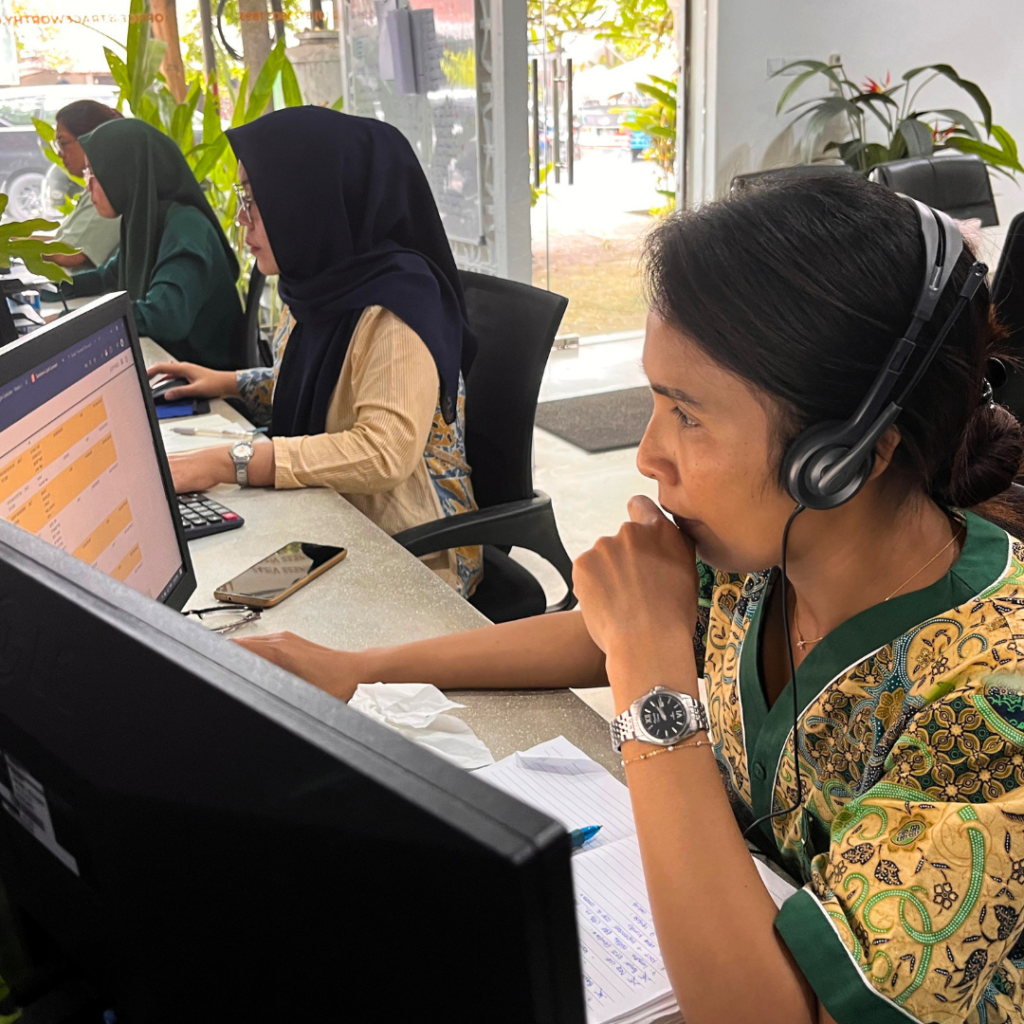
With the accounts rebuilt, Coretax does not accept filings for periods that fell due before the changeover, so those reports were submitted through the portal the tax authority keeps open for exactly those years. The company was then migrated into Coretax for its current obligations, its access activated and a representative set up to act for it, the step that had never been taken.
The payroll-tax history was cleared and the withholding slips issued to the staff, so the employees’ positions came current.
The fixed penalties were paid in full, set amounts under the law that the company met without any dispute.
Presenting the two late years to the tax office, and every exchange with it, was the work of TraceWorthy’s specialist team, native Indonesian speakers trained twice weekly on the finance and tax systems and the ever-changing regulatory environment.
Tracy Wilkinson had seen the shape many times across a long career, the capable founder whose business had outrun the administration beneath it. She read the business model in the rebuilt statements and tested whether it could still sustain the school. She then talked the founder through the systems he would need to stay operational and compliant, and reassured him that he did not have to understand all of it himself. What would help him most, she said, was a place in TraceWorthy’s workshops on financial obligations and the language of finance, so that he could work with the team and with any bookkeeper he might later hire.
For the dive school owner, the school meant the diving and the fifteen people it kept in work. The tax filings were the government’s to demand, and never why he had built it.
Left alone, the school faced mounting fixed penalties, interest on the tax paid late, tax-collection letters and the enforcement that follows them, the freezing of a license through OSS, and personal exposure for the owner as the company’s director. Government agencies run a Konfirmasi Status Wajib Pajak (KSWP, taxpayer status confirmation) before they grant many licenses and permits, and a valid status depends on the last two years of annual returns being filed. With those returns outstanding, the company would fail that check, and the licenses and permits that depend on it would be withheld.
Looking forward
Today the dive school and all of its employees are compliant, from the old pajak online records through to Coretax, and TraceWorthy runs the daily bookkeeping and every regulatory filing. The owner is back where he is useful, in the water and with his customers, and the tax that once overwhelmed him now belongs to people who do it for a living.
Coretax cross-matches a company’s figures against its suppliers, its customers, its banks, and other government records, so a missing return or a number that does not reconcile surfaces, and quickly. What took an experienced eye to find in this case, the system would now flag by default. The safest course is the one this owner reached in the end, which was to bring in help before the sanctions tightened any further.
If your filings have slipped behind, or you cannot say with certainty where your company stands with the tax office and the licensing system, we can establish the position and put it right. The sooner that work starts, the smaller the problem is. Speak to us.
Frequently asked questions
What happens if a company misses its tax filings in Indonesia?
Several effects run at once. Each late monthly return draws a fixed fine of IDR 100,000, and a late annual company return draws IDR 1,000,000. Tax paid late draws interest at a monthly rate set by the Minister of Finance. The tax office issues warning letters and then tax-collection letters for the arrears, and unreported investment activity exposes the company’s licenses to sanction through OSS.
Government agencies also run a taxpayer-status check, the Konfirmasi Status Wajib Pajak (KSWP), before granting many licences and permits, and that check turns on the company having filed its last two years of annual returns, so unfiled returns can see the licences and permits withheld.
Can a company that was left out of Coretax still be brought in and made current?
Yes. The recovery runs across both systems the transition left in place. The company is registered into Coretax for its current obligations, its access activated and a representative appointed to act for it. Returns for periods that fell due before the changeover cannot go through Coretax, so those are lodged through the portal the tax authority keeps open for exactly those years. From there the fines and interest are settled and the record brought current.
What does it cost to catch up on years of missed filings and payroll taxes?
The cost comes in two parts. The fixed fines and the interest are set by law, and the company settles them as billed. The larger effort is rebuilding the accounts from source documents, setting depreciation on the assets, setting amortisation on the leases, preparing and submitting financial statements and reports, and clearing the payroll-tax history for every employee. This is often a time-consuming exercise.
However, catching up costs less than the enforcement and the risk to the licenses that non-compliance invites.
Should an owner facing this engage an accountant, or something more?
This calls for an integrated team, because an accountant on their own is equipped for a company that already runs. An accountant keeps the books of a working company, recording transactions as they occur. A company two years behind has nothing for an accountant to keep, because the books and the standing with the tax office both have to be rebuilt first. That rebuilding is the specialist team’s work.
Set beside it is a judgment an accountant does not offer, which is reading whether the business model can sustain the company and equipping the owner to work with the people who keep it compliant. Restoring a company whose system has stopped working needs both.
Who is Tracy Wilkinson
Tracy Wilkinson is the founder of TraceWorthy and the strategist who sat with the founder through the story above. Across a forty-year career, and well over two hundred businesses set up and scaled since 1995, she has built a record of recognising a broken financial model before its numbers fail, and of seeing the pattern in a company’s figures that others miss. She has been a business and life coach since 1996, and that is the discipline she drew on to get the business owner back on track, taking responsibility for his company’s statutory compliance standing.
On the technical accounting and tax work, the authority sits with the specialists she assembled and trained. Her own contribution is the reading of a business as a whole, the business modelling that shows what a sound structure looks like, and the counsel that keeps a person functioning while a crisis is worked through. Tracy examined the business model behind the figures to assess the sustainability of the dive school, set out the systems the business owner would need to understand to stay operational and compliant, booked him into workshops to learn the finance language that would let him manage his own staff and providers, and steadied a man who had baulked at not knowing what to do about his company’s messy financial records.
The technical execution, the tax reconstruction and the systems work, together with the dealings with the authorities, belong to her specialist team. Her value is in judging whether a business model can sustain itself, and in giving a founder enough of the finance language to direct the specialists who serve it. She reminds a founder that a business is its people and its purpose first, and that the financial statements and the report filings are merely the tools a government requires to ensure it is compliant with the laws and regulations of Indonesia.
Who is TraceWorthy
TraceWorthy is an advisory practice serving businesses that operate in Indonesia, across legal, compliance, finance, tax, and immigration work. The team are native Indonesian speakers who train twice weekly on the regulations and the government systems as those change, and the practice improves its methods continuously so that a client’s problem is met with knowledge current to the day it arises.
TraceWorthy is built to be the calm head of reason when an owner has lost their footing, the practice that rebuilds what has fallen out of order and then keeps it in order, so that the founder can return to the work only they can do. The measure of the work shows in an owner back in the water, and in the jobs of the people the school still supports.