

Current as at 29 October 2026.
The Director General of Taxes issued Decree Number KEP-239/PJ/2026 on 8 October 2026, setting the percentage by which an administrative tax sanction can be reduced or removed for a taxpayer who applies by 1 October 2028.1 The percentage is fixed by the date a return is filed or the principal, which is the tax itself before any sanction, is paid. For late or amended returns, and for older tax letters whose principal is still unpaid, the highest tier of 100 per cent ends on 31 December 2026. The principal tax remains payable in every case, and tax penalty relief is granted only on a written application for each letter. Land and building tax on a villa or a house in Bali is a regional tax outside the decree, with fine waivers set by each regency and city.
What does KEP-239/PJ/2026 provide?
The decree implements Article 27A, which Peraturan Menteri Keuangan (PMK, Minister of Finance Regulation) Number 71 of 2026 inserted into PMK Number 118 of 2024 on corrections, objections, reductions and cancellations in taxation.2 PMK 71/2026 took effect on 2 October 2026 and authorises the Directorate General of Taxes to reduce or cancel administrative sanctions for up to two years from that date.7 KEP-239/PJ/2026 took effect on 8 October 2026 and sets out which sanctions qualify and the percentage that applies to each filing or payment date.
Neilmaldrin Noor, Expert Staff to the Minister of Finance for Tax Supervision, stated on 28 October 2026 that the programme reduces or removes administrative sanctions within a set period and leaves the principal tax payable.8 The Director General decides each application within six months of receiving it, and refuses an application that fails a condition, in which case the sanction remains payable.9
Which sanctions qualify for tax penalty relief?
The decree covers overdue returns and the tax letters in a taxpayer’s account in Coretax, the tax administration system: the Surat Ketetapan Pajak (SKP, tax assessment letter) and the Surat Tagihan Pajak (STP, tax collection letter).
| Category | What it covers | Condition |
|---|---|---|
| (a) Late return | Annual income tax returns for tax years up to 2025, and periodic returns for periods up to September 2026, showing tax underpaid | Return filed between 8 October 2026 and 30 June 2027 |
| (b) Voluntary amendment | The same returns, amended to show tax underpaid | Amended return filed and the tax paid in that period |
| (c) Late payment | Tax due under the same returns, showing tax underpaid, and paid late | Return filed and the tax paid in that period |
| (d) Audit letters issued from 8 October 2026 | SKP, land and building tax SKP, or STP issued after a tax audit between 8 October 2026 and 30 June 2027 | Principal paid by 30 June 2027 |
| (e) Letters issued before 8 October 2026 | Any SKP or STP, including land and building tax letters, issued earlier | Principal, tax debt or the required part of the sanction paid by 30 June 2027 |
| (f) Collection letters issued from 8 October 2026 | STP or land and building tax STP issued between 8 October 2026 and 30 June 2027 | Principal, tax debt or the required part of the sanction paid by 30 June 2027 |
| (g) Voluntary Disclosure Programme assessments | SKP on assets undisclosed or under-disclosed in the 2022 programme, issued between 8 October 2026 and 31 December 2027 | Principal paid by 31 December 2027 |
Individuals and companies that register voluntarily for a tax number, or are confirmed voluntarily as Pengusaha Kena Pajak (PKP, VAT-registered business), receive the same tiers on late filing and late payment, set by the date the return is filed, for returns up to tax year 2025 and periods up to September 2026 that show tax underpaid.11
Which dates set the percentage?
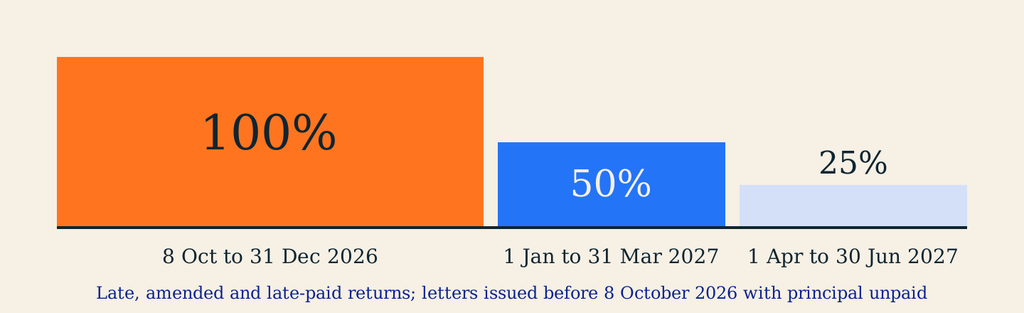
Find the row for the sanction, then read across to the date of filing or payment.
| Sanction | 100% removed | 50% removed | 25% removed | Final date |
|---|---|---|---|---|
| Late return, amended return or late payment, on a return showing tax underpaid | Filed, and for an amendment or late payment the tax paid, 8 October to 31 December 2026 | 1 January to 31 March 2027 | 1 April to 30 June 2027 | 30 June 2027 |
| Assessment from a tax audit, issued from 8 October 2026 | Principal paid within one month of the letter, or by 31 December 2026 for a letter issued in 2026 | Paid one to two months after the letter | Paid after two months | 30 June 2027 |
| Collection letter issued from 8 October 2026 for current-year tax left unpaid | Principal paid within one month of the letter | Paid one to two months after the letter | Paid after two months | 30 June 2027 |
| Letter issued before 8 October 2026 with the principal unpaid on that date, including interest on an approved instalment or deferral | Principal paid by 31 December 2026 | Paid 1 January to 31 March 2027 | Paid 1 April to 30 June 2027 | 30 June 2027 |
| Assessment under the 2022 Voluntary Disclosure Programme, issued 8 October 2026 to 31 December 2027 | Principal paid within one month of the letter, or by 31 December 2026 | Paid one to two months after the letter | Paid after two months | 31 December 2027 |
An amendment counts as completed only when the amended return is filed and the tax is paid, so the sanction on a return amended in December 2026 and paid in February 2027 is reduced by 50 per cent. The instalment and deferral interest in the fourth row is charged under Article 19(2) of the Undang-Undang Ketentuan Umum dan Tata Cara Perpajakan (KUP Law, General Provisions and Tax Procedures Law).11
Where there is no unpaid principal to settle, the relief is obtained by paying part of the sanction itself.1
| Sanction | Pay 10%, and 90% is removed | Pay 25%, and 75% is removed |
|---|---|---|
| Any sanction in a letter issued before 8 October 2026 whose principal was paid before that date, including the invoice fine and a fine with no principal tax | Payment by 31 December 2026 | Payment 1 January to 30 June 2027 |
| Late-filing, amendment, late-payment or invoice sanction in a collection letter issued 8 October 2026 to 30 June 2027, where the principal was paid before 8 October 2026 or there is none | Payment by 31 December 2026, or within one month of the letter | Payment after that month, up to 30 June 2027 |
The invoice fine is 1 per cent of the tax base, imposed on a VAT-registered business that issues a tax invoice late or does not issue one.11
Does the relief cover nil returns from a dormant company?
The late-filing fine on a nil return is a sanction with no principal tax, and the Directorate General’s guidance on the programme sets the partial-payment route as the scheme for sanctions of that kind.11
| Position of the nil return | Relief available |
|---|---|
| The late nil return itself, filed now | None on the filing route, which requires a return showing tax underpaid |
| Fine billed in a collection letter issued before 8 October 2026 | Pay 10% by 31 December 2026 and 90% is removed; pay 25% between 1 January and 30 June 2027 and 75% is removed |
| Fine billed in a collection letter issued 8 October 2026 to 30 June 2027 | Pay 10% by 31 December 2026 or within one month of the letter and 90% is removed; pay 25% after that month, up to 30 June 2027, and 75% is removed |
| Fine billed in a collection letter issued after 30 June 2027 | Outside the programme |
The tax office sets the issue date of the collection letter, so a company that files its overdue nil returns before the end of 2026 gives the tax office the most time to issue the letter within the period. Before a dormant company pays anything, list every collection letter in its Coretax account by issue date and by type of sanction, because the category and the percentage depend on the issue date. Our team confirms the treatment of each type of letter with the client’s registered tax office on the first application.
In what order should you pay and apply?
Under PMK 71/2026, a payment against a letter is applied to the principal first, and only the excess is applied to the sanction.11 Relief applies only to a sanction that remains unpaid, so once a collection letter has been paid in full, sanction included, no sanction remains to reduce. Our team performs a letter-by-letter relief reconciliation for each client, in these steps:
- download the tax account statement and every SKP and STP from Coretax;
- assign each letter and each overdue return to its category, recording the issue date and whether the principal has been paid;
- file or amend the returns and pay the principal within the period in which the highest percentage still available applies;
- where the principal was paid before 8 October 2026, pay 10 per cent of the sanction by 31 December 2026 and leave the remainder unpaid;
- lodge one application for each letter through Coretax, with the stamped statements and any withdrawal letter;
- record the date of each decision, because a second application for the same letter has to be lodged within three months of it.
An application lodged up to 1 October 2028 is in time, and its percentage is the one fixed by the filing or payment date in 2026 or 2027.
What must the application contain?

Each application covers one letter and is written in Indonesian. The decree and PMK 118/2024 add these conditions:
- the principal tax underlying the sanction has been paid;
- a stamped statement confirms that no lawsuit or other legal remedy has been filed, or the letter withdrawing it is attached;
- a stamped statement confirms that the sanction arose from an oversight or was not the taxpayer’s fault;
- the application is lodged before any request to auction seized goods;
- the sanction itself has not been paid.
The statement of oversight is a signed declaration of fact, so a taxpayer signs it only where it is accurate. A taxpayer may apply twice for the same letter at most, and a fine on land and building tax may be the subject of one application only. In Coretax the application is lodged under the taxpayer services menu as service AS.26-03, and the system issues an electronic receipt on submission.9
What if an objection or appeal is already lodged?
PMK 71/2026 excludes the 30 per cent sanction imposed after an objection decision that is not appealed, the 60 per cent sanction imposed after an appeal decision, and the 60 per cent sanction imposed after a judicial review verdict.11
For the sanctions in an assessment letter, PMK 118/2024 allows an application only where no objection was filed, where the objection was withdrawn and the Director General approved the withdrawal, or where the objection was filed and not considered.2 Any lawsuit or other legal remedy has to be withdrawn, with evidence of the withdrawal attached.
Interest charged in a collection letter for late payment of an assessment that was the subject of an objection is removed in full if the tax debt is paid by 31 December 2026, halved if it is paid between 1 January and 31 March 2027, and reduced by a quarter if it is paid between 1 April and 30 June 2027.11
Once an objection is withdrawn, the principal in the assessment is payable as assessed.
For each disputed letter, compare the sanction the decree would remove with the principal the objection could reduce, and with the cost of paying that principal now for the expected duration of the dispute.
Does the relief cover land and building tax on a Bali villa?
The land and building tax within PMK 71/2026 is PBB-P5L, the Pajak Bumi dan Bangunan (PBB, land and building tax) on plantation, forestry, mining and other sectors, which the Directorate General of Taxes administers.10 Tax on a villa or a house is Pajak Bumi dan Bangunan Perdesaan dan Perkotaan (PBB-P2, rural and urban land and building tax), which Article 4(2) of Law Number 1 of 2022 assigns to the regency or city government.3
In Denpasar, Mayor of Denpasar Regulation Number 3 of 2026 waives PBB-P2 fines for tax years up to 2025 without any application, until 30 November 2026.4 Regulation Number 3 of 2026 also reduces the 2026 principal on residential, non-commercial property whose assessment rose by 20 per cent or more after the value adjustment, by up to 37.5 per cent, and excludes object numbers first issued in 2026.
In Tabanan, Regent of Tabanan Regulation Number 13 of 2026 waives PBB-P2 fines for tax years 1994 to 2026 from 30 March to 31 December 2026, without any application, by deleting the fines in the regency’s PBB-P2 system. A taxpayer who receives that waiver may not then apply to pay the remaining tax by instalments or to defer it.5
Badung’s Regent Regulation Number 9 of 2026 contains no fine waiver. It reduces the PBB-P2 principal automatically, at a rate between 5 and 50 per cent set by how far the current assessment exceeds the 2024 assessment. No reduction applies where the assessment fell or stayed the same, where there was no assessment in the previous year, or where the building area was enlarged or changed.6
No 2026 regulation waiving PBB-P2 fines in Badung or Gianyar appears in the Audit Board’s legal database as at 29 October 2026.
An owner in Badung or Gianyar settles the principal shown on the Surat Pemberitahuan Pajak Terutang (SPPT, annual land and building tax notice) with the regency’s revenue agency, and we confirm with the agency whether a waiver is open before payment is made.
How does TraceWorthy help?
Our tax team performs a letter-by-letter relief reconciliation of each client’s Coretax account, reading every letter against the tables the Directorate General publishes for the programme and assigning each sanction to its category under KEP-239/PJ/2026.
We schedule each payment for the date on which the highest percentage still available applies, and we draft each application and stamped statement in Indonesian.
We lodge the application through Coretax and record the decision date, so that any second application is lodged within three months.
For property in Bali, we reconcile the PBB-P2 position with the regency or city revenue agency and arrange payment under the regional programme that applies.

TraceWorthy’s team includes qualified and experienced lawyers, accountants, tax specialists, compliance experts and immigration specialists, alongside the community, business and people development skills that Tracy Wilkinson brings herself. We perform this work for clients in Indonesia and overseas. To have your company’s tax penalty relief position and your property tax position set out before 31 December 2026, schedule a consultation with our team.
This article is general information and is current as at 29 October 2026. The percentages and conditions for each sanction are set out in the appendix to KEP-239/PJ/2026, and regional land and building tax programmes change by regency and city, so the result for any taxpayer depends on its own filing and payment dates. It is no substitute for advice on a taxpayer’s own position, and it creates no advisory relationship.
Frequently asked questions
The Ministry of Finance describes the programme as a reduction or removal of administrative sanctions within a set period. The principal tax remains payable in full, and the relief applies to sanctions only.
Applications must reach the Director General of Taxes by 1 October 2028. The percentage is fixed before the application, by the date a return is filed or a principal amount is paid, and the 100 per cent tier for late and amended returns, and for older letters with unpaid principal, ends on 31 December 2026.
Relief applies only to a sanction that remains unpaid. Where the principal was paid before 8 October 2026 and the sanction is outstanding, a taxpayer who pays 10 per cent of the sanction by 31 December 2026 has the remaining 90 per cent removed.
Land and building tax on a villa or a house is PBB-P2, a regional tax assigned to the regency or city and outside KEP-239/PJ/2026. Denpasar and Tabanan have published PBB-P2 fine waivers for 2026, ending on 30 November 2026 and 31 December 2026. Badung’s 2026 regulation reduces principal and waives no fines.
The taxpayer lodges one application for each letter through Coretax, as service AS.26-03, written in Indonesian. The application attaches the stamped statements on legal remedies and on oversight, any withdrawal letter, and the letter concerned.
Legal References
1. Director General of Taxes Decree Number KEP-239/PJ/2026 on Tax Policy concerning the Reduction or Removal of Administrative Sanctions (Keputusan Direktur Jenderal Pajak Nomor KEP-239/PJ/2026). Diktum Kesatu to Keempat and Lampiran.
2. Minister of Finance Regulation Number 118 of 2024 on Procedures for Correction, Objection, Reduction, Removal and Cancellation in Taxation, as amended by Minister of Finance Regulation Number 71 of 2026 (Peraturan Menteri Keuangan Nomor 118 Tahun 2024 sebagaimana diubah dengan Peraturan Menteri Keuangan Nomor 71 Tahun 2026). Articles 23, 24, 27A and 29.
3. Law Number 1 of 2022 on Financial Relations between the Central Government and Regional Governments (Undang-Undang Nomor 1 Tahun 2022 tentang Hubungan Keuangan antara Pemerintah Pusat dan Pemerintahan Daerah). Article 4(2).
4. Mayor of Denpasar Regulation Number 3 of 2026 on the Reduction of 2026 Tax Principal and the Waiver of Administrative Fines on Regional Taxes for Tax Periods up to 2025 (Peraturan Walikota Denpasar Nomor 3 Tahun 2026), enacted and promulgated 26 January 2026. Articles 4 to 7 and Lampiran.
5. Regent of Tabanan Regulation Number 13 of 2026 on the Waiver of Payment of Administrative Sanctions on Rural and Urban Land and Building Tax (Peraturan Bupati Tabanan Nomor 13 Tahun 2026 tentang Pemberian Pembebasan Pembayaran atas Sanksi Administratif Pajak Bumi dan Bangunan Perdesaan dan Perkotaan), enacted and promulgated 30 March 2026. Articles 2 to 4 and 6.
6. Regent of Badung Regulation Number 9 of 2026 on the Reduction of Principal of Rural and Urban Land and Building Tax (Peraturan Bupati Badung Nomor 9 Tahun 2026 tentang Pemberian Pengurangan atas Pokok Pajak Bumi dan Bangunan Perdesaan dan Perkotaan), enacted and promulgated 25 May 2026. Article 2 and Lampiran.
Research and Data Sources
1. PwC Indonesia, TaxFlash Volume 14 of 2026, 22 October 2026.
2. detikFinance, Ministry of Finance briefing on PMK 71/2026, 28 October 2026.
3. DDTCNews, applying for reduction or removal of tax sanctions through Coretax, October 2026.
4. Directorate General of Taxes, on the administration of PBB-P5L and PBB-P2.
5. Directorate General of Taxes, guidance on PMK 71/2026 and KEP-239/PJ/2026, October 2026.