

Part of the series: Bali Property Compliance
- SLF, KBLI 2025, and Short-Stay Villas
- Nominee Arrangements in Property Monetisation
- KBLI 2025 and Your PT PMA: What Is Now Live and What You Must Verify
- Indonesia Residence Pathways: A Decision Framework for Foreign Nationals Planning Long-Term Stays
- Property Acquisition in Bali: A Due Diligence Framework for Foreign Nationals
- PT PMA Restrictions in Bali: Why the Property Workarounds No Longer Work
- Foreign Land Ownership in Bali: The Lines a Lawful Structure Will Not Cross
This article is designed as a reference document. Its purpose is to map the available residence pathways in Indonesia against the profiles of the foreign nationals most likely to seek each one, so that the reader can identify the pathway that fits their situation and understand the principal compliance obligations attached to it before seeking specific advice.
Every foreign national who intends to reside in Indonesia beyond a short-term tourist stay is entering a permit system with multiple entry points, distinct eligibility conditions, and compliance obligations that continue for the duration of the stay. The Indonesian residence system does not operate on a single permit type. It operates on a structured progression: an entry visa leads to a limited stay permit, which in most categories can eventually progress to a permanent stay permit. Each step in that progression has its own documentation requirements, its own sponsor obligations, and its own restrictions on activities the permit holder is permitted to undertake.
TraceWorthy routinely receives enquiries from foreign nationals who have already entered Indonesia on a short-term visa and are now attempting to determine which permit they should have applied for before arriving. The correct answer depends on the purpose of the stay, the nature of any business or employment relationship, the applicant’s age and financial position, and whether there are family members whose status also needs to be structured. Identifying the right pathway before making any commitments, whether to a PT PMA structure, a property transaction, or an employment arrangement, determines whether the residence position is compliant from the outset or requires remediation from the start.
How the Indonesian Residence System Works
The Indonesian Immigration Law (Law No. 6 of 2011 and its implementing regulations) structures lawful long-term residence through two sequential permit types.
The Izin Tinggal Terbatas (ITAS), commonly known by the physical card’s name, the Kartu Izin Tinggal Terbatas (KITAS), is the limited stay permit. It is issued for a specific purpose (work, investment, family reunification, retirement, study, or social-cultural activity) and for a defined duration, typically one to two years per issuance. The KITAS does not automatically confer work authorisation. Work authorisation under a separate instrument (the RPTKA, or Expatriate Utilisation Plan) is required for employment relationships in Indonesia and must be obtained alongside or in advance of the Work KITAS.
The Izin Tinggal Tetap (ITAP), or KITAP, is the permanent stay permit. It is available to KITAS holders who have satisfied a qualifying continuous residence period in the same permit category. KITAP is valid for five years and is renewable. It provides broader rights than the KITAS across most categories.
Indonesia’s immigration system provides three distinct application pathways for obtaining a KITAS, and the appropriate pathway depends on where the client is and which visa they are travelling on when they engage TraceWorthy.
The offshore pathway is available to clients who are outside Indonesia when the process begins. TraceWorthy submits the application through the evisa.imigrasi.go.id government portal, which consolidated all visa and stay permit services in 2024 and replaced earlier paper-based processes including the VITAS. The e-Visa is typically issued within five to ten working days. The client enters Indonesia on the e-Visa and the ITAS stamp is issued at the immigration checkpoint on arrival. The physical KITAS card follows, delivered digitally.
The onshore Alih Status (Altus) pathway is available to clients already in Indonesia on a qualifying D-class multiple-entry visit visa, provided at least 30 days of validity remain on that visa at the point the application is lodged. TraceWorthy submits the Alih Status application through evisa.imigrasi.go.id. The client attends the relevant immigration office for biometric capture and the KITAS is issued, typically within three to four weeks.
Entry on a Visa on Arrival (B-index, 30 days), a 7-day Visa on Arrival (F-index), or a Visa Exemption (A-index) does not qualify for onshore Alih Status. Clients in Indonesia on any of these entry types must pursue the offshore pathway or the exit-and-return route described below.
The D12 pre-investment visa is the visa most commonly held by TraceWorthy’s clients who pursue onshore Alih Status to an Investor KITAS. The D12 is a multiple-entry pre-investment visa under Keputusan Menteri Imigrasi Dan Pemasyarakatan Nomor M.IP-08.GR.01.01 Tahun 2025 (Decree of the Minister of Immigration and Corrections Number M.IP-08.GR.01.01 of 2025), valid for one or two years with a maximum stay of 180 days per entry. It permits pre-investment activities including field surveys, feasibility assessments, preliminary market research, and preparatory business meetings. The D12 can be converted to an Investor KITAS (E28A) through onshore Alih Status. Onshore applications for the D12 itself are no longer available; the D12 must be obtained through evisa.imigrasi.go.id before entering Indonesia. A bank statement showing a minimum balance of USD 5,000 for the three months prior to application is required.
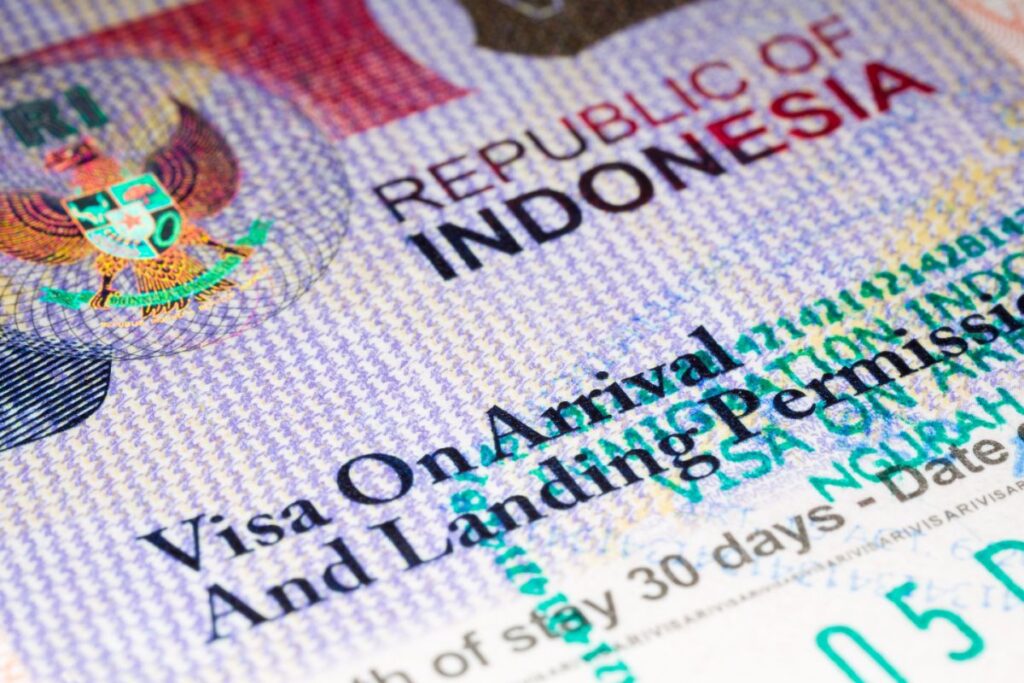
The exit-and-return pathway applies where a client is already in Indonesia on a Visa on Arrival or other non-qualifying entry when they engage TraceWorthy. The client departs Indonesia, often combining the departure with a stay elsewhere, while TraceWorthy obtains the D12 e-Visa through the government portal. The client then re-enters on the D12, which qualifies for onshore Alih Status to the KITAS. Depending on the destination and the client’s individual circumstances, this pathway is often less expensive and less time-consuming than alternative approaches to resolving a non-qualifying entry status.
The E33G remote worker pathway operates differently from the investment routes described above. An applicant outside Indonesia applies for the E33G directly as a Temporary Stay Visa (E-index) through evisa.imigrasi.go.id; no prior visit visa is required. The E33G e-Visa is issued and the client enters Indonesia on it, with the KITAS processed on arrival. An applicant already in Indonesia on a qualifying C or D-class visit visa can apply for Alih Status to the E33G from within Indonesia, subject to the 30-day minimum remaining validity requirement. The D12 pre-investment visa is not the appropriate entry vehicle for E33G applicants, as the D12 is designated for pre-investment activities and not for remote employment purposes. For clients in Indonesia on a Visa on Arrival, the exit-and-return approach applies: the client departs, TraceWorthy applies for the E33G e-Visa, and the client enters Indonesia on it. No D12 step is involved in this sequence.
The E33G requires a formal employment contract with a company registered outside Indonesia. The permit is not available to freelancers who do not have such a contract with a qualifying foreign entity. The minimum annual income requirement is USD 60,000, with a bank balance of USD 2,000 for the three prior months for offshore applicants. Onshore Alih Status applicants are subject to a higher bank balance requirement; this figure should be confirmed through TraceWorthy at the time of application, as it is drawn from operational guidance rather than published regulatory text.
All applications, regardless of pathway, are managed by TraceWorthy through evisa.imigrasi.go.id on behalf of clients. Since May 2025, all stay permit extensions require the applicant’s physical attendance at the relevant immigration office; this regulatory requirement cannot be delegated, and TraceWorthy manages the documentation and scheduling sequence around the attendance obligation.
The Comparison Table
The table below maps each of the principal residence pathways by profile, duration, sponsor requirement, work authorisation status, the primary financial threshold, and whether the pathway leads to KITAP eligibility. The figures indicated are operative as of the publication date. Immigration thresholds and requirements change periodically; TraceWorthy confirms current requirements at the time of each application.
| Pathway | Who It Suits | Single Period Duration | Sponsor | Work Authorisation | Primary Financial Threshold | Leads to KITAP |
|---|---|---|---|---|---|---|
| Work KITAS | Foreign nationals employed by Indonesian companies | 12 or 24 months | Indonesian employer (PT, PT PMA, representative office) | Yes (RPTKA and IMTA required in addition to KITAS) | Salary set by RPTKA; no general minimum | Yes, after continuous qualifying period |
| Investor KITAS | Shareholders or directors of PT PMA entities actively managing their investment | Up to 24 months | PT PMA company | No; a separate work permit (RPTKA/IMTA) is required for employment income | IDR 10 billion minimum authorised capital in the PT PMA | Yes, after continuous qualifying period |
| E33G Remote Worker KITAS | Foreign nationals formally employed by non-Indonesian companies working remotely from Indonesia; formal employment contract required; not available to freelancers without a qualifying contract | 12 months | Licensed sponsor or agent | No; all income must originate outside Indonesian territory | Annual income of at least USD 60,000; bank balance of at least USD 2,000 (offshore) for three months prior to application; onshore applicants subject to a higher threshold; confirm through TraceWorthy at time of application | No |
| Retirement KITAS (Silver Hair) | Foreign nationals aged 55 and above intending to retire in Indonesia | 12 months, renewable | Approved retirement sponsor | None (work and business activity not permitted) | Proof of pension or retirement income at the applicable monthly threshold; health insurance required | Yes, after continuous qualifying period |
| Second Home Visa | Long-term residents, investors, and retirees with significant capital seeking multi-year stays without annual renewals | 5 or 10 years | None required | No local employment; remote work for overseas companies permitted | Bank deposit or real estate purchase of at least IDR 2 billion (approximately USD 130,000) in Indonesia | Yes, after three years of continuous residence |
| Golden Visa | High-net-worth individual investors, corporate principals | 5 or 10 years | None required | Depends on route; consult TraceWorthy for current framework | Individual: from IDR 5.3 billion (5-year) upward; Corporate director/commissioner routes from USD 25 million | Yes, after qualifying period |
| Dependant KITAS | Spouses and children of KITAS holders; spouses of Indonesian citizens | Matches primary KITAS holder’s duration | Primary KITAS holder or Indonesian citizen spouse | Generally none; spouses of Indonesian citizens have separate rights | No general threshold; dependent on primary holder’s compliance | Spouses of Indonesian citizens: after two years of marriage and KITAS holding |
| Student KITAS | International students enrolled at accredited Indonesian educational institutions | Duration of academic programme (typically 12 months, renewable) | Accredited educational institution | None | Proof of enrolment; no general income threshold | No |
| Social Cultural KITAS | Researchers, NGO workers, religious workers, and others engaged in non-commercial activities | 12 months | Indonesian sponsoring organisation | Limited; specific to approved social or cultural activity | No general threshold | Yes, for certain subcategories after continuous qualifying period |
The Pathways in Detail
Work KITAS
The Work KITAS is the appropriate pathway for foreign nationals who have accepted employment with an Indonesian company (whether a PT, PT PMA, or representative office). The employer must first obtain an Expatriate Utilisation Plan (RPTKA) approval from the Ministry of Manpower, which confirms that the specific role is open to foreign nationals and that the employment conditions meet the applicable regulatory standards. The Work KITAS is then issued on the basis of the approved RPTKA.
The Work KITAS and the RPTKA are distinct instruments. The RPTKA authorises the employer to engage a foreign worker. The KITAS authorises the foreign worker to reside. Both are required for lawful employment, and both must be maintained in alignment throughout the employment relationship.
Work KITAS holders are required to register with BPJS Ketenagakerjaan (employment social security) and BPJS Kesehatan (health insurance). Employers carry the obligation to make the required contributions.
A full treatment of the Work KITAS, including the RPTKA sequence, the position categories open to foreign nationals, and the extension process, will be covered in the dedicated Work KITAS article in this series.
Investor KITAS
The Investor KITAS is issued to foreign nationals with a shareholding or directorship position in a PT PMA entity and are actively managing their investment in Indonesia. The sponsor is the PT PMA company itself.
The Investor KITAS does not include work authorisation. A foreign national who is both a shareholder and a working director drawing a salary from the PT PMA requires both an Investor KITAS and a separate work permit (RPTKA and IMTA). The Investor KITAS and the Work KITAS serve different functions and cannot substitute for each other.
The minimum authorised capital requirement for a PT PMA, at IDR 10 billion per KBLI code per project location under BKPM Regulation No. 5 of 2025, is the relevant financial threshold for the Investor KITAS. The KITAS application will require documentation of the PT PMA’s establishment, the applicant’s share register position, and the NIB.
A full treatment of the Investor KITAS, including the document sequence, the extension process, and the interaction with the PT PMA’s LKPM and annual report obligations, is covered in the dedicated Investor KITAS article in this series.
E33G Remote Worker KITAS
The E33G pathway was introduced in 2023 as Indonesia’s formal response to the demand from digital nomads and remote workers for a lawful long-term residence option that does not require local employment or an Indonesian corporate sponsor.
Two eligibility conditions define the E33G. First, the applicant must present a formal employment contract with a company registered outside Indonesia. The permit is not available to freelancers who work independently without such a contract. Second, all income must be generated entirely outside Indonesian territory. An E33G KITAS holder who receives income from Indonesian clients or Indonesian business activities is in breach of the permit’s conditions, and the consequences include permit revocation and deportation.
The applicable financial thresholds are a minimum annual income of USD 60,000 and a minimum bank balance of USD 2,000 for the three months prior to application for offshore applicants. Onshore Alih Status applicants are subject to a higher bank balance requirement. These figures are drawn from current operational guidance and should be confirmed through TraceWorthy at the time of application, as they are not reproduced verbatim in published regulatory text.
The E33G does not lead to KITAP. A foreign national whose circumstances change, for example by establishing a PT PMA, will need to transition to a different permit category, typically an Investor KITAS, before a KITAP pathway becomes available.
A full treatment of the E33G remote worker pathway, including sponsor requirements, the renewal process, and the transition to Investor KITAS for those who later establish a PT PMA, is covered in the dedicated E33G article in this series.
Retirement KITAS
The Retirement KITAS, also referred to in Indonesian immigration administration as the Silver Hair permit, is available to foreign nationals aged 55 and above who wish to retire in Indonesia. The permit is issued for one year at a time and is renewable. Work and business activity are not permitted under this pathway.
The financial requirement is proof of a pension or retirement income at the applicable monthly threshold. Health insurance covering the period of the proposed stay is also required. The precise income threshold is subject to periodic revision; TraceWorthy confirms the applicable figure at the time of each application.
An important procedural note: applicants for the Retirement KITAS should generally apply through an Indonesian embassy or consulate in their country of residence before travelling to Indonesia. Converting a tourist visa to a Retirement KITAS within Indonesia is not a standard pathway and introduces procedural risk.
A full treatment of the Retirement KITAS, including the sponsor mechanic, the health insurance requirements, the renewal sequence, and the healthcare considerations for long-term retirees, is covered in the dedicated Retirement KITAS article in this series.
Second Home Visa
The Second Home Visa provides a five or ten-year residence option for foreign nationals who can demonstrate the required capital commitment: a minimum bank deposit of IDR 2 billion, equivalent to approximately USD 130,000, in an Indonesian bank, or a property purchase of equivalent value. The visa does not require annual renewal, which is a significant practical advantage over annual KITAS renewal for those who qualify.
The Second Home Visa does not authorise local employment. Remote work for non-Indonesian employers is permitted. The visa leads to KITAP eligibility after three years of continuous residence in Indonesia.
Immediate family members of Second Home Visa holders can obtain long-term visas and residency through the associated family provisions.
Dependant KITAS and Family Pathways
A full treatment of the dependant and family pathways, including the sequencing of applications for families relocating together, the student pathway for children at Indonesian schools or universities, and the position of spouses of Indonesian citizens, is covered in the dedicated family pathways article in this series.
The core principle applicable to all dependant KITAS applications is that the permit’s duration, conditions, and validity are tied to the primary KITAS holder’s position. If the primary holder’s KITAS lapses, the dependant KITAS lapses with it. Planning the renewal sequence for the primary KITAS must account for all dependant permits attached to it.
The Path to KITAP
Most KITAS categories provide a pathway to KITAP after a qualifying continuous residence period in Indonesia. The qualifying period varies by category and by the individual immigration officer’s assessment of the application. As a general guide, the Work KITAS typically requires a minimum of five years’ continuous holding before KITAP eligibility is assessed. The Investor KITAS and Retirement KITAS categories generally require between three and five years of continuous holding, and the Second Home Visa requires three years.
KITAP grants five-year stays per issuance and reduces the administrative burden of annual renewals that applies to most KITAS categories. KITAP holders are eligible for the foreigner e-KTP identification card and generally receive stronger recognition from Indonesian financial institutions for banking, lending, and property-related transactions.
The KITAP application process includes background verification and, in many cases, a home visit by immigration officers. Applications should be submitted well in advance of the qualifying KITAS expiry date.
Compliance Obligations Common to All KITAS Categories
Several compliance obligations apply across most KITAS categories, regardless of the specific pathway.
The Surat Keterangan Tempat Tinggal (SKTT) is the local residence certificate issued by the civil registration authority. KITAS holders are required to register their address and obtain the SKTT from the local Dinas Kependudukan dan Pencatatan Sipil (Disdukcapil) within a defined period of arrival or address change. Failure to maintain a current SKTT creates a compliance gap that surfaces during KITAS renewal and at any government interaction requiring proof of registered address.
Tax residency is a separate and parallel obligation. A foreign national who is present in Indonesia for 183 days or more within a twelve-month period becomes a tax resident for Indonesian income tax purposes. Tax residency triggers the obligation to report worldwide income to the Indonesian tax authority. The KITAS category held by the foreign national does not affect the tax residency determination, which is based on physical presence.
BPJS Ketenagakerjaan and BPJS Kesehatan registration obligations apply to Work KITAS holders through their employer and to Investor KITAS holders through their PT PMA. Other categories should confirm the applicable BPJS position with TraceWorthy at the time of application.
The in-person extension requirement introduced in May 2025 means that every KITAS renewal requires the applicant’s physical attendance at the relevant immigration office. For clients based in Bali, the offices in Denpasar, and the newer offices planned for Tabanan and Klungkung, service the main residential and business areas of the island. TraceWorthy coordinates the renewal process for clients and manages the documentation sequence; the attendance obligation rests with the permit holder.
Why the Pathway Decision Matters Before Commitment
The most common enquiry pattern TraceWorthy receives on residence pathways follows a consistent structure: the foreign national has already arrived in Indonesia, is operating under a tourist visa extension, has either committed to a PT PMA structure or is running a business without one, and is now attempting to regularise a position that was not structured correctly at the outset.
The cost of remediation is higher than the cost of early structuring. A foreign national who establishes a PT PMA on the basis of an Investor KITAS, and who later requires a Work KITAS because they are drawing a salary from the company, needs an RPTKA before the Work KITAS can be issued. The RPTKA application requires time and preparation. If the salary arrangement predates the RPTKA, the period of remuneration without a work permit is a compliance gap in the employment record.
Similarly, a foreign national who operates on the E33G pathway and later begins receiving income from Indonesian clients has breached the conditions of their current permit rather than transitioned to an appropriate one. The correct sequence is to transition to an Investor KITAS first and then develop the local income position.
Selecting the right pathway at the point of initial planning determines whether the subsequent years of residence are compliant from the first day or are spent managing the residual risk of an incorrect early decision.
Conclusion
The Indonesian residence permit system provides a structured and accessible framework for foreign nationals who commit to understanding it correctly before making commitments that depend on it. Each pathway has a defined profile, a defined compliance obligation, and a defined progression to longer-term status.
This article provides the comparative framework. The individual pathway articles in this series, covering the Investor KITAS, the E33G remote worker route, the Retirement KITAS, and family and dependant pathways in full detail, provide the operational guidance for each specific permit type.
Contact TraceWorthy to identify which pathway applies to your situation, to plan the application sequence, or to assess a current residence position that may require regularisation.
Glossary
| Indonesian Term | Abbreviation | English Translation or Explanation |
|---|---|---|
| Dinas Kependudukan dan Pencatatan Sipil | Disdukcapil | Civil registration and vital statistics authority at the regency or city level; issues the SKTT local residence certificate to registered KITAS holders |
| Izin Mempekerjakan Tenaga Kerja Asing | IMTA | Work Permit for Foreign Workers; issued by the Ministry of Manpower; required alongside the RPTKA for a Work KITAS holder to lawfully receive employment income from an Indonesian company |
| Izin Tinggal Terbatas | ITAS/KITAS | Limited Stay Permit; the temporary residence status issued for a defined purpose and duration. KITAS refers to the physical card. |
| Izin Tinggal Tetap | ITAP/KITAP | Permanent Stay Permit; issued for five years; available to KITAS holders who have satisfied the qualifying continuous residence period for their permit category |
| Kartu Tanda Penduduk Orang Asing | e-KTP OA | Foreigner Resident Identity Card; available to KITAP holders; the Indonesian national identification card for foreign permanent residents |
| Rencana Penggunaan Tenaga Kerja Asing | RPTKA | Expatriate Utilisation Plan; the company-level approval from the Ministry of Manpower that authorises an Indonesian entity to employ a named foreign national in a specific role; required before a Work KITAS can be issued |
| Surat Keterangan Tempat Tinggal | SKTT | Local Residence Certificate; issued by the Disdukcapil; required to be obtained by KITAS holders following registration of a residential address |
| e-Visa | Indonesia’s online immigration visa application system, which replaced the VITAS (Visa Izin Tinggal Terbatas) paper-based process; the pre-arrival entry mechanism for foreign nationals applying for a KITAS, managed through the Directorate General of Immigration‘s online platform |