
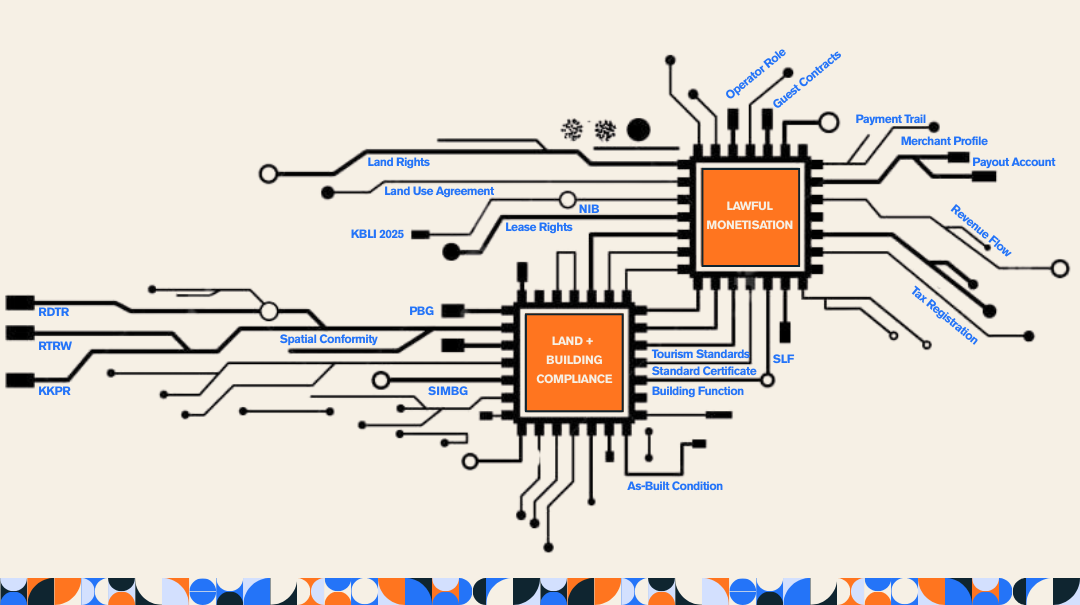
Why a management company leaves the core issue unresolved, and which evidence supports a lawful pathway
Many property monetisation models in Indonesia were built in an environment where paperwork gaps, fragmented digital systems, and light-touch platform onboarding gave investors room to keep moving while the underlying legal position remained weak. That environment is changing.
Indonesia’s regulatory architecture now places far more weight on sequencing. Business licensing sits inside a broader chain of approvals and supporting evidence. Spatial compliance, building approvals, functional fitness, activity classification, and operator responsibility all feed into the question of whether revenue generation can continue on a stable legal foundation.
For the short-stay accommodation market, that shift exposes a recurring weakness. A third-party manager may run the day-to-day operation. A third-party manager does little for a misaligned operator role, missing building prerequisites, or an evidence trail that points in the wrong direction.
Key takeaways
- KBLI 2025 is now the governing business activity classification reference. Administrative lag changes very little in the legal analysis.
- Government Regulation No. 28 of 2025 on the Implementation of Risk-Based Business Licensing places Persetujuan Bangunan Gedung / Building Construction Approval (PBG) and Sertifikat Laik Fungsi / Certificate of Function Worthiness (SLF) within the basic requirements stage in risk-based licensing, which means the building pathway now feeds directly into the monetisation pathway.
- Sertifikat Laik Fungsi / Certificate of Function Worthiness (SLF) is a building-use gateway issued by local government. It belongs to the building governance file, rather than the tourism licensing file.
- A management company arrangement usually leaves the owner in the principal operator position in substance, particularly under KBLI 55901 Aktivitas Jasa Manajemen Akomodasi / Accommodation Management Services Activities.
- A lawful pathway depends on role separation evidenced across contracts, payment records, licensing outputs, building governance records, and the operator’s day-to-day responsibilities.
Where a lease sits between land title and monetisation, agreement design and authorised capacity become central to the legal analysis.
The building pathway comes before the revenue pathway
The foundation of any legal monetisation route for real estate in Indonesia is the Sertifikat Laik Fungsi (SLF), or Certificate of Function Worthiness. SLF is the bridge between a completed physical structure and lawful use. In practical terms, a building reaches monetisation readiness only after the land, spatial, and building approvals align with the intended commercial function.
That sequence begins with the spatial plan. The investor first tests the intended use against the relevant spatial framework, then secures the spatial conformity pathway, then applies for building approval through the Persetujuan Bangunan Gedung / Building Construction Approval (PBG) process. After construction and inspection, SLF confirms that the building is fit for use in line with that approved function. Under the current risk-based licensing framework, PBG and SLF sit inside the basic requirements stage that supports business licensing outputs.
This order matters. The market often treats licensing as the start of the commercial process. In legal and operational terms, licensing comes later. The land file and the building file set the conditions for whether a monetisation model can be regularised and defended.
KBLI 2025 is in force, even when systems lag
KBLI 2025 is now the national classification reference, and BPS has confirmed a six-month adjustment period from the promulgation of Central Statistics Agency Regulation Number 7 of 2025 concerning the Indonesian Standard Industrial Classification. Badan Pusat Statistik / Central Statistics Agency (BPS) has also stated it will provide a correspondence table between KBLI 2020 and KBLI 2025 as a basis for OSS system adjustment, while existing running licences continue during the transition.
That combination describes the practical reality many investors are experiencing. The law has moved forward, while the administrative systems are catching up.
For compliance design work, system lag offers weak protection. The business model needs to be mapped against current classifications and current licensing architecture, then regularised through a sequence that the systems can process as they update.
The risk-based licensing reset ties SLF into business licensing
Government Regulation Number 28 of 2025 concerning the Administration of Risk-Based Business Licensing replaced Government Regulation Number 5 of 2021 concerning the Administration of Risk-Based Business Licensing and restates the risk-based licensing architecture. In the official abstract, the “basic requirements” stage expressly includes Kesesuaian Kegiatan Pemanfaatan Ruang
/ Spatial Utilisation Activity Conformity (KKPR), environmental approval, PBG, and SLF before the business licensing outputs that follow.
This is the point that matters for monetisation.
SLF now sits inside the business licensing pathway. It belongs to the preconditions stage for a lawful operating footprint.
Even where a short-stay accommodation operation appears commercially active on online travel platforms, the legal architecture still expects the building to be properly permitted and fit for use before the business licences connected to its operation carry full force.
What SLF is, in plain terms
Under the Ministry of Public Works and Public Housing framework, SLF is the certificate issued by local government to confirm a building’s functional fitness before it can be utilised.
In the same framework, PBG is the building approval issued to the building owner for construction or modification activities. Applications for PBG and SLF are made by the building owner or the party authorised by the owner.
In commercial terms, SLF is a gate. When monetisation depends on a building being used by guests, SLF forms part of the legal foundation for that use.
SLF is the mandatory bridge from construction to lawful use
SLF should be understood as a use gateway. A building can exist physically, yet the legal pathway still expects the building to pass through a final fitness review before commercial use becomes stable. That is why the sequence matters so much: zoning and spatial conformity first, then building approval, then inspection and SLF, then the business licensing outputs connected to the operating model.
This is also why a short-stay accommodation structure can look commercially active while still carrying deep compliance weakness. If the land file, the PBG file, the SLF file, and the business model point in different directions, the investment can generate revenue while still sitting on an unstable legal foundation.
The lease layer matters, because SLF and building evidence follow the land-use agreement
Many foreign investors do not sit at the land title layer. They sit on long-term use arrangements. That changes the compliance work because the evidence trail must tie together the land rights or use rights that allow building and use, the building approvals and functional fitness, and the licensing outputs for the business model.
Regulation of the Minister of Public Works and Public Housing Number 12 of 2024 concerning Certificate of Building Ownership, on building ownership evidence, is useful because it makes visible how land-use agreements and building evidence interact. It recognises the land utilisation agreement as a supporting document and links lifecycle events to that agreement, including deletion of building ownership evidence when the land utilisation agreement ends, and where SLF is declared invalid.
The lesson is structural. Land-use arrangements and building fitness documentation sit inside monetisation risk. If the agreement layer is weak, or the agreement fails to support the intended use, the evidence trail becomes difficult to defend.
The name on the SLF and the name on the operator file must point to one lawful use pathway
A common source of confusion appears where a foreign investor sits between land title and monetisation through a lease or other use arrangement. In those cases, simplistic formulas such as “the SLF must always be in the Perseroan Terbatas Penanaman Modal Asing / Foreign Investment Limited Liability Company (PT PMA) name” create more confusion than assistance. The stronger legal test is whether the building administration file, the land-use agreement, and the operating file point to one coherent and lawful use pathway.
The building administration framework refers to the building owner or the authorised party in the approval and certification process. That means the commercial design has to be built with the land-use agreement, the building approval, and the intended operating structure in mind from the beginning.
For investors, this is where projects often become stuck. The land-use agreement says one thing, the building file says another, and the revenue model points somewhere else again. Once that happens, every later step becomes heavier.
Why a management company leaves the core issue unresolved
Most management-company advice rests on two assumptions.
The first assumption is that a Perseroan Terbatas Penanaman Modal Dalam Negeri / Domestic Investment Limited Liability Company (PT PMDN) manager’s licence profile can cure a property that carries weak building documentation, weak land-use positioning, or a misaligned operator role.
The second assumption is that a management contract can shift the identity of the short-stay accommodation operator for regulatory purposes, even where contracting, money flows, and liability remain in the same place.
Both assumptions usually fail when a regulator, a platform, a bank, or a counterparty tests the facts.
SLF and PBG issues remain live even with a manager
A manager can hire staff, run guest communications, handle check-in and check-out, and maintain the property. Those tasks leave untouched the question of whether the building has met PBG requirements and carries a valid SLF. SLF is a functional fitness gate issued by local government before use.
In a risk-based licensing framework where PBG and SLF sit in the preconditions stage, missing or misaligned building prerequisites remain a core defect, regardless of who runs day-to-day operations.
KBLI 55901 confirms that management-for-fee acts in the owner’s name
KBLI 2025 is more explicit about roles. For accommodation management services, KBLI 55901 Aktivitas Jasa Manajemen Akomodasi / Accommodation Management Services Activities describes third-party accommodation management where the manager is responsible for business and operations, acts in the property owner’s name, and is paid via a management fee.
That is exactly why management-only structures are weak as a compliance solution for restricted or sensitive short-stay accommodation categories. If the manager acts in the owner’s name, the underlying owner-operator position remains visible.
KBLI 55203 signals that villa accommodation supply is treated as owner-managed inventory
KBLI 55203 Aktivitas Vila / Villa Activities describes short-stay accommodation in private houses rented to tourists, managed by the owner.
Again, the issue sits in the regulatory model. Villa supply is framed as owner-managed short-stay accommodation supply, rather than a category automatically converted into a lawful operation through outsourcing.
Why this matters even more in short-stay accommodation
The short-stay accommodation market introduces a second gate on top of the building pathway: the participation gate. KBLI 2025 now describes villa accommodation supply and accommodation management more distinctly. Villa supply appears in KBLI 55203 Aktivitas Vila / Villa Activities, while accommodation management-for-fee appears in KBLI 55901 Aktivitas Jasa Manajemen Akomodasi / Accommodation Management Services Activities. Those two descriptions matter because they separate owner-managed accommodation supply from third-party management acting in the owner’s name.
This is where many investors receive poor advice. A management company can perform tasks. A management company does little to change who is running the business in substance. If the owner remains the commercial principal across contracts, money flows, pricing, and liability, the operator question points back to the owner. That is why the article frames the issue as a problem of operating substance rather than management language.
The issue regulators and platforms test: who is really running the business
A management agreement can look tidy on paper. The real question sits elsewhere. When a regulator, platform, bank, or buyer reviews the structure, they usually want to know who is actually running the short-stay accommodation business.
That question is answered through evidence.
They look at whose name appears in the guest terms. They look at who receives the booking income. They look at who controls pricing, refunds, cancellations, and guest communications. They look at who manages staff, vendors, housekeeping, check-in, check-out, and incident response. They also look at which entity appears across licences, tax registrations, and reporting records.
When those pieces point back to the PT PMA, the PT PMA remains the operator in substance, even where a PT PMDN management company sits in the middle performing day-to-day tasks.
That is why management-company advice so often leaves investors exposed. It changes the language around the structure. The commercial reality usually remains largely untouched.
The lawful pathway relies on real separation, backed by one evidence trail
A workable model can exist. It begins with proper role separation.
For a single villa used in the short-stay accommodation market, the legal design question is simple: who is the accommodation operator, and does every key document point to the same answer.
A lawful pathway usually requires the operator to contract with guests in its own name, receive guest revenue in its own merchant and banking profile, carry the operational risk, and appear in the licensing footprint that matches the activity. The asset owner then earns landlord-style income through a land and building arrangement that supports the intended use.
That structure works because the documents, the payment records, the licensing profile, and the day-to-day operating facts all tell the same story.
Tourism business standards are now part of the compliance surface area
Separate from KBLI selection and building prerequisites, the tourism sector is also tightening its operational standards and sanction frameworks. Regulation of the Minister of Tourism Number 6 of 2025 concerning Business Activity Standards, Supervision Procedures, and Administrative Sanctions in the Tourism Sector under Risk-Based Licensing is expressly titled as a business activity standard and supervision and administrative sanctions instrument for risk-based licensing in the tourism sector.
For short-stay accommodation operators, this increases the need for evidence-backed operating processes. The standards discussion has direct operational impact. It becomes part of what gets tested when a business is reviewed.
What evidence is needed to design a defensible pathway
Clients often ask whether the structure is legal. A more useful question is whether the structure can survive a review.
That depends on the evidence file.
An evidence pack for short-stay accommodation regularisation typically needs:
Operator evidence
- Guest contracting party and liability allocation
- Booking terms, cancellations, refunds, complaints, incident response
- Merchant of record settings and payout accounts
Money trail evidence
- Invoices or receipts
- Payout reports
- Bank statements that show guest revenue separation from landlord income
Building governance evidence
- PBG position, including any as-built remediation requirements
- SLF position and feasibility of issuance or renewal
- SIMBG records where applicable
Land and rights evidence
- Land rights status, plus lease documentation where lease rights are used
- Land utilisation agreement where building and land ownership differ
- Zoning and spatial conformity support for the intended use, site by site
Classification and licensing evidence
- KBLI 2025 mapping for the actual revenue model
- Documentation of any required remapping within the statutory adjustment period
- Investment policy position for the activity lane, including any allocation to cooperatives and UMKM
Once those files are read together, the pathway becomes much easier to see. Either the structure supports lawful monetisation, or it needs redesign before the risk deepens.
Foreign participation and building legality are two separate gates
A lawful short-stay accommodation pathway for a foreign investor depends on two aligned files.
The first file is the building and land file: zoning, spatial conformity, land-use agreement, PBG, and SLF. The second file is the operator and licensing file: activity classification, licensing outputs, payment trail, guest contracting, and operational responsibility.
A foreign investor can pass the building gate and still face difficulty in the participation gate. That is why a lawful monetisation design for short-stay accommodation cannot be built from the management agreement alone. It has to be built from the land file upward, with the operator role and the revenue model designed around the current legal framework.
What this means for PT PMA groups
If you are a PT PMA owner and you have been told that a PT PMDN management company can legitimise a single villa that is trading in the short-stay accommodation market, treat that advice as untested until the operator role and the building prerequisites have been verified.
KBLI 2025 is now the reference point, even if OSS and other systems are still completing technical updates. BPS has signalled how the transition is intended to work, including correspondence tables and a formal adjustment period.
During a transition, it is easy to confuse “the system has not caught up” with “the law has changed already”. Those are different issues.
Next steps: what to instruct TraceWorthy to do
If you are considering short-stay accommodation monetisation, begin with a land document review and a building-pathway review. That allows TraceWorthy to test the site against zoning, land-use authority, PBG position, SLF position, and the intended operator model before capital is committed further. From there, the work can move into role separation, licensing design, and a sequenced regularisation plan.
Where regularisation is already needed, the review should produce:
- A written gaps register covering land, building, KBLI, OSS licensing, and operational substance.
- A sequenced remediation plan aligned to risk-based licensing, starting with prerequisites such as PBG and SLF where required.
- A role-separated operating design with one consistent evidence trail across contracts, payment records, licensing outputs, and operational responsibility.
This is the work that turns “we have been operating for years” into “we can defend this model when it is tested”.
Bilingual Glossary
| Acronym | Indonesian full term | English meaning | Practical use in this context |
|---|---|---|---|
| ATR / BPN | Kementerian Agraria dan Tata Ruang / Badan Pertanahan Nasional | Ministry of Agrarian Affairs and Spatial Planning / National Land Agency | Land administration, title, spatial affairs, and related land records |
| BPS | Badan Pusat Statistik | Central Statistics Agency | Issues KBLI 2025 |
| BPJS | Badan Penyelenggara Jaminan Sosial | Social Security Administering Body | Employment and health social security registration |
| HGB | Hak Guna Bangunan | Right to Build | One of the land-right pathways commonly used for corporate land use |
| IMB | Izin Mendirikan Bangunan | Building Construction Permit | Legacy building permit regime replaced by PBG |
| ISIC | International Standard Industrial Classification | International Standard Industrial Classification | International classification framework aligned with KBLI |
| KBLI | Klasifikasi Baku Lapangan Usaha Indonesia | Indonesian Standard Industrial Classification | Business activity classification system used for licensing and supervision |
| KKPR | Kesesuaian Kegiatan Pemanfaatan Ruang | Spatial Utilisation Activity Conformity | Spatial conformity approval for the intended land use |
| LKPM | Laporan Kegiatan Penanaman Modal | Investment Activity Report | Investment reporting obligation |
| NIB | Nomor Induk Berusaha | Business Identification Number | Core business identifier in OSS |
| NPWP | Nomor Pokok Wajib Pajak | Tax Identification Number | Tax registration number |
| OSS | Online Single Submission | Online Single Submission | Indonesia’s integrated business licensing platform |
| PBG | Persetujuan Bangunan Gedung | Building Construction Approval | Building approval replacing IMB |
| PKKPR | Persetujuan Kesesuaian Kegiatan Pemanfaatan Ruang | Approval of Spatial Utilisation Activity Conformity | Spatial conformity approval, often used in project and land-use sequencing discussions |
| PP | Peraturan Pemerintah | Government Regulation | Secondary legislation issued by the government |
| PT | Perseroan Terbatas | Limited Liability Company | Indonesian company form |
| PT PMA | Perseroan Terbatas Penanaman Modal Asing | Foreign Investment Limited Liability Company | Foreign investment company vehicle |
| PT PMDN | Perseroan Terbatas Penanaman Modal Dalam Negeri | Domestic Investment Limited Liability Company | Indonesian domestic investment company vehicle |
| PUPR | Pekerjaan Umum dan Perumahan Rakyat | Public Works and Public Housing | Ministry responsible for building and infrastructure regulations |
| RDTR | Rencana Detail Tata Ruang | Detailed Spatial Plan | Detailed zoning plan for a specific area |
| RTRW | Rencana Tata Ruang Wilayah | Regional Spatial Plan | Regional spatial planning framework |
| SBKBG | Surat Bukti Kepemilikan Bangunan Gedung | Certificate of Building Ownership Evidence | Building ownership evidence document linked to the building file |
| SIMBG | Sistem Informasi Manajemen Bangunan Gedung | Building Management Information System | Digital system used for PBG, SLF, and related building administration |
| SLF | Sertifikat Laik Fungsi | Certificate of Function Worthiness | Certificate confirming the building is fit for lawful use |
| TDUP | Tanda Daftar Usaha Pariwisata | Tourism Business Registration Certificate | Legacy tourism registration term from the earlier regime |
| UMKM | Usaha Mikro, Kecil, dan Menengah | Micro, Small, and Medium Enterprises | Protected business segment in investment policy |
| UU | Undang-Undang | Law / Act | Primary legislation |
Legal References