

Roles, Risks, and Required Permits
Too many foreign investors come to us for advice on diligent land transactions, and then take a short cut to “save money”. Later, they come back to us to fix all manner of errors that could have been easily and affordably avoided. If you have been in our office, you might have heard us say, “the poor man pays twice.” To avoid being “the poor man, read on.
A Field Guide for Foreign Investors
Foreign investors succeed in Indonesia when the work behind the price receives disciplined attention. A diligent land transaction in Indonesia covers purpose, people, documents, spatial rules, and the pathway through permits and registration, as well as land due diligence. The sequence matters. Describe the intended use, test it against spatial plans, design the legal structure, set documents and milestones, and register the outcome so future investors and purchasers can verify each step against the public record.
This article is a complete reference for foreign nationals contemplating property investment in Indonesia. It maps Notary versus Lawyer in Indonesian property, explains zoning and permits in Bali, sets out title checks and inheritance risks in Indonesia, and aligns the operating model with a foreign investment company and licensing scope. Each section includes actions you can run with a project team.
What Land Due Diligence in Indonesia Covers in Practice
In Indonesia, the groundwork for any land transaction is documentary and procedural. The work begins long before contracts are signed: mapping intended use against spatial plans, testing title and authority, tracing inheritance exposure, and defining the permit route with environmental obligations. Corporate structure and licensing must match the activity on the ground, while access, easements, and boundaries are verified in the field and against the registry. The following list sets out the practical checks that shape price, timing, and exposure before any offer proceeds.
- Define the intended use in plain language and test it against the Rencana Detail Tata Ruang / Detailed Spatial Plan (RDTR) and the Rencana Tata Ruang Wilayah / Regional Spatial Plan (RTRW) for the exact location.
- Align the vehicle and licences with activity through a Perseroan Terbatas Penanaman Modal Asing / Foreign Investment Limited Liability Company (PT PMA) and the Klasifikasi Baku Lapangan Usaha Indonesia / Indonesian Standard Industrial Classification (KBLI).
- Run title checks and inheritance risks in Indonesia across chain, encumbrances, easements, and family authority, and compare against Kementerian Agraria dan Tata Ruang / Badan Pertanahan Nasional / Ministry of Agrarian Affairs and Spatial Planning–National Land Agency (ATR / BPN) records.
- Sequence zoning and permits in Bali, including Persetujuan Bangunan Gedung / Building Approval (PBG), Sertifikat Laik Fungsi / Certificate of Worthiness for Use (SLF), and the appropriate environmental tier: Surat Pernyataan Kesanggupan Pengelolaan dan Pemantauan Lingkungan Hidup / Statement of Ability for Environmental Management and Monitoring (SPPL), Upaya Pengelolaan Lingkungan–Upaya Pemantauan Lingkungan / Environmental Management and Monitoring Measures (UKL-UPL), or Analisis Mengenai Dampak Lingkungan / Environmental Impact Assessment (AMDAL).
- Draft enforceable agreements, instrument the deal through a Pejabat Pembuat Akta Tanah / Land Deed Official (PPAT), and complete registration at ATR / BPN.
Each element feeds the others, which is why a diligent land transaction process works best as a single plan rather than isolated tasks.
Role Matrix: Who Does What, and When
The comparison below anchors the difference between a notary and a lawyer in Indonesian property transactions and shows where a licensed brokerage fits. Use the matrix to allocate responsibility, reference the legal basis for each task, and verify deliverables before any milestone is scheduled. During feasibility and pre-closing reviews, work through the rows to confirm who is accountable, which statute or regulation applies, and which document will be produced. The red-flag row guides corrective actions and sequencing when gaps appear.


| Notary / PPAT (Land Deed Officer) | Lawyer (Advokat) | Real-Estate Broker | |
| Mandate and legal basis | Notary: UU 30/2004 as amended by UU 2/2014 (Notary Law). PPAT: PP 37/1998 as amended by PP 24/2016 (land deed official). BPN procedural regime for registration. | UU 18/2003 (Advocates Law), Code of Ethics of the Indonesian Advocates Association. Authority to advise, draft, negotiate, and represent. | Permendag 51/M-DAG/PER/7/2017 (property brokerage), SKKNI competency standards, AREBI code of ethics. Licensed intermediary for marketing and deal facilitation. |
| Primary functions | Drafts, executes, and archives authentic deeds; prepares AJB (sale-purchase), PPJB (where used), Hak Tanggungan and related instruments; submits for BPN registration. | Structures the transaction; runs legal risk reviews; drafts bespoke conditions precedent and remedies; aligns deal with zoning, corporate, tax, and permitting pathways; represents in disputes and government processes. | Sources listings and buyers / tenants; frames commercial terms; prepares offer packs; coordinates with Notary / PPAT and parties until closing; market positioning and promotion. |
| Core documentary tasks | Verify identities and authorities; collect prerequisite tax slips and clearances; confirm certificate particulars presented at signing; ensure deed formalities; lodge applications to update land book. | Title chain and annotation review; zoning and spatial plan fit for intended use; inheritance and family-claim exposure; easements / access mapping; environmental and permit pathway analysis (PBG / SLF, UKL-UPL / AMDAL / SPPL); company / KBLI fit; payment security and default remedies. | Market comparables; offer letters; term-sheet coordination; inspection records; handover checklists; referral and coordination with Notary / PPAT once parties agree. |
| Deliverables | Authentic deed set (AJB, PPJB where applicable), mortgage deed, minutes, copies/excerpts, BPN filing receipts, updated land book and certificate once issued. | Legal due-diligence report; risk register; term sheet and definitive agreements with protections; regulatory roadmap; correspondence and opinions; representation records. | Listing dossier; marketing plan; offer summary; negotiation log; deal file handed to Notary / PPAT and parties. |
| Interfaces and authorities | BPN/ATR for registration; tax offices for BPHTB and PPh items; civil registry for identity checks as needed. | BPN/ATR, spatial planning office, licensing/OSS, environment agency, zoning committees, and courts/arbitration where required. | Sellers, buyers, landlords, tenants; internal compliance with trade ministry and association standards; coordination with Notary/PPAT. |
| Scope limits | Instrument validity and registrability sit at the centre of the work. Broader project feasibility, zoning alignment for future use, unrecorded community claims, and commercial risk allocation fall outside the standard deed mandate unless separately engaged. | Advisory remit is wide; hands-on registration at BPN is usually through a Notary / PPAT. Litigation or regulatory escalation handled as required. | Intermediation remit; legal risk analysis, zoning interpretation, and inheritance diagnostics sit outside brokerage scope. |
| Professional accountability | Administrative and civil exposure tied to deed practice, protocol duties, and authenticity standards; professional discipline under Notary Law and PPAT regulations. | Sanctions under Advocates Law and professional ethics; civil liability for negligent advice; duty to client. | Administrative sanctions under Permendag and association ethics; civil liability possible where misrepresentation or negligence is proven. |
| Red-flag gaps seen with foreign investors | Deed prepared for a seller without full authority (e.g., unresolved inheritance); lease never registered; annotations or encumbrances overlooked at signing; reliance on presented documents without wider risk scan. | Conditions precedent missing for zoning, access, or permits; weak termination and refund pathways; English and Bahasa versions misaligned; forum and governing law unsuitable for enforcement; tax and corporate structure mismatched to land use. | Price and timeline drive decisions; zoning and title assumptions carried over from marketing; informal access relied upon; promise of “clean and clear” without documentary foundation; reliance on verbal assurances from local stakeholders. |
| Examples of specific checks | Identity and capacity; certificate number and plot data; BPHTB and PPh settlement evidence; mortgage release filings; deed form and signatures; submission to BPN. | RTRW / RDTR zoning against intended use; KKPR history; overlaps and boundary integrity; easement records and field verification; inheritance status (Surat Keterangan Waris / akte waris); environmental threshold for UKL-UPL vs AMDAL; PBG / SLF feasibility; KBLI and foreign shareholding caps. | Market fit; expected ADR / occupancy (for rentals); commercial comparables; buyer/tenant qualification; offer alignment with seller’s stated conditions. |
| Best moment to engage | Once term sheet is legally settled and parties are ready to instrument and register; also when planning a refinance or collateralisation. | Before offers are final; during feasibility; at heads-of-terms stage to set conditions precedent and risk allocation; at signs of dispute. | At market sounding and asset discovery; when preparing offers and commercial terms; throughout negotiation cycles. |
| Documents primarily handled | AJB, PPJB (if used), APHT (mortgage deed), SKMHT (power of attorney for mortgage), copies/excerpts, registration dossiers. | Due-diligence reports, legal opinions, term sheets, sale and purchase agreements with tailored warranties/indemnities, lease/option structures, corporate resolutions, regulatory submissions. | Listing agreements, marketing materials, offer letters, negotiation notes, basic checklists for handover and coordination. |
| Foreign-investor watchpoints | Authentic deed ≠ full feasibility. Registration success can still leave zoning, access, or inheritance risks unresolved for the intended business model. | Legal structure must fit investment list, KBLI, zoning, and permit tiers; bilingual contract alignment is essential; payment and milestone security should match regulatory gates. | Intermediation value is real, yet separate legal review remains essential for title realities, zoning, and regulatory pathways. |
Notary Versus Lawyer in Indonesian Property Transactions: When Each Leads
Assign each stage of a diligent land transaction to the professional with the statutory mandate for it, so the transaction record remains traceable and defensible. During feasibility and early negotiation, leadership sits with the lawyer, who facilitates land due diligence, designs conditions precedent, allocates risk, and drafts terms that reflect zoning and permit gates. During closing, leadership shifts to the PPAT, who executes authentic deeds and updates the land book with ATR / BPN. Throughout, the brokerage team coordinates market activity and logistics. Revisiting this role split at each milestone prevents task overlap that leads to gaps in responsibility and missed filings.
Zoning and permits in Bali
The right transaction team will work with what exists in the spatial plan and build from there. Zoning work begins with a look-up of Rencana Detail Tata Ruang / Detailed Spatial Plan (RDTR) and the Rencana Tata Ruang Wilayah / Regional Spatial Plan (RTRW) for the land parcel, followed by Kesesuaian Kegiatan Pemanfaatan Ruang / Spatial Use Conformity (KKPR) confirmation when required. Record the designation, height envelope, setbacks, buffers, and any cultural or heritage overlays. Keep those limits in the design brief so the permit file matches the codes, calculations, and drawings that reviewers assess during Persetujuan Bangunan Gedung / Building Approval (PBG) checks.
Environmental tiering steers both design and timing. Locations and scale drive the pathway through Surat Pernyataan Kesanggupan Pengelolaan dan Pemantauan Lingkungan Hidup / Statement of Ability for Environmental Management and Monitoring (SPPL), Upaya Pengelolaan Lingkungan–Upaya Pemantauan Lingkungan / Environmental Management and Monitoring Measures (UKL-UPL), or Analisis Mengenai Dampak Lingkungan / Environmental Impact Assessment (AMDAL). The permit sequence continues with Persetujuan Bangunan Gedung / Building Approval (PBG) submissions, technical reviews, and inspections. After practical completion, pursue Sertifikat Laik Fungsi / Certificate of Worthiness for Use (SLF) issuance and diarise renewals applicable to the building class. When schedules and drawings align with the permit sequence, review cycles shorten and resubmissions decrease, reducing permit time and consultant fees.
For investors running multiple assets, repeat the zoning and permit analysis across each parcel rather than extrapolating from a neighbour. Parcels that sit side by side can fall under different envelopes or overlays.
Title checks and inheritance risks in Indonesia
Transactions stall when seller authority is unproven or land parcel boundaries are in dispute. Title checks begin with a current certificate, land book data, and a look through the chain of transfers and encumbrances. The right transaction team will match seller identity and marital status to the certificate holder. They will confirm releases for any Hak Tanggungan / land mortgage recorded through an APHT. Record easements, irrigation lines, temple access, and other pathways visible on site, and compare each to the cadastral map and the Nomor Identifikasi Bidang / Parcel Identification Number (NIB).
Inheritance requires its own file. Your team should review the heirs’ deed or court-recognised statement, and verify that every signatory has authority to transact. A sale or lease with incomplete succession exposes the buyer or lessee to later claims. Fieldwork matters as much as paperwork, so map fences, monuments, and long-standing community use against the cadastral map and interview neighbours where appropriate.
A complete due diligence pack assists at closing and years later. Assemble copies and excerpts, tax evidence for Pajak Bumi dan Bangunan / Land and Building Tax (PBB) and Bea Perolehan Hak atas Tanah dan Bangunan / Duty on Acquisition of Land and Building Rights (BPHTB), and a single indexed dossier that future investors and purchasers can audit quickly against ATR/BPN extracts and deed numbers.
Foreign investment company and licensing scope
If a foreign investor plans to monetise land in Indonesia, a diligent land transaction is even more important. An operating model must be established that matches the activity on the ground. A PT PMA framework links shareholding rules with sector eligibility and KBLI scope. The right transaction team will record KBLI codes that match the intended use, then align Online Single Submission / Online Single Submission (OSS) filings and any sectoral permits. Where a single site hosts several activities, the structure may require one entity with multiple KBLI or a group with distinct entities.
Cashflows and responsibility flow from the same design. With a PT PMA and KBLI plan in place, contracts, Pajak Penghasilan / Income Tax (PPh), Pajak Pertambahan Nilai / Value Added Tax (PPN), payroll, and service delivery mirror the KBLI scope stated on the license, avoiding queries during inspections and audits. It is important to revisit the PT PMA and KBLI layout when scope expands or when adjacent parcels join the project, then roll changes through OSS and corporate resolutions.
Case Patterns That Cost Investors Time and Capital
The cases below come from transactions where land due diligence, paperwork, zoning, or authority fell out of sequence. Small oversights such as open inheritance files, unrecorded access, or designs outside the height envelope trigger redesigns, extra fees, and regulatory pushback. Treat these patterns as checkpoints before any offer, deposit, or construction spend.

Short-stay operations under the wrong license scope
Villas offered for nightly stays under real-estate services Klasifikasi Baku Lapangan Usaha Indonesia / Indonesian Standard Industrial Classification (KBLI) 6820 or under Penyediaan Akomodasi Jangka Pendek Lainnya / Other Short-Term Accommodation (KBLI 55199) when the latter is allocated to Cooperatives and Micro, Small, and Medium Enterprises (MSMEs) under Presidential Regulation 49/2021.
Impact: marketing takedowns and compliance exposure; redesign of the corporate and licensing model.
Remedy: select an accommodation KBLI that is open to larger enterprises under the Positive Investment List, align zoning and building classification, and lodge through Online Single Submission (OSS).
Zoning designation excludes the intended use
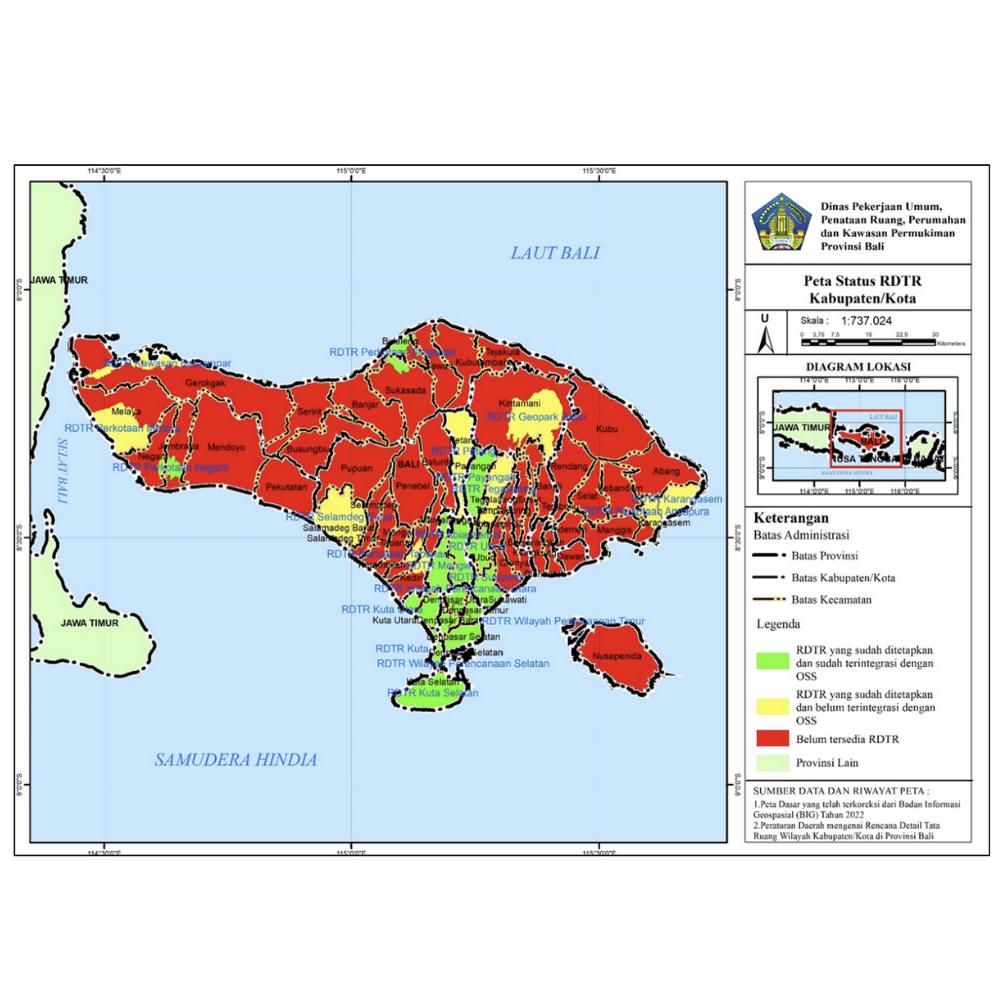
Rencana Detail Tata Ruang / Detailed Spatial Plan (RDTR) shows residential or protected land while the plan assumes tourism accommodation or commercial activity.
Impact: rework of the concept and drawings; refusal at Kesesuaian Kegiatan Pemanfaatan Ruang / Spatial Use Conformity (KKPR) or Persetujuan Bangunan Gedung / Building Approval (PBG) review.
Remedy: verify RDTR and Rencana Tata Ruang Wilayah / Regional Spatial Plan (RTRW) for the parcel, record height and setback controls, and redesign or re-site the project accordingly.
Inheritance file unresolved for the registered holder
Certificate holder deceased with only partial Surat Keterangan Waris or deed of heirs, or heirs in dispute.
Impact: delay in deed execution before the Pejabat Pembuat Akta Tanah / Land Deed Official (PPAT); exposure to later claims.
Remedy: complete succession documentation and align signatory authority before any Akta Jual Beli / Sale and Purchase Deed (AJB) or Perjanjian Pengikatan Jual Beli / Conditional Sale and Purchase Binding Agreement (PPJB).

Access and easements missing from the record
Long-standing temple path, irrigation line, or neighbour access visible on site without a recorded servitude.
Impact: objections during permitting and community engagement; potential redesign of circulation and boundaries.
Remedy: map routes in fieldwork, negotiate and instrument easements, and update the file prior to PBG submission.
Environmental tier understated for location or scale
Site within a sensitive corridor or project scale triggers Upaya Pengelolaan Lingkungan–Upaya Pemantauan Lingkungan / Environmental Management and Monitoring Measures (UKL-UPL) or Analisis Mengenai Dampak Lingkungan / Environmental Impact Assessment (AMDAL), while filings rely on Surat Pernyataan Kesanggupan Pengelolaan dan Pemantauan Lingkungan Hidup / Statement of Ability for Environmental Management and Monitoring (SPPL).
Impact: requests for additional studies mid-process; extended review timelines.
Remedy: assess triggers early, set the correct tier with evidence, and sequence studies before technical checks.
Building classification and drawings misaligned with permit requirements
Architectural set, structural calculations, and fire-safety systems prepared without reference to local envelopes, coastal or river buffers, or cultural overlays; PBG file and drawings diverge.
Impact: multiple review rounds; redesign fees; schedule drift prior to Sertifikat Laik Fungsi / Certificate of Worthiness for Use (SLF).
Remedy: integrate RDTR controls and Standar Nasional Indonesia / Indonesian National Standards (SNI) into the brief and coordinate design deliverables with the PBG checklist.
Parcel identifiers and annotations inconsistent across documents
Nomor Identifikasi Bidang / Parcel Identification Number (NIB), area, or boundaries vary between the certificate, cadastral map, and measurements; historical Hak Tanggungan / land mortgage release missing from the record.
Impact: refusal at registration, objections from adjacent owners, and uncertainty for future investors and purchasers.
Remedy: reconcile measurements with ATR / BPN extracts, process releases via Akta Pemberian Hak Tanggungan / Deed of Granting Mortgage Right (APHT) or Surat Kuasa Membebankan Hak Tanggungan / Power of Attorney to Impose a Mortgage (SKMHT) as relevant, and update the land book before closing.
A small investment in comprehensive land due diligence, plus the right transaction team, resolves these patterns before deposits, design packages, or marketing campaigns.
Checklist: Land Due Diligence in Indonesia You Can Run Today
Land due diligence in Indonesia works as a sequence. Use these seven actions on every site to avoid making mistakes that cost time and money:
- Confirm RDTR and RTRW designation, height, setbacks, buffers, and any heritage overlay for the exact parcel.
- Map KKPR status and record the basis for the determination.
- Align entity, licenses, and activity through a PT PMA and KBLI plan.
- Complete title checks and inheritance verification and create a single evidence pack, including the parcel NIB and recent PBB.
- Select SPPL, UKL-UPL, or AMDAL and compile the basis for the tier with drawings and narratives.
- Plan the route through PBG with realistic inspection dates and schedule SLF issuance after practical completion.
- Draft bilingual agreements with conditions precedent and milestone-linked payments, then instrument and register through the PPAT.
This is land due diligence in Indonesia at working level, ready to brief your architect, engineer, and investment partners from one evidence set.
How TraceWorthy Runs the Sequence
TraceWorthy is the right transaction team for foreign investors. Our team takes the time to understand what an investor wants from the investment, beginning with purpose and location. We then facilitate comprehensive land due diligence to properly understand all facets of the land the investor is interested in. If the property passes due diligence, we assemble a legal and permitting plan structured to meet PBG submission requirements and SLF inspections. Hand-offs between our team of lawyers and the PPAT are scheduled, and brokerage is coordinated to reflect the legal and technical gates. Authority and boundaries remain verifiable against ATR / BPN records during audits, purchaser due diligence, or transfer.
Speak with TraceWorthy before commitments are made
Arrange a feasibility and due-diligence session. We will run land due diligence in Indonesia across zoning, permits, title, inheritance, and corporate scope, then set documents and dated milestones that carry the deal from offer through registration with an evidence index ready for officials and investment partners.
If you plan to extend a lease, acquire adjacent parcels, or build, request a timeline and evidence list your project team can execute, with each step tied to a specific filing, inspection, or receipt.
Our Team Is Your Team