

Magie Moretha spends her days inside the space where many Indonesian enterprises experience friction. Policy files sit in shared folders, printed manuals gather dust, supervisors rely on memory, and teams apply their own versions of the rules. In this environment, continuous quality improvement remains at the level of aspiration, with limited effect on daily operations.
This article examines how owners and directors of companies in Indonesia can redesign policies and procedures so that colleagues use them in daily work. The focus sits on service enterprises, where a mix of languages, systems and regulatory duties creates complexity. The destination is a quality management system that guides behaviour, generates reliable evidence and supports continuous quality improvement over time.
1. Why policy folders fail service enterprises in Indonesia
Many companies in Indonesia assemble policies in response to external pressure. A regulator asks for a document, a client tender lists a requirement, or a certification project introduces a set of templates. Each request produces a file. Over several years, this cycle creates a dense library of documents with very little connection to real workflow.
Several patterns appear repeatedly in quality reviews.
- Policies and procedures live in separate repositories, each with incomplete version control.
- Teams describe “how we actually do things” in a way that diverges from written instructions.
- New colleagues receive induction materials that differ from daily practice on the ground.
- Supervisors and managers cannot easily show auditors which document currently applies.
These patterns weaken assurance for owners, directors and investors. They also absorb energy inside teams, because employees rely on trial and error to discover which rule carries real weight. A quality management system in Indonesia loses strength when documentation drifts away from practice.
2. Continuous quality improvement as the organising frame
Continuous quality improvement provides a practical frame for policy and procedure design. Within this frame, teams treat documents as components in an ongoing cycle of planning, execution, review and adjustment. The cycle responds to internal priorities as well as to external expectations.
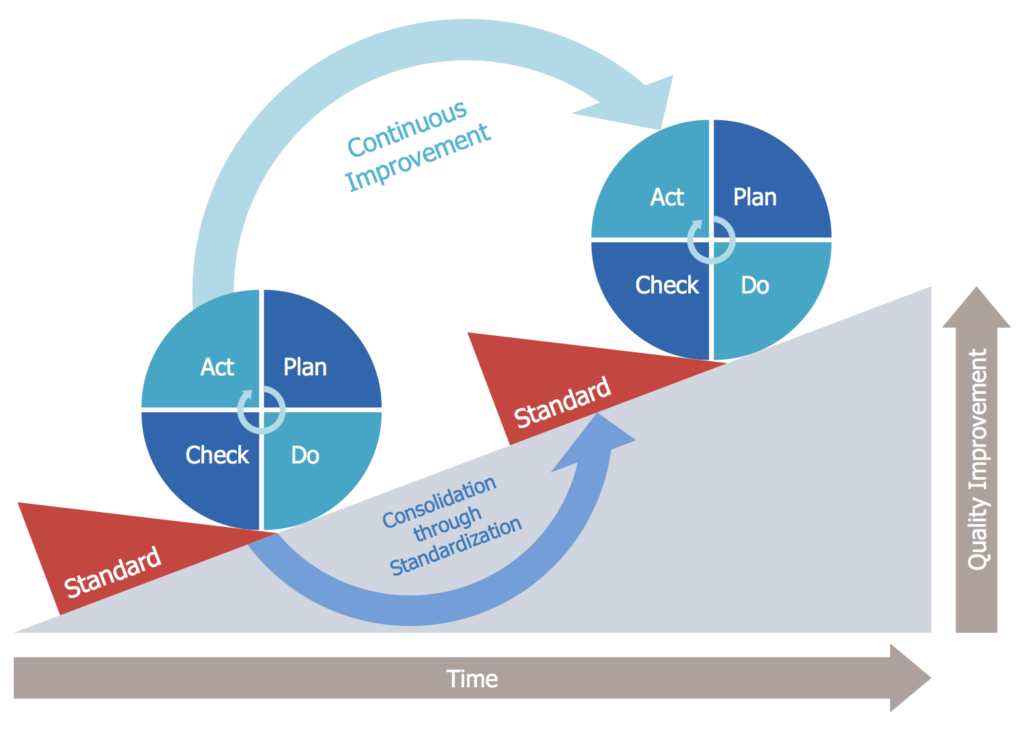
The Plan–Do–Check–Act sequence sits at the centre of this approach.
During the Check phase, managers and supervisors review data, internal audit findings and feedback from clients and staff.
During the Act phase, the organisation revises processes, invests in retraining, upgrades tools or updates documentation.
During the Plan phase, leaders and practitioners define processes in detail, including responsibilities, tools, records and indicators.
During the Do phase, teams carry out the agreed activities and apply the procedures under normal operating conditions.
This sequence aligns closely with ISO 9001 requirements and with sector frameworks that apply to training providers, professional services, hospitality operations and many other service enterprises. A quality management system in Indonesia that embeds this cycle operates as an adaptive structure rather than a static document library.
3. Connecting policy and procedure development to daily work
Policy and procedure development for service businesses becomes far more effective when it begins with observation of real work. Written rules that arise from templates or generic standards create friction. Written rules that arise from current workflows help teams to see documents as a support that reduces obstacles in daily work.
A practical approach follows four stages.
- Document the current process in plain language
Map the journey from trigger to outcome. For example, a client onboarding process might begin with an enquiry and end with a signed engagement letter, set-up in the accounting system and assignment of a responsible manager. Each step, handover and record appears on a single page. - Identify regulatory and contractual duties along the path
For companies in Indonesia, this can include foreign investment reporting, tax registration, visa documentation, or anti-money laundering checks. Service enterprises also manage client-specific mandates, such as service level agreements and data protection commitments. - Assess pain points and risks with the people who perform the work
Frontline teams and supervisors often describe delays, repetitive tasks, missing information and unclear authority. These insights reveal where the current process undermines continuous quality improvement. - Translate the mapped process into policy and procedure elements
Policy statements assign responsibility and set principles. Procedures provide step-by-step instructions, define required records, and reference tools or systems. This sequence grounds policy and procedure development for service businesses in observable reality. Structured policy and procedure development for service businesses creates a bridge between documentation and operational behaviour.
4. Designing a quality management system in Indonesia
A quality management system needs to cope with several layers of obligation. Companies answer to corporate law, sector licences, tax rules, employment regulations and investor expectations. Service enterprises also juggle client requirements and internal governance choices, particularly where overseas stakeholders require structured reporting.
An effective quality management system brings these layers into a single, navigable architecture. The system sets out a hierarchy of documents that explains the purpose of policies, procedures, work instructions, templates and records. Each document type has a defined owner, approval route and review interval that are visible to management and to those who use the documents. A single register lists current policies and procedures, accessible to all relevant staff. Cross-references connect each process to statutory, regulatory and contractual duties, so that no requirement depends solely on institutional memory.
Design work for a quality management system in Indonesia often begins with an inventory. Teams list existing documents, assign each item to a process area, and assess its status. This reveals duplicates, obsolete instructions and areas where daily work lacks formal guidance. From there, Magie and the TraceWorthy team shape a document structure that matches the business model and the operating environment.
5. Using internal audit and compliance improvement as input for learning
Internal audit and compliance improvement act as diagnostic tools inside a quality management system. The central question is whether policies and procedures lead to outcomes that are consistent, compliant and efficient in the conditions where people actually work.

A well structured internal audit and compliance improvement programme should:
- Check whether required records exist, contain accurate information and link to decisions.
- Trace regulatory and contractual duties to the steps where teams discharge them.
- Test whether staff can locate and apply current documents during real tasks.
- Compare recorded practice against process maps and written procedures.
Findings from internal audit and compliance improvement point toward redesign work. Repeated issues in a single process often indicate that a procedure, a training module, a tool or a resourcing assumption no longer suits the environment. Management can then commission focused improvements instead of broad, unfocused initiatives. In this way, internal audit and compliance improvement provide structured feedback for continuous quality improvement and for the wider quality management system in Indonesia.
Within TraceWorthy itself, twice-weekly in-house training sessions turn this philosophy into daily practice. Every Tuesday and Thursday the team gathers for structured learning on subjects that range from Indonesian regulations and visa rules to finance workflows, client communication and internal tools. Team members prepare and deliver subject matter presentations, then field questions from colleagues. The presenter must understand the topic deeply enough to explain it clearly. Colleagues contribute examples from current work, which often surface gaps in procedures, ambiguities in policies or weaknesses in templates.
These sessions do more than transmit information. They bring together people from legal, finance, compliance, operations and administration in a shared environment where systems, procedures and real cases sit on the table at the same time. A training session on immigration regulations, for example, may reveal that a client onboarding checklist misses a required document, or that an internal handover between two teams lacks a defined step. A presentation on payment controls may show that the quality management system needs an additional control point or a clearer description of roles in a procedure.
The rhythm also matters. Twice-weekly training gives TraceWorthy a regular forum where audit findings, regulatory changes and operational stories can flow back into system design. Audit observations inform the choice of training topics. Questions from training feed into revisions of policies and procedures. Management of Change decisions are explained in a room where staff can ask detailed questions and where misunderstandings surface early. Continuous quality improvement therefore lives in the interplay between formal internal audit and compliance improvement on one side and these structured learning sessions on the other.
For client enterprises, this offers a practical pattern. Internal audit and compliance improvement supply evidence of how systems behave. Regular, well-designed training sessions create space for teams to process that evidence, share experience and co-design better ways of working. A quality management system gains strength when both elements operate together: the audit programme reveals how the organisation performs, and ongoing training supports the skills, awareness and engagement required to implement improvements in a grounded, sustainable way.
Internal audit and compliance improvement extend beyond confirmation of adherence. Findings highlight where the quality management system in Indonesia requires redesign. Repeated nonconformities in a process suggest that the procedure, training or resources require adjustment. In this way, internal audit and compliance improvement become a structured feedback mechanism for continuous quality improvement.
6. Embedding tools and constraints into procedure design
A procedure that ignores tools and constraints generates workarounds. For service enterprises in Indonesia, those tools might include accounting platforms, visa management portals, HR systems, ticketing tools and informal communication channels. Continuous quality improvement depends on procedures that direct work inside these tools and removes parallel manual steps wherever possible.
During policy and procedure development for service businesses, design sessions should ask:
- Which systems and software support this process today, and where do people improvise?
- Which forms, templates and checklists already exist, even if they remain unofficial?
- Which steps depend on external parties, such as notaries, accountants, agents or regulators?
- Which physical constraints apply, including office layout, shift patterns and bandwidth limits?
Each answer shapes the written procedure. Collective participation of teams in policy and procedure development for service businesses reinforces ownership and understanding. The result is a document that guides staff through actual screens, forms and handovers. When a quality management system reaches this level of integration, staff see procedures as routes through complexity, presented as practical guidance that staff can follow in sequence.
7. Writing procedures that multilingual teams can interpret
Many companies in Bali and elsewhere in Indonesia bring together Indonesian nationals, foreign managers and international clients. A quality management system that supports continuous quality improvement must respect this multilingual reality.

Effective procedure drafting in this context follows several practices.
- Use plain language, short sentences and active verbs.
- Avoid idioms, culture-specific references and vague expressions.
- Provide bilingual headings or glossaries where legal or technical terms appear.
- Align terminology with contracts, licences and system labels, so that teams see consistent wording.
Policy and procedure development for service businesses also benefits from visual support. Flowcharts, swimlane diagrams and annotated screenshots give colleagues a shared reference independent of language skill. These elements increase uptake and reduce misinterpretation during audits or inspections.
8. Implementation: from approval to embedded behaviour
Once leadership approves new or revised documents, the work of implementation decides whether the investment delivers value. Continuous quality improvement relies on the way supervisors and teams respond to change and on the quality of the support they receive.
A structured implementation plan for a quality management system in Indonesia usually includes several strands. Senior leaders receive targeted briefings so that messages remain consistent across departments. Operational teams attend focused workshops where staff rehearse new procedures through scenarios drawn from real cases. Induction programmes, job descriptions and supervision checklists are updated so that expectations appear in the tools that managers use every week. Key steps are built into digital tools, so that systems prompt required actions at the right time rather than relying only on memory.
Internal audit and compliance improvement programmes can schedule early reviews of new processes. Audit visits within the first quarter after implementation often reveal gaps in understanding, missing tools and workload pressures. Continuous quality improvement then proceeds through incremental adjustments informed by evidence, which limits the need for disruptive overhauls.
9. Case illustrations from Indonesian service environments
Two brief composite illustrations show how these principles apply in practice. These scenarios reflect patterns commonly seen in Indonesian service enterprises rather than specific TraceWorthy client engagements.
Case illustration: client onboarding in a professional services firm
A professional services firm in Bali delivers excellent technical work yet struggles with client onboarding. Each engagement follows a different pattern. Some files lack identification documents, others lack clear scope, and billing delays arise frequently.
The firm’s leadership decides to treat client onboarding as a continuous quality improvement priority. The internal team maps the journey from enquiry to first invoice, identifies obligations under Indonesian company law and tax rules, and catalogues existing templates. Together they design a single client onboarding procedure with defined steps, mandatory records and system prompts that align with the firm’s accounting platform.
Within six months, internal audit and compliance improvement checks show higher completeness rates for client files, shorter onboarding times, fewer invoice disputes and clearer responsibility assignments. The quality management system in that firm begins to generate reliable information for leadership decisions on pricing, capacity planning and client selection.
Case illustration: operations coordination in a hospitality company
A hospitality company in Bali with several villas and service teams faces variation in guest experience. Housekeeping teams use different checklists, maintenance requests lack tracking, and handovers between shifts depend on informal chats between supervisors at irregular times.
In response, the company initiates a continuous quality improvement project that brings together representatives from housekeeping, maintenance, front office and management. Teams describe their work, highlight pain points, and compare expectations from guests and owners. The outcome is a suite of harmonised procedures for housekeeping, maintenance and guest communication, all linked to a central task management tool that records requests, assignments, completion times and follow-up visits.

Internal audit and compliance improvement cycles track completion rates, incident reports, guest feedback and staff workload metrics. Over time, management observes greater consistency in guest comments, fewer last-minute emergencies and smoother coordination between departments. The quality management system now supports both service quality and realistic workload planning for teams on the ground.A hospitality company in Bali with several villas and service teams faces variation in guest experience. Housekeeping teams use different checklists, maintenance requests lack tracking, and handovers between shifts depend on informal chats between supervisors at irregular times.
In response, the company initiates a continuous quality improvement project that brings together representatives from housekeeping, maintenance, front office and management. Teams describe their work, highlight pain points, and compare expectations from guests and owners. The outcome is a suite of harmonised procedures for housekeeping, maintenance and guest communication, all linked to a central task management tool that records requests, assignments, completion times and follow-up visits.
Internal audit and compliance improvement cycles track completion rates, incident reports, guest feedback and staff workload metrics. Over time, management observes greater consistency in guest comments, fewer last-minute emergencies and smoother coordination between departments. The quality management system now supports both service quality and realistic workload planning for teams on the ground.
10. The role of a Compliance Manager in sustaining progress
Sustained continuous quality improvement relies on a role that links governance, regulation and daily operations. A Compliance Manager such as Magie Moretha fulfils this function inside TraceWorthy and for client enterprises. Within client engagements, she leads policy and procedure development for service businesses so that process design, regulation and daily operations remain aligned.
Key responsibilities within this role include design and maintenance of the architecture of the quality management system; coordination of policy and procedure development for service businesses across departments and sites; leadership of internal audit and compliance improvement programmes and synthesis of findings into management information; and management of Management of Change so that regulatory updates and business shifts flow into updated documents, tools and training.
Viewed through this lens, a quality management system operates as an active asset. It reduces surprises during inspections, protects licences and contracts, supports long-term planning for investors and boards, and gives owners and directors structured insight into how their enterprises operate across locations. Continuous quality improvement, anchored in realistic policies and procedures, requires consistent attention and deliberate leadership. The return appears in resilient operations, reliable evidence and teams that understand how their work links to client outcomes and regulatory duties.