

Part of the series: Founder Stories
- Lessons in Business Partnerships: What We Learned From a Summer Fling
- The Emotional Transition – Shifting from Employee to Entrepreneur
- Suitcase Entrepreneurship
- A Journey of Transformation: Martijn's r•Plastic Adventure
- Developing the Boss Before the Business
- Climbing Mountains with a Broken Heart
- The Heart of the Matter
- Four Ways TraceWorthy Stabilises Decision-Making Under Pressure
- Human-Centred, Design-Led Business Systems
- How a Trusted Director Drained the Company a Creative Founder had Built
- The Sexiest Cow in Bali: Turning Business Waste Into a Product
Decisions, workflows, contracts, reporting, and tools are shaped on purpose before growth or stress reshapes them by accident. Design leads the work, so the system serves the people using it rather than forcing constant workaround.
Structural Alignment that Stabilises Behaviour
Enterprises across Bali and Indonesia face recurring breakdowns that stem from structure rather than effort. Interviews with founders, finance leads, and legal officers indicate the same pattern: high energy, scattered tooling, and decision paths that change week to week. This article examines the method behind design-led business systems and documents how structural alignment produces steady behaviour across teams.
Definition anchored in practice
A human-centred, design-led business system shapes decisions, workflows, contracts, reporting, and tools in advance of stress. The operating model reflects real work as it happens on the floor, within inboxes, inside ledgers, and across meeting rooms. Structural alignment means roles, rules, timelines, and information flow in one direction, through one pathway, at the cadence the enterprise can sustain.
Conditions observed in the field
Field notes from live projects show the following recurring conditions that precede instability:
- Authority sits with one person while necessary data sits elsewhere.
- Reporting reflects an audit archive rather than day-to-day operations.
- Legal terms describe a clean diagram while the team follows a different route.
- Handovers exist in chat threads rather than a defined mechanism.
Each condition introduces drag. Accumulation leads to missed filings, reactive cashflow moves, and leadership time spent re-explaining the same work.
Method: design first, then workload (with earlier testing)
The human-centred method proceeds in staged work. Early observation, feasibility screening, and table-top trials come before any end-to-end pathway. The objective is to convert design-led business systems into a tested pathway with defined roles, timings, controls, and measures that sustain performance during peak load. Early testing exposes structural misalignment in business before it sets into policy and directs governance, legal, and financial design to the points of highest operational risk. Each stage records evidence through instrumentation so leaders can see whether human-centred systems design is stabilising behaviour: decision routes followed, reports delivered on schedule, handovers completed, and exceptions raised through the authorised channel. The sequence that follows covers rapid field sampling, paper prototypes, simulation, a contained pilot, and load tests prior to any scale.
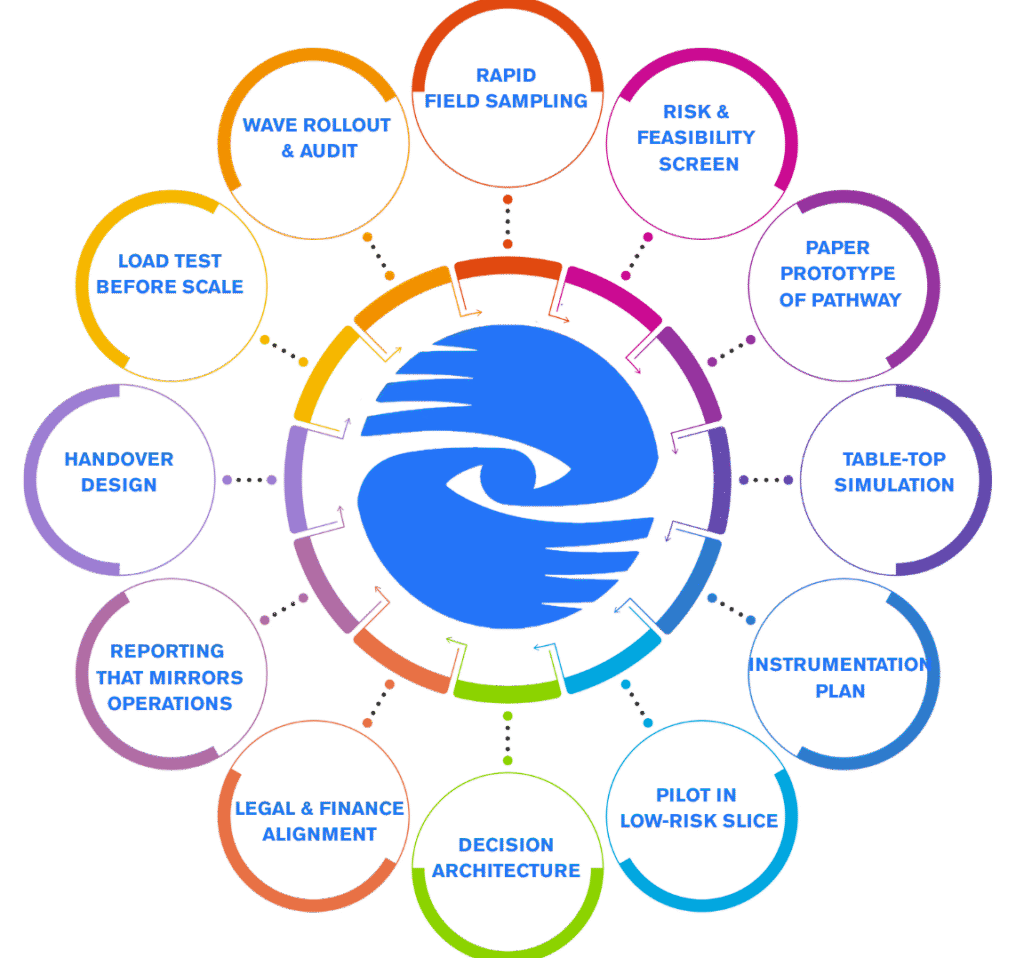
Rapid field sampling
Shadow the work across a full cycle. Record triggers, artefacts, timestamps, tools in use, and handoffs. Collect live examples: invoices, chat threads, draft contracts, dashboard screenshots.
Risk and feasibility screen
List legal, financial, operational, and reputational constraints. Mark red-flag steps that would breach policy, licence terms, tax timetables, or employment obligations. Define decision classes that require board or director authority.
Paper prototype of the pathway
Draw the end-to-end route on a single surface. Use swimlanes for roles, boxes for steps, and gates for approvals. Attach artefact samples to the steps they support.
Table-top simulation
Walk the prototype with the people who run the work. Rehearse real cases with timestamps. Capture stalls, duplicate effort, missing inputs, and unclear ownership. Amend the pathway on the spot.
Instrumentation plan
Choose the measures that will prove stability: decision route adherence, report delivery rate, contract cycle time, handover completion rate, exceptions raised through the official pathway. Define owners and data sources for each measure.
Pilot in a low-risk slice
Select a contained unit: one team, one vendor type, or one location. Publish start and end dates, rollback steps, and the precise changes under test. Capture the measures from step 5 during the pilot.
Decision architecture
Name the owner, required inputs, sequence, and record of outcome for each decision class. Store the routes in an auditable location and link them from the tools people already use.
Legal and finance alignment
Rewrite authorities, thresholds, retention periods, and dispute pathways so paper logic and lived practice match. Synchronise calendars with VAT, PPh 21, LKPM, payroll, and board cycles.
Reporting that mirrors operations
Identify upstream data sources, owners, and quality checks. Publish a reporting calendar that aligns with operational cadence. Deliver the smallest executive set with drill-through for depth.
Handover design
Replace ad-hoc chat with a formal handover surface. Record state, owner, date, next action, and dependencies. Train to routine use.
Load test before scale
Simulate absence, seasonal surge, supplier delay, and withheld payment. Record where the structure flexes and where it fractures. Adjust the pathway rather than asking for heroics.
Wave rollout and audit
Extend the design in waves. Keep the instrumentation visible. Hold monthly audits against the measures and correct drift at the source.
Evidence of stabilised behaviour — bespoke fashion manufacturer
A Bali-based bespoke fashion house produces made-to-measure garments for private clients and small retailers. The atelier runs pattern design, cutting, machining, finishing, and fittings across a three-week cycle. After adopting a design-led business system, the week opens with a production desk at 09:00 on Mondays. The meeting runs from a single decision pathway: fabric purchase approvals above IDR 15,000,000 (fifteen million Rupiah) sit with the Operations Lead; rush-order acceptance requires Capacity and Finance inputs; discount authority sits with the Commercial Lead and is recorded in the same register. Each decision closes with a timestamp, owner, and link to the artefact: purchase order, client email, or revised tech pack.
Reporting follows a calendar that matches the atelier rhythm. On Tuesdays by 16:00, the workshop publishes Work-in-Progress by collection and by client, drawn from the pattern log and cutting sheets. On Wednesdays by 14:00, Finance issues a cash position that combines retail receipts, wholesale invoices, payables to mills, and payroll dates. The Thursday dashboard aggregates these sources for the Creative Director and shows three views: order intake by channel, production capacity consumed versus released, and gross margin by job. The figures land through one route and carry source links, so queries trace back to pattern IDs, fabric rolls, and client approvals.
Contract handling moved onto a standard suite that matches the way the atelier trades. A supplier framework covers roll reservations, shade variance, and defect credits; a client services schedule sets fittings, remake thresholds, and delivery windows; an intellectual property assignment wraps commissioned designs. The cycle time from draft to signature sits within five working days for suppliers and three working days for private clients. Disputes reference the same terms, so resolution runs through one pathway with documented steps and an auditable trail.
Handover practice anchors daily continuity. Every garment carries a card with state, owner, due date, and next action: “Pattern graded → Cut assigned → Stitching in progress → Finish pressing → Final fitting booked.” When a machinist or finisher takes leave, the card and register transfer to a named peer at 15:30 with the Supervisor present. Exceptions enter through a single form: fabric shortfall, measurement variance, machine outage, or late client approval. Each exception receives an owner and a return-to-plan step before end of day.
The measures reflect the change in human-centred rhythm. Across the last eight weeks, 97 per cent of production decisions followed the documented route. Report delivery met the calendar in 15 of 16 instances. Contract cycle time sat within the declared window for 26 of 28 agreements. Handover completion reached 94 (ninety-four) per cent at shift change. Exceptions raised through the authorised channel increased in week one, then settled as upstream issues cleared. The atelier’s leaders describe steadier weeks, fewer ad-hoc meetings, and a production floor that moves with a traceable sequence from order to delivery.
Case patterns
Fieldwork across Indonesian enterprises shows recurring operational signatures that surface early in interviews, document reviews, and calendar traces. Signals appear in decision logs, version histories, and contract timelines, then correlate with slippage during busy weeks. The patterns below summarise these signatures and the conditions under which they intensify.
- All spending and vendor control concentrate in one person. Design work establishes thresholds, dual approval rules, and an operating calendar that releases the bottleneck.
- Finance holds multiple versions of truth. Reporting is rebuilt from system sources with ownership and data checks at the source, removing reconciliation churn.
- Deals advance through goodwill while terms lag. A standard suite—NDA, term sheet, services schedule, IP assignment—cuts cycle time and lowers risk exposure.
- Team members compensate for gaps without recognition. A formal service level and exception pathway turns patchwork into accountable work.

Measures that show movement
To enable human-centred decision-making by design, executives need yardsticks that verify whether the pathway performs as specified. Measures must show route adherence, timing discipline, and the conversion of inputs into recorded outcomes. The following metrics provide that evidence and allow comparative review across quarters.
- Percentage of decisions that follow the documented route.
- Report delivery rate against the calendar across a quarter.
- Contract cycle time from draft to signature, segmented by type.
- Handover completion rate at shift change or role change.
- Exceptions raised through the pathway versus side channels.
Sustained improvement across these measures indicates that behaviour has stabilised through structure rather than effort spikes.
Implementation notes for Indonesian context
Enterprises operating in Indonesia carry additional compliance and licensing load. Decision-making by design requires a technical layer that takes these conditions as baseline. TraceWorthy works inside the client team alongside internal counsel, finance leads, HR, procurement, and operations to instrument the pathway and keep decisions lawful, sequenced, and recorded.
- Authority and governance fit
- Authority matrices align with the Company Constitution, board resolutions, and director powers. TraceWorthy documents decision classes that require board or shareholder approval, anchors thresholds in policy, and maintains an auditable register of approvals.
- Regulatory calendars that match the operating week
- VAT, PPh 21, PPh 23, and LKPM dates sit in a single calendar with owners, inputs, and filing sequences. TraceWorthy coordinates handoffs between finance, HR, and legal so filings do not collide with payroll, inventory counts, or board meetings.
- Licensing and OSS workflow
- OSS status, sector licences, and NIB data live in a controlled register with renewal dates and evidence links. TraceWorthy assigns preparatory tasks to functions, schedules pre-renewal checks, and rehearses submissions to reduce rejection loops.
- Contract suites for local forums and suppliers
- Supplier frameworks, services schedules, and IP terms reference governing law and practical dispute bodies. TraceWorthy maintains bilingual templates and signature pathways, including deed conversion steps for notarial execution.
- Land and premises diligence
- Title, ITR (Informasi Tata Ruang), access rights, and utilities evidence sit in a single file set tied to decision gates for leases, purchases, or fit-outs. TraceWorthy verifies documents, logs open items, and triggers holds when evidence gaps appear.
- Employment structure and payroll alignment
- Role definitions, contracts, and payroll cadence reflect Indonesian employment law and tax rules. TraceWorthy links hiring, onboarding, and payroll changes to decision routes with source artefacts and approval records.
- Document control and bilingual execution
- Policy, contract, and filing artefacts are versioned and indexed in both languages where required. TraceWorthy manages naming standards, retention periods, and access rights so teams retrieve the same source every time.
- Exception and escalation routes
- Compliance exceptions enter through a defined form with owner, remediation steps, and target dates. TraceWorthy tracks closure rates and reports unresolved items during the executive rhythm.
This configuration embeds regulatory reality into the operating model. Decisions then proceed along a known route, through the right authority, with evidence that stands up during audits, renewals, and disputes.
Working checklist for leaders
Leaders seeking immediate movement can apply this checklist during the next planning cycle:
- Identify one decision class that causes delay. Publish the owner, inputs, sequence, and record.
- Select one report that leaders actually use. Rebuild it from source data and publish a monthly schedule.
- Choose one contract type used weekly. Standardise the terms and signature pathway.
- Define one human-centred handover that fails regularly. Replace chat trails with a single form and a named owner.
- Run one load test: simulate a key person’s absence for seven days and record where work stalls.
Completion of these five actions within a quarter provides a baseline for broader redesign.
TraceWorthy’s role
Under a human-centred, design-led operating model, reliability becomes measurable. Alignment of roles, rules, timing, and information yields documented decision routes, on-schedule reporting, closed handovers, and complete audit trails. Contract cycle times shorten, dispute exposure falls, and executive time returns to planning and oversight. Performance is sustainable during peak load and can scale with lower risk.
TraceWorthy serves as an embedded practitioner within the executive rhythm. The team documents decision routes, builds authority matrices, and aligns calendars with tax and regulatory cycles. It maintains bilingual contract suites and document control, runs table-top simulations and load tests, and sets instrumentation that reports route adherence, handover completion, and cycle times. During rollout, TraceWorthy trains owners, chairs monthly reviews, and corrects drift at source. The engagement concludes with a working pathway, audited measures, and a governance stack that managers operate without external supervision.